Internally displaced people vs refugees: understanding the difference and taking action
At a glance
- A refugee has crossed an international border to escape. An internally displaced person has fled within their own country. This distinction has major consequences for the legal protection each one receives.
- According to UNHCR (Mid-Year Trends report, November 2025), at the end of June 2025, 117.3 million people worldwide were forcibly displaced: 42.5 million refugees and 67.8 million internally displaced people.
- Internally displaced people are often the most vulnerable. They remain under the authority of their own government, which is sometimes the very cause of their displacement, and they are often in areas that humanitarian workers struggle to reach.
- LIFE works in several of the world's most serious displacement crises, including Sudan, the DRC, Palestine and Mali.
- LIFE's donor relations team is happy to answer any questions you may have.
When a crisis breaks out, people often use the word "refugees" loosely to describe everyone who flees. But that single word hides very different legal and humanitarian realities. Understanding the difference between internally displaced people and refugees helps us see who can be helped, by whom, and how.
What is the difference between a refugee and an internally displaced person?
Quite literally, the border is what separates the two. A refugee is someone who has crossed an international border to escape persecution, armed conflict, violence or serious human rights violations in their home country. They are entitled to international legal protection under the 1951 Geneva Convention and fall under UNHCR's mandate. An internally displaced person (IDP) has fled their home for the same reasons but has not crossed an international border. They remain inside their own country, and therefore under the jurisdiction of their own state. The distinction may sound technical, but it has huge consequences for protection, access to aid and rights.
| Refugee | Internally displaced person | |
|---|---|---|
| Has crossed a border | Yes | No |
| International legal status | Yes (1951 Geneva Convention) | No |
| Protected by | Host country + UNHCR | Their own government |
| Access to aid | More structured | Often harder |
| Particular vulnerabilities | Distance from home, asylum procedures | Conflict zones, sometimes a hostile government |
A cruel paradox
according to UNHCR, internally displaced people remain under the protection of their own government, even when that government caused their displacement. That is why UNHCR often describes them as "among the most vulnerable people in the world": they have no automatic right to the international protection given to refugees, and they often end up in areas that humanitarian workers struggle to reach.
The figures for 2025
UNHCR data (Mid-Year Trends report, November 2025) paints an alarming picture. At the end of June 2025, 117.3 million people worldwide were forcibly displaced.
| Category | Number (end of June 2025) |
|---|---|
| Refugees (UNHCR mandate) | 30.5 million |
| People in refugee-like situations | 3.3 million |
| Other people in need of protection | 6.1 million |
| Palestine refugees (UNRWA mandate) | 5.9 million |
| Total refugees | 42.5 million |
| Internally displaced people (conflict and violence) | 67.8 million |
| Asylum seekers | 8.42 million |
| Total forcibly displaced | 117.3 million |
Source: UNHCR, Mid-Year Trends report, 4 November 2025. In its 2026 Global Appeal, UNHCR projects that this total could reach 136 million forcibly displaced and stateless people by the end of 2026.
What these figures tell us
there are almost twice as many internally displaced people as refugees. And unlike refugees, they cannot cross a border to receive international protection. Many live in informal camps, with overstretched host families, or right in the middle of active conflict zones.
Who protects internally displaced people?
This is where the international system shows its most glaring shortcomings. Unlike refugees, internally displaced people are not covered by any specific international treaty guaranteeing their protection. In 1998, the UN adopted the Guiding Principles on Internal Displacement. These principles recognise the rights of internally displaced people and the obligations governments have towards them. But they are not legally binding at international level. In practice, it is often UNHCR, UNICEF, WFP and humanitarian NGOs that provide protection and assistance to internally displaced people in the areas they can reach, working with local authorities when those authorities are willing to cooperate.
The main displacement crises in 2025-2026
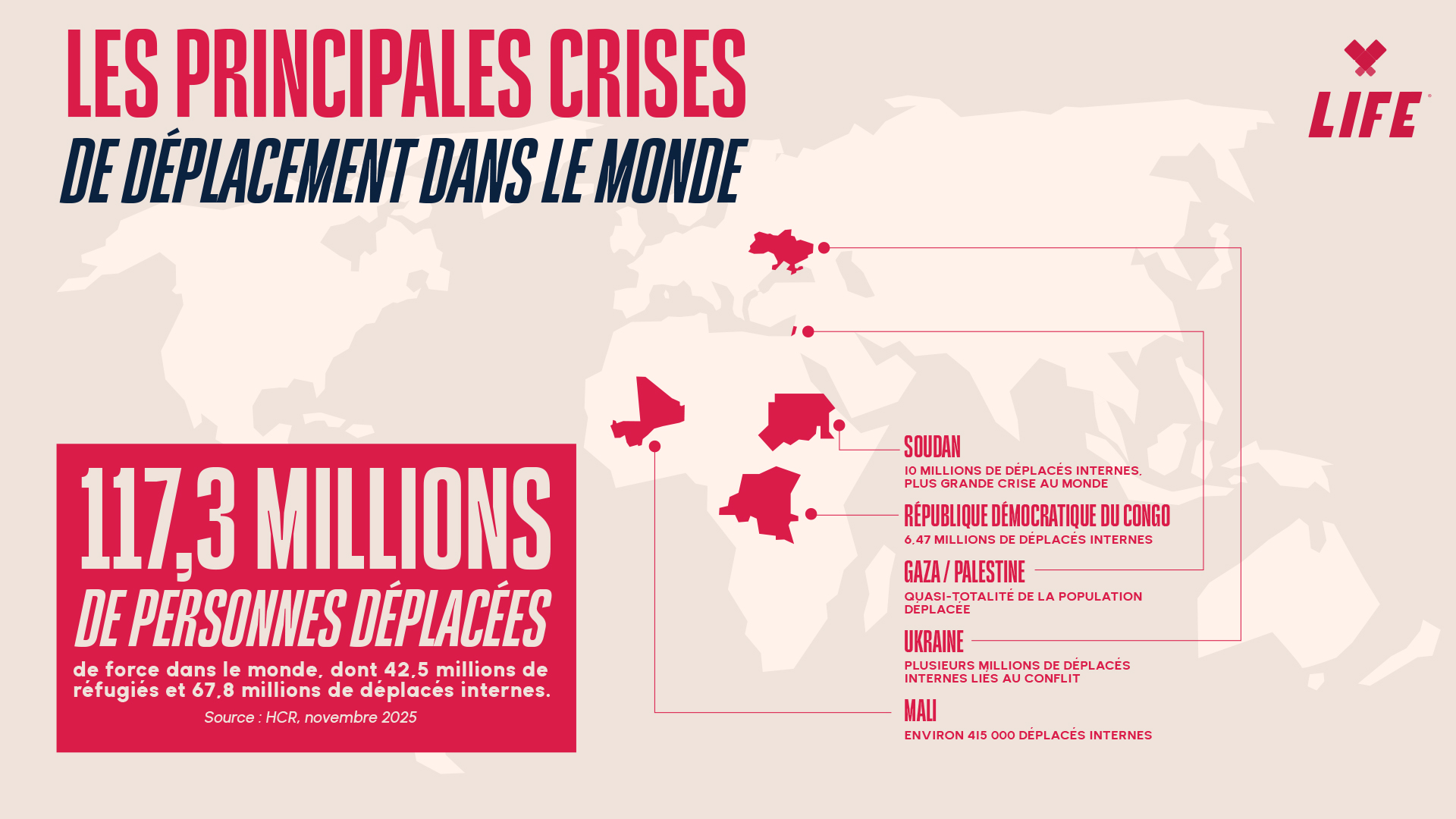
The largest crises in the world in mid-2025, according to UNHCR:
| Country | Situation |
|---|---|
| Sudan | 10 million internally displaced people (the largest crisis in the world) |
| DRC | 6.47 million internally displaced people |
| Ukraine | Several million people internally displaced by the conflict |
| Syria | 6.5 million internally displaced people (falling as people return home) |
| Gaza / Palestine | Almost the entire population of Gaza displaced |
| Mali | Around 415,000 internally displaced people |
LIFE is present in several of these crises. To learn about the specific situation in each country, read our articles on the crisis in Sudan, the crisis in the DRC and the situation in Palestine.
How are displaced people and refugees helped on the ground?
On the ground, aid does not always distinguish by legal status: it is needs that guide the response. Programmes in displacement crises usually cover several areas. Access to food is often the first priority: direct distributions of food parcels, or cash payments so that families can buy locally what they actually need. Restoring access to water happens at the same time, and is essential to prevent epidemics in overcrowded areas. Sheltering families who have lost their homes starts with tents and tarpaulins and gradually moves towards more lasting solutions. Finally, supporting host families is often overlooked but crucial: families who take in displaced people also face a real economic shock. LIFE works across all four areas where it operates, relying on local partners who can reach people that international organisations cannot. To understand how a humanitarian response actually unfolds, our article Humanitarian emergencies: how NGOs respond on the ground explains each stage in detail. And to learn more about climate refugees, a particular group of displaced people who have no international protection at all, read our article Climate refugees: who are they and how can we help?
Would you like to protect children affected by armed conflict?
Your donation qualifies for 66% French tax relief, and you will receive an annual tax receipt. Our team is here to help with any questions, so do get in touch!
Donate now →Frequently asked questions
What is the difference between a refugee and an asylum seeker?
An asylum seeker is someone who has fled their country and is asking for international protection in a host country, but whose claim has not yet been decided. A refugee is someone whose claim has been recognised: they have refugee status and the protections that come with it. Every refugee was first an asylum seeker.
How many internally displaced people are there in the world?
According to UNHCR (Mid-Year Trends report, November 2025), 67.8 million people were displaced within their own country by conflict or violence at the end of June 2025. That is almost twice the number of refugees. Sudan is the world's largest internal displacement crisis, with 10 million people displaced.
Why are internally displaced people less well protected than refugees?
Refugees are covered by the 1951 Geneva Convention and UNHCR's mandate. Internally displaced people remain under the authority of their own government, even if that government caused their displacement. There is no binding international treaty guaranteeing them equivalent protection. The UN's 1998 Guiding Principles recognise their rights, but they are not legally binding.
Do most refugees come to Europe?
No. According to UNHCR, 73% of the world's refugees are hosted in low- and middle-income countries, often close to the crises they fled. The vast majority stay in their region of origin. Countries such as Chad, Uganda and Bangladesh host millions of refugees with very limited resources.
What is the difference between an internally displaced person and a climate refugee?
An internally displaced person has fled conflict or violence but remains in their own country. A climate refugee has fled disasters or environmental degradation linked to climate change. The two groups can overlap: in countries such as Somalia or Sudan, people are fleeing both conflict and climate shocks. Neither group automatically receives refugee status under the Geneva Convention.
Ready to help?
I start a fundraiser
Support the causes close to your heart by starting an online fundraiser with LIFE.
Raising funds for a charity has never been easier!