Sudan crisis: understanding the situation and knowing where to give
At a glance
- According to OCHA, Sudan is going through the world's worst humanitarian crisis and its largest displacement crisis. Since April 2023, the conflict has pitted the Sudanese Armed Forces (SAF) against the Rapid Support Forces (RSF).
- According to UN figures published in January 2026 to mark 1,000 days of war: 9.3 million people displaced within the country, 4.3 million refugees abroad, and more than 21 million facing acute food insecurity.
- Humanitarian access remains severely obstructed: convoys blocked, aid workers targeted, visas refused to NGOs.
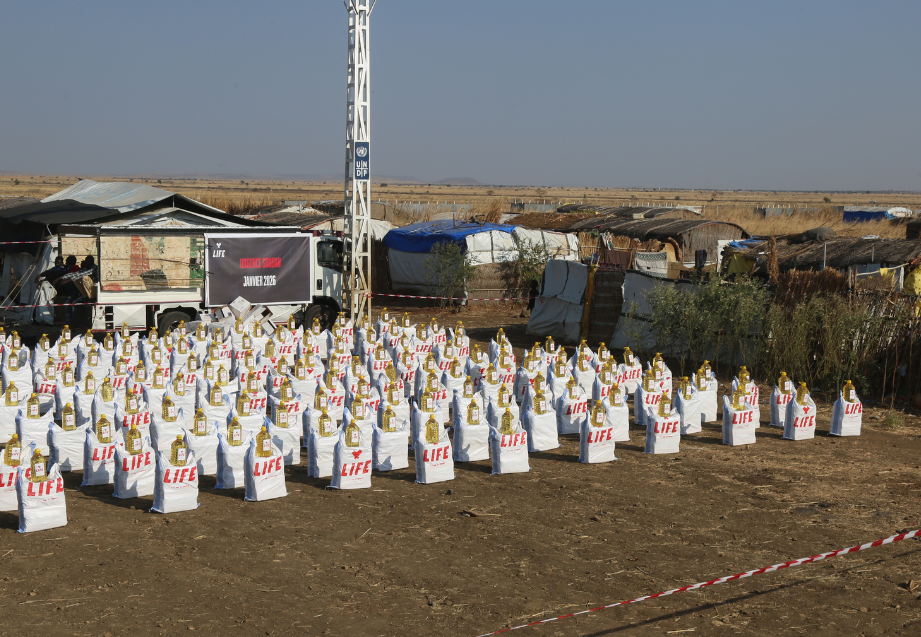
- LIFE works in Sudan through local partners, running food aid and basic healthcare programmes.
- LIFE's donor relations team is on hand to answer all your questions about ongoing operations.
The crisis in Sudan is one of the least covered by the media, yet one of the most serious in the world. Since fighting broke out in April 2023, the country has sunk into a spiral of violence, displacement and deprivation that the UN officially describes as the world's worst humanitarian and displacement crisis.
This guide explains what is happening, why it is so serious, and how you can make a real difference from France.
What is the situation in Sudan in 2026?
Since 15 April 2023, the conflict has pitted the Sudanese Armed Forces (SAF) against the paramilitary Rapid Support Forces (RSF). In January 2026, the country passed the milestone of 1,000 days of war, with no lasting ceasefire in sight.
The fall of El Fasher in late October 2025 marked a particularly dark turning point. After more than 500 days of siege, the RSF seized the last government stronghold in North Darfur. Hundreds of thousands of civilians fled. Testimonies gathered by the UN report executions targeting non-Arab communities, mass rape and disappearances.
The crisis in numbers
According to figures published by OCHA to mark 1,000 days of war (January 2026):
| Indicator | Figure |
|---|---|
| Internally displaced people | 9.3 million people |
| Refugees in neighbouring countries | More than 4.3 million |
| People facing acute food insecurity | More than 21 million |
| People in need of humanitarian aid | Nearly 34 million |
| Aid workers killed since the start | More than a hundred |
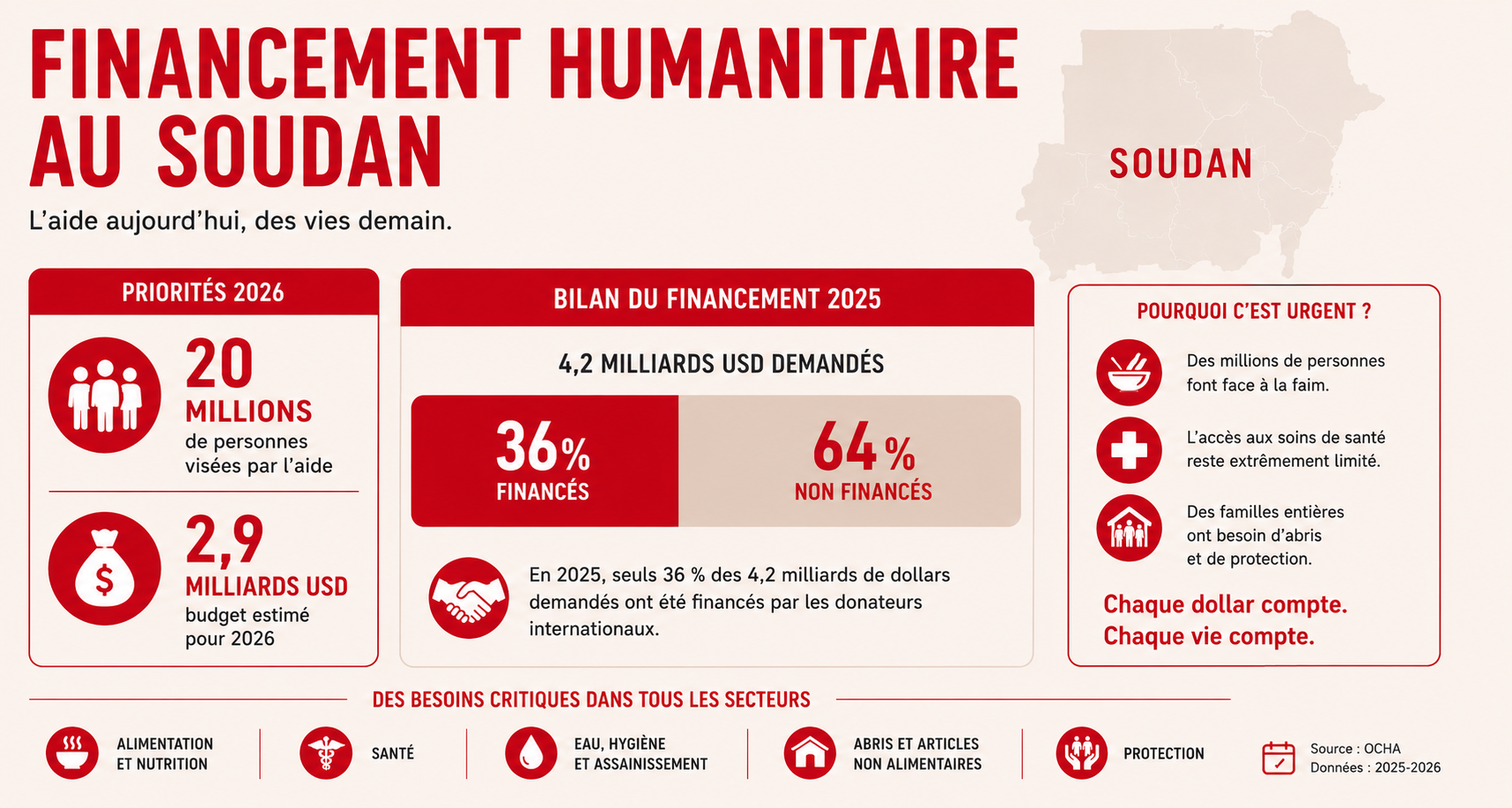
For 2026, OCHA aims to help 20 million people, with an estimated budget of 2.9 billion dollars. In 2025, international donors funded only 36% of the 4.2 billion dollars requested.
Important
Starvation as a weapon of war: the UN Fact-Finding Mission concluded that the RSF and their allies are deliberately using starvation as a method of warfare, which constitutes a war crime under international humanitarian law. Emergency community kitchens, a vital source of food for millions of civilians, have been forced to close under the combined impact of attacks and cuts in international funding.
Why is this crisis so invisible?
Sudan suffers from a glaring lack of media attention. Yet the scale of the figures exceeds that of many other crises that regularly make the headlines.
Several factors explain this invisibility: journalists' access is severely restricted by both parties to the conflict, the delivery of humanitarian aid is also blocked, and visas are granted in a trickle. According to Human Rights Watch's World Report 2026, in May 2025 only 110 visas for the UN and international NGOs had been granted out of 355 pending applications.
This lack of visibility has a direct consequence: underfunding. Less media coverage means fewer donations and less aid on the ground.
In practice
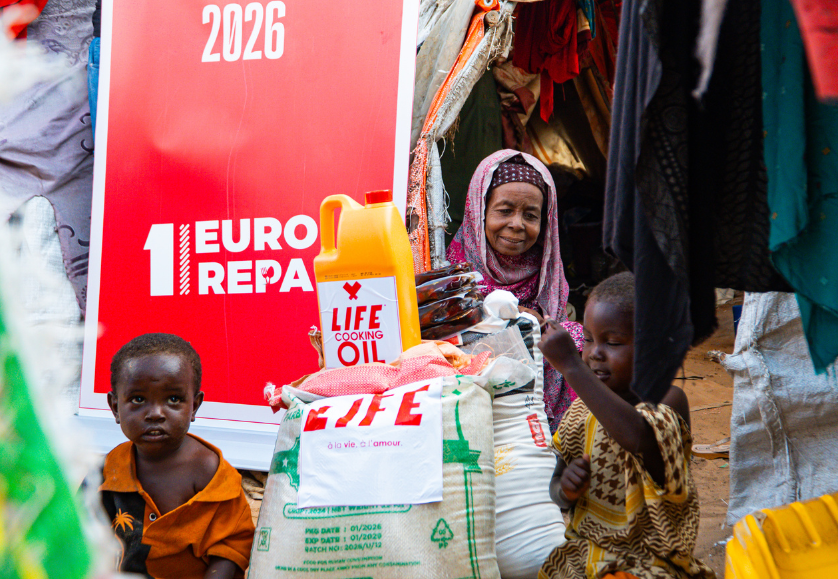
The forgotten dimension: according to OCHA (February 2026), 12 million people in Sudan, mainly women and girls, are exposed to gender-based violence. Female-headed households are three times more affected by food insecurity, and three quarters of them say they do not have enough to eat.
How LIFE works in Sudan
LIFE works in Sudan in a context of extremely limited access. Its programmes focus on the most urgent needs, identified with its local partners:
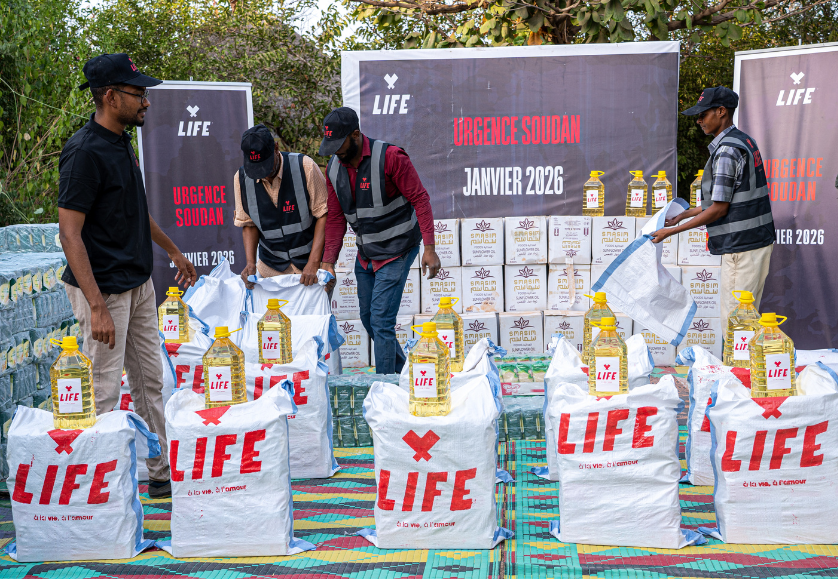
- Emergency food distribution: food parcels for displaced families in accessible areas
- Access to clean water: support for water points in displacement camps
- Essential kits: hygiene, shelter and blankets for families without a home
- Support for basic healthcare: helping keep still-functioning medical facilities running
The security situation and access restrictions demand a high degree of operational flexibility. LIFE works with networks of local partners present in areas where international access is impossible.
To follow LIFE's operations in Sudan, visit life-ong.org/urgences/soudan. The donor relations team is available to give you detailed information on ongoing programmes.
Why give to Sudan now?
The Sudan crisis is structurally underfunded. In 2025, less than a third of the funds requested were raised. This shortfall has direct consequences: community kitchens closing, health programmes suspended, distributions interrupted.
Giving now allows LIFE to keep its operations going at a time when institutional funding is shrinking. It also means acting without waiting for the crisis to return to the TV news headlines.
To understand how much regular giving matters to an NGO, our article Regular vs one-off giving: what impact for a charity? explains everything. And to make sure LIFE is a trustworthy organisation before you give, our guide Giving to an NGO: 5 criteria for choosing a trustworthy charity offers a complete method.
Would you also like to understand what people uprooted by this conflict are going through? Our article Internally displaced people vs refugees: understanding the difference and taking action offers useful insight.
Would you like to support the people of Sudan?
Your donation qualifies for 66% French tax relief, and you receive an annual tax receipt. Our team is here to help with any questions, so do get in touch!
Donate now →Frequently asked questions
Why is so little said about the crisis in Sudan?
Access for journalists and aid workers is severely restricted by both parties to the conflict. According to Human Rights Watch's World Report 2026, in May 2025 only 110 visas had been granted out of 355 pending applications for the UN and international NGOs. This lack of visibility leads directly to underfunding of the humanitarian response.
Has famine been declared in Sudan?
Famine conditions have been documented in several areas of Sudan since 2024, notably in Darfur. The UN Fact-Finding Mission concluded that the RSF and their allies are deliberately using starvation as a method of warfare, which constitutes a war crime. The food situation remains critical in many parts of the country.
Do donations really reach Sudan?
Humanitarian access is severely obstructed, but organisations with a long-standing presence on the ground and established networks of local partners manage to keep operations going in accessible areas. LIFE works with such partners. The donor relations team can give you detailed information on ongoing programmes and areas of operation.
What are the Rapid Support Forces (RSF)?
The RSF are Sudanese paramilitaries who have been fighting the regular army (SAF) since April 2023. Born out of the Janjaweed militias of Darfur, they were gradually institutionalised before turning against the central government. UN experts accuse both parties to the conflict of serious violations of international humanitarian law.
How is my donation to LIFE for Sudan used?
LIFE allocates donations received for Sudan to its field programmes: food aid, clean water, essential kits and medical support. LIFE's annual accounts are published and certified by an independent auditor. The donor relations team can give you detailed information on how your donation is allocated and on ongoing operations in Sudan.
Ready to help?
I start a fundraiser
Support the causes close to your heart by starting an online fundraiser with LIFE.
Raising funds for a charity has never been easier!