DRC: the forgotten crisis affecting millions of displaced people
At a glance
- The Democratic Republic of the Congo is home to Africa's largest internal displacement crisis. According to OCHA, 6.47 million people were displaced within the country in early 2026, 80% of them women and children.
- In January 2026 alone, a further 74,000 people fled their homes in the east of the country because of armed clashes (OCHA, February 2026 report).
- The crisis is chronically underfunded: in 2025, only 23.9% of needs were met, the lowest rate since 2016 according to OCHA.
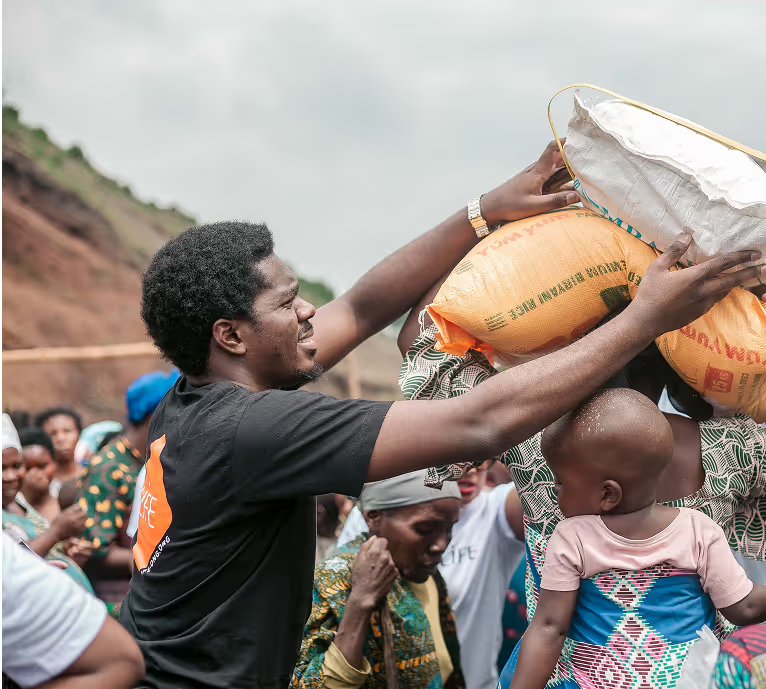
- LIFE works in eastern DRC with programmes providing food aid, access to water and support for displaced people.
- LIFE's donor relations team is on hand to answer any questions you have about our current operations.
The DRC almost never makes the headlines on French television news. And yet it is one of the most serious, longest-running and most neglected humanitarian crises on the planet. For decades, the east of the country has been torn apart by armed conflicts that uproot millions of civilians and stretch humanitarian capacity to breaking point.
This guide explains what is really happening in the DRC, why it is so hard to resolve, and how you can take practical action from France.
What is the situation in the DRC in 2026?
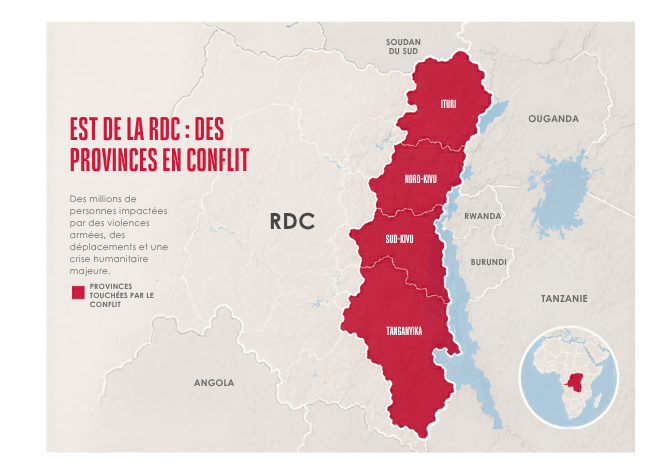
The crisis is centred on the east of the country: the provinces of North Kivu, South Kivu, Ituri and Tanganyika account for most of the violence and displacement. The conflict involves dozens of armed groups, including M23, which the UN says is backed by Rwanda, and the Armed Forces of the DRC (FARDC).
According to OCHA's report published in February 2026, in January 2026 alone 74,000 people were forced to flee their homes, bringing the total number of internally displaced people to 6.47 million. Of these, 76% fled because of armed group activity and fighting. Women and children make up 80% of this uprooted population.
The crisis in numbers
Sources: OCHA DRC, January and February 2026 reports
| Indicator | Figure |
|---|---|
| Internally displaced people in the DRC | 6.47 million people |
| Newly displaced in January 2026 | 74,000 people |
| People in need in 2026 | Nearly 15 million |
| People targeted for aid in 2026 | 7.3 million (due to lack of funding) |
| Internally displaced people in South Kivu alone | 1.51 million (as of 31 January 2026) |
| Food-insecure people in South Kivu | 2.97 million (IPC3+) |
Important
The underfunding paradox: according to OCHA DRC's January 2026 analysis note, only 23.9% of humanitarian needs were funded in 2025, the lowest rate since 2016. The direct consequence: in 2026, humanitarian aid has been narrowed to 7.3 million people, down from the 11 million targeted in 2025. Millions of vulnerable people will receive no assistance at all.
Why has the crisis in the DRC lasted so long?
The DRC is Africa's second-largest country, with vast natural resources (coltan, cobalt, gold, diamonds). This wealth has fuelled rivalry and conflict for decades.
Several factors make the crisis especially hard to resolve:
- The sheer number of armed actors: more than 100 armed groups operate in the east of the country, with very different agendas and sources of funding
- Regional interference: neighbouring countries directly or indirectly support some of these groups
- Weak state presence in some remote areas: the regular army does not control the whole territory
- The vastness of the country: conflict zones are often hard to reach and lack basic infrastructure
This complexity does not excuse the media's silence on the crisis. But it partly explains why the international community struggles to commit to it over the long term.
In practice
What OCHA says: in its January 2026 report, the organisation describes the humanitarian crisis in the DRC as "one of the most protracted and most neglected of our time". The humanitarian community cannot scale up its response without renewed financial commitment from donors.
Who is affected?
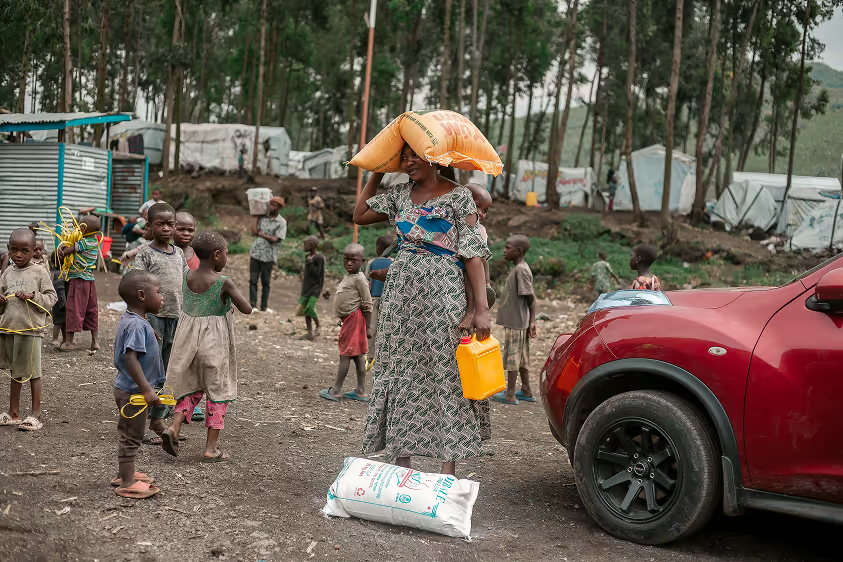
Behind the figures are real faces. The vast majority of displaced people in the DRC are civilians who play no part in the conflicts. They are farmers, herders and families who lived in remote villages and lost everything overnight.
The most vulnerable are women who head their households: in North Kivu, according to OCHA, 91.2% of them have poor food consumption. Children are especially at risk: severe acute malnutrition, disease and no way to go to school. In South Kivu alone, 688,000 pupils had no access to education in January 2026.
Most displaced people live with host families who share what little they have. Others crowd into collective centres, schools and churches. Others still sleep out in the open.
How LIFE is helping in the DRC
LIFE has been working in eastern DRC for several years, in an extremely challenging operating environment. Its programmes target the most urgent needs of displaced people:
- Emergency food aid: distributions of food parcels and cash for displaced families
- Access to safe drinking water: support for water points in affected areas
- Essential kits: hygiene items, emergency shelter, blankets
- Support for host communities: families who take in displaced people also suffer an economic shock, which LIFE works to ease
LIFE works with local partners who understand the dynamics on the ground and can reach areas that are often out of bounds for international humanitarian organisations.
To follow LIFE's operations in the DRC, visit life-ong.org/urgences/rdcongo. Our donor relations team can give you detailed information about current programmes.
Why giving to the DRC makes a real difference today
The crisis in the DRC is one of the most underfunded in the world. In 2025, barely 23.9% of needs were met. In 2026, the response plan was scaled back for lack of resources: millions of vulnerable people who should have received help will get none.
Against this backdrop, every euro you give to LIFE for the DRC helps fill the gap left by institutional donors pulling back.
To understand how NGOs handle humanitarian emergencies and how your donation is put to work on the ground, our article Humanitarian emergencies: how NGOs respond on the ground explains the whole process. To learn about another of Africa's forgotten crises, read our article Crisis in Sudan: understanding the situation and knowing where to give. And to understand how international humanitarian law is meant to protect civilians in these areas, our article International humanitarian law: the rules that protect civilians in war zones sets out the framework.
Would you like to support displaced people in the DRC?
Your donation qualifies for 66% French tax relief, and you will receive an annual tax receipt. Our team is here to help with any questions, so do get in touch!
Donate now →Frequently asked questions
Why do we hear so little about the crisis in the DRC?
Several factors explain the lack of media coverage: the complexity of the conflict (more than 100 armed groups), the difficulty journalists face in reaching areas of violence, geographical distance, and competition with other crises that get more attention. OCHA itself describes the Congolese crisis as "one of the most protracted and most neglected of our time".
What is M23 and why does it matter?
M23 (the March 23 Movement) is a Congolese armed group active in North Kivu which, according to the UN, is backed by Rwanda. Its offensive has triggered waves of mass displacement in the east of the country. The situation worsened in 2025-2026, with intense fighting in the provinces of North Kivu and South Kivu.
Is there a famine in the DRC?
Some areas of eastern DRC are experiencing acute food insecurity. According to OCHA, in North Kivu 85.6% of households have poor food consumption. In South Kivu, 2.97 million people are in IPC Phase 3 or worse. The situation has not officially been declared a famine at national level, but millions of people face serious food insecurity.
Does humanitarian aid actually reach eastern DRC?
Delivering aid is complicated by insecurity, cut-off roads and access restrictions. But NGOs with established local partners manage to keep operations running in many areas. LIFE relies on these local networks to work where international access is difficult. Our donor relations team can tell you about the areas and programmes currently under way.
How is my donation to LIFE for the DRC used?
LIFE allocates donations received for the DRC to its field programmes: food aid, safe drinking water, essential kits and support for host communities. LIFE's annual accounts are published and certified by an independent auditor. Our donor relations team can give you precise details of how your donation is allocated.
Ready to help?
I start a fundraiser
Support the causes close to your heart by starting an online fundraiser with LIFE.
Raising funds for a charity has never been easier!