How to choose a trustworthy humanitarian sponsorship organisation
At a glance
- Not all sponsorship organisations are equal. What sets a reliable one apart: verifiable financial transparency, a local partner on the ground, traceable aid and a recognised legal status.
- Be wary of unclear running costs: a serious organisation clearly shows how funds are split between direct aid and logistics.
- Individual sponsorship faces legitimate ethical criticism (dependency, false expectations, the child's privacy). A good organisation responds with concrete safeguards.
- A tax receipt, an independent accreditation, regular updates and an identifiable partner on the ground are the best signs of a serious organisation.
- A serious NGO's donor care team answers your questions precisely, without pressure or artificial urgency.
Taking on a sponsorship means entrusting an organisation with money every month, trusting that it will reach a child on the other side of the world. That trust has to be earned, and it can be checked. Before you decide who to sponsor through, here are the criteria that separate genuinely serious organisations from those that trade on emotion.
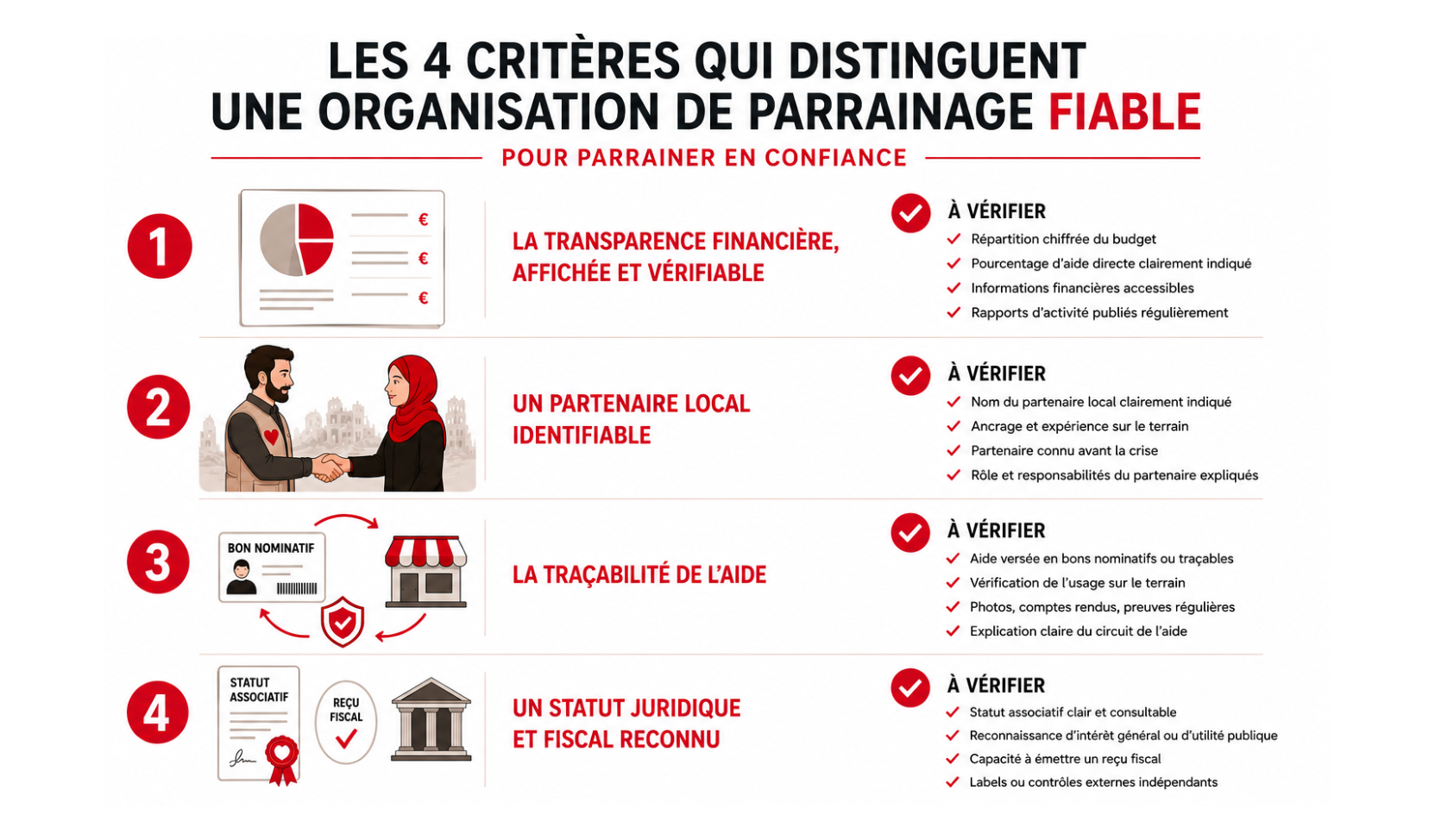
The 4 criteria that set a reliable sponsorship organisation apart
1. Financial transparency, published and verifiable
A serious organisation doesn't simply say that "most" of your gift goes to the child. It shows the exact breakdown: how much goes to direct support, and how much to logistics and monitoring. This breakdown should be accessible, clear and backed by figures.
As a concrete example, LIFE's sponsorship programme in Gaza states that of the €78 monthly sponsorship, €65 goes directly to supporting the child and €13 to logistics and monitoring: 83% direct aid. An organisation that spells out what every euro does is putting its cards on the table. Vague wording with no figures at all, on the other hand, should raise your suspicions.
2. An identifiable local partner
No French NGO can, on its own from Europe, select and follow children in a crisis zone. It's simply not physically possible. The real work always relies on a local partner: people on the ground who identify the children, distribute the aid and check how it is used.
A reliable organisation names this partner and explains its roots. For its Gaza programme, LIFE works with Al-Amal Training Society, which has been active in the territory since 1997. If you can find no information on who actually does the work on the ground, that's a warning sign. A long-established partner that knew the area before the crisis is, by contrast, a mark of reliability.
3. Traceable aid
How do you know the money really reaches the child? The most rigorous organisations have put tracking systems in place: aid given as named vouchers rather than cash, checks on how it is used on the ground, dated photos and regular reports.
The better documented the aid's journey, the less room there is for misuse or inefficiency. At LIFE, support is provided as coded vouchers linked to the child's name, redeemable at contracted local shops and verified on site. An organisation that can't explain how it tracks aid all the way to the child shouldn't inspire your trust.
4. Recognised legal and tax status
A serious organisation is a registered association, recognised as being of general interest or public benefit, and able to issue tax receipts. That last point isn't just a benefit for you: it's also a mark of legitimacy, because it means the organisation meets specific legal criteria. Accreditations from external bodies, such as independent charity watchdogs, offer an additional guarantee.
Warning signs that should send you running
Just as the right criteria reassure, certain signs should set alarm bells ringing straight away:
- Artificial urgency. An organisation that pushes you to sign up "right now", with a countdown, is trying to cut your thinking short. Serious organisations give you time to decide.
- Financial opacity. No clear information on how funds are allocated, and vague phrases like "your gifts change lives" with no figures to back them up.
- No named local partner. If you can't tell who does the work on the ground, that's a problem.
- Unrealistic promises. An organisation promising direct, unlimited contact with the child, easy visits or daily updates either doesn't understand the realities on the ground or is selling you an illusion.
- No tax receipt. An organisation that can't issue a tax receipt doesn't have the status needed to raise donations properly.
The donor care test
a good habit is to contact the organisation before committing and ask specific questions. Who is your partner on the ground? How is the aid tracked? What happens if I stop? A serious organisation answers precisely and openly. One to avoid will dodge the question or muddy the waters.
Criticisms of individual sponsorship: what you should know
Let's be honest: individual sponsorship faces serious ethical criticism from respected humanitarian organisations. Ignoring it would be dishonest. Understanding it is exactly what helps you choose an organisation that addresses it properly.
Three criticisms come up most often:
Creating dependency. Prolonged individual support, if poorly designed, can trap a family in reliance on aid rather than helping it towards independence. A good organisation's response: frame sponsorship as temporary support for rebuilding, and support the community around the child too.
False expectations and the child's privacy. Some organisations have given up individual sponsorship for fear of exploiting the child or creating unrealistic expectations. A good organisation's response: keep updates strictly managed, protect the child's image and privacy, and never put them "on display".
Tensions within the community. Singling out one child can breed jealousy where everyone is in need. A good organisation's response: make sure the support also benefits those around the child, for example by helping the host family or funding shared services.
These criticisms don't condemn sponsorship: they outline what good sponsorship should look like. An organisation that is aware of these pitfalls and puts safeguards in place is precisely the one to choose.
Getting the balance right
serious sponsorship isn't about "buying" a child or keeping up an imagined relationship. It's about funding, in a traceable and dignified way, the concrete needs of an identified child, while also supporting the world around them. This balance between an individual bond and collective benefit is what makes a programme good.
Applying these criteria to sponsorship in Gaza
Gaza is a good test case for these criteria, because the constraints there are extreme: intermittent access, no care facilities, inflation and insecurity. In such a context, reliability matters even more.
The scale of need is documented: more than 58,000 children in Gaza have lost one or both parents since October 2023, according to UNICEF, as reported by the Palestinian Central Bureau of Statistics (April 2026). With needs on this scale, how serious your chosen organisation is isn't a detail: it decides whether your help makes a real difference.
In practice, a serious organisation for sponsoring an orphan in Gaza should tick every box: a firmly established local partner, aid tracked through named vouchers rather than cash, transparency on how funds are allocated, a status that allows it to issue tax receipts, and honesty about what monitoring is genuinely possible.
This is exactly the checklist we set out in our article Sponsoring an orphan in Gaza: how it works with LIFE, which shows how these criteria come to life in a real programme. And to understand why this kind of regular commitment suits this context better than a one-off gift, our article Child sponsorship in Gaza: why it's more effective than a one-off donation explores the question in depth.
To go further on how to choose a charity in general, beyond sponsorship alone, our guide Giving to an NGO: 5 criteria for choosing a trustworthy charity is a useful companion read, as is our article NGO transparency: how to check how your donations are used.
Looking for a reliable organisation to sponsor an orphan in Gaza?
LIFE works with a partner that has been in Gaza since 1997 and tracks every bit of aid all the way to the child. Your gift qualifies for 66% French tax relief and you receive a tax receipt every year. Our team is here to help.
Discover the programme →Frequently asked questions
What makes a sponsorship organisation reliable?
Four main criteria: published financial transparency with figures (the split between direct aid and logistics), an identifiable local partner doing the work on the ground, traceable aid (named vouchers, checks, reports), and a recognised legal status allowing it to issue tax receipts. Accreditations from external bodies offer an additional guarantee.
How can I spot a sponsorship scam?
The main warning signs are: artificial urgency to make you commit quickly, financial opacity, no named local partner, unrealistic promises of unlimited contact with the child, and an inability to issue tax receipts. A serious organisation answers your questions precisely without putting pressure on you.
Is individual sponsorship ethical?
Individual sponsorship faces legitimate criticism: the risk of dependency, false expectations, intrusion into the child's privacy and tensions in the community. These criticisms don't condemn sponsorship, but they define what good sponsorship looks like. A serious organisation puts safeguards in place: protecting the child, supporting the wider community, and managed, honest updates.
Why does the local partner matter so much?
Because no NGO can, on its own from abroad, identify and follow children in a crisis zone. The local partner does the real work: selecting the children, distributing and checking the aid, and monitoring. An organisation that names its partner and explains its roots is more reliable than one that is vague on this point. A long-established partner is a further mark of reliability.
Should I be wary of organisations that promise direct contact with the child?
Some caution is wise. Promising direct, unlimited contact or easy visits often ignores the realities on the ground and can create false expectations, or even raise child protection concerns. The most serious organisations manage updates carefully and are honest about what is genuinely possible, rather than overselling an imagined relationship.
Ready to help?
I start a fundraiser
Support the causes close to your heart by starting an online fundraiser with LIFE.
Raising funds for a charity has never been easier!