Sponsoring a child in Gaza: why it does more than a one-off donation
At a glance
- A one-off donation meets the emergency of the moment. Sponsorship, on the other hand, funds a child's recovery over time, which better fits the reality of orphanhood on the scale seen in Gaza.
- Regular giving has real practical value: it gives the NGO the predictability it needs to commit to long-term costs (schooling, healthcare follow-up, psychological support) rather than reacting from one day to the next.
- Sponsorship is named and traceable: one sponsor, one child, vouchers issued in the child's name. You know who you are helping and what your support pays for.
- One-off donations are still very useful for responding to a sudden peak in a crisis. The two kinds of giving work together; they don't compete.
- LIFE's donor relations team can help you choose the option that best suits your situation.
With Gaza facing an orphan crisis, one question comes up again and again: is it better to make a one-off donation in response to what you see on the news, or to commit to regular sponsorship? Both come from a good place. But they don't have the same effect, either for the child or for the organisation supporting them. Understanding the difference helps you make an informed choice.
One-off donations and sponsorship: two different approaches
A one-off donation responds to a moment. You see an unbearable image, you give, and that gift pays for immediate help: a food parcel, a hygiene kit, an emergency response. That is precious, and in the first hours of a crisis it can save lives.
Sponsorship answers a different question. Not "how can I help right now?", but "how can I support this child over the months and years ahead?" An orphaned child in Gaza doesn't just need a meal today: they need to eat every month, go back to school, receive medical care and recover psychologically. None of these needs can be met in one go.
It's the difference between putting out a fire and rebuilding the house. Both are necessary. But for a child who has lost everything, it is rebuilding over time that changes the course of a life.
A distinction that matters
one-off donations mainly fund the emergency phase, when the priority is immediate survival. Sponsorship funds the recovery phase, when a child is helped to become a child again. In Gaza, where needs will last for years, this second phase is just as crucial as the first.
Regular giving has real practical value
You might think that, for an NGO, ten one-off donations are worth the same as a sponsorship of the same total. In fact they aren't, and the reason is very practical.
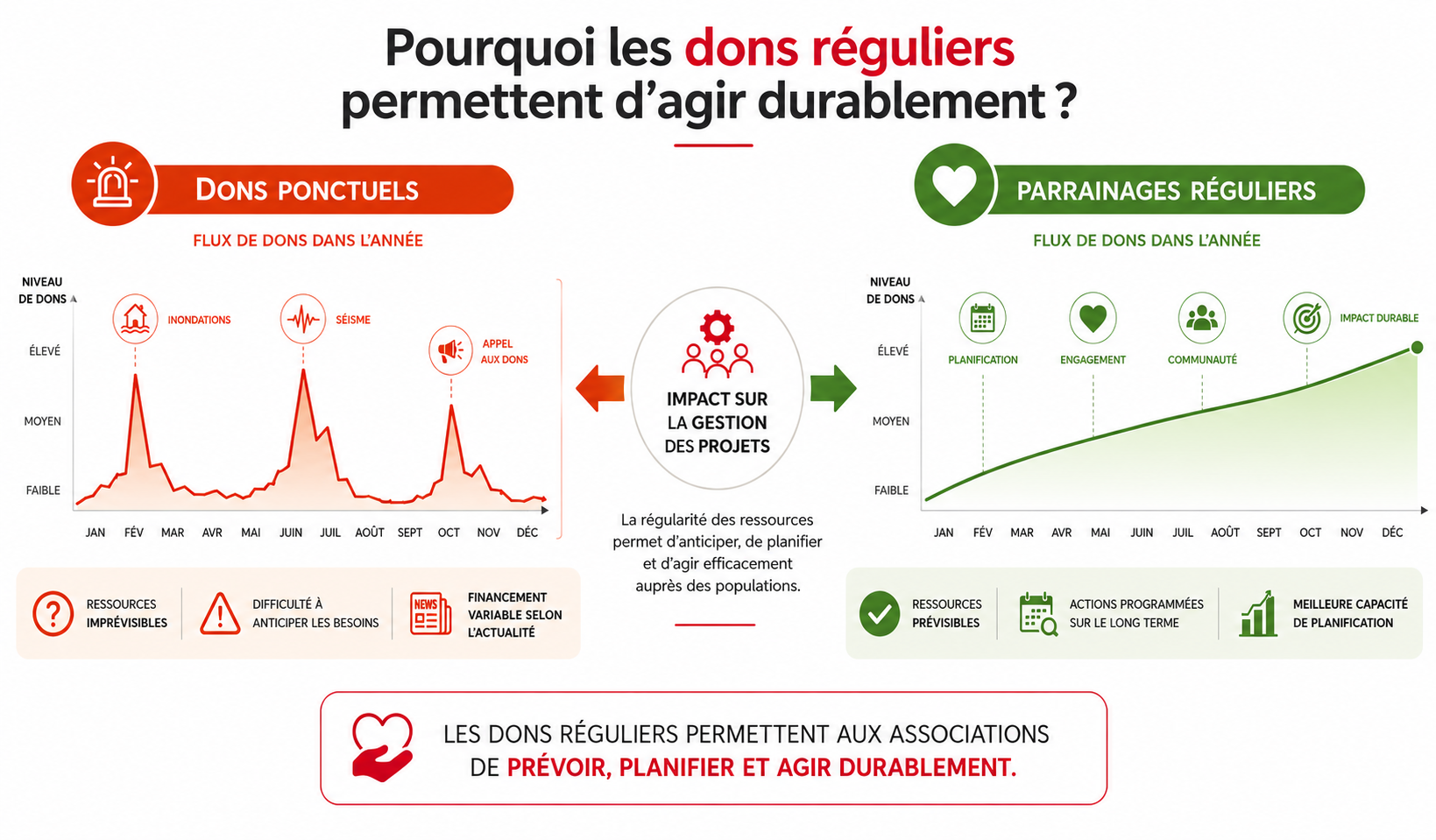
A responsible humanitarian organisation doesn't spend money as soon as it comes in. It plans: recruiting and training local teams, signing contracts with shopkeepers, committing to a school year, setting up medical follow-up. All these commitments depend on knowing in advance what resources it can count on.
That is exactly what sponsorship makes possible. By committing to give €78 every month, a sponsor gives the NGO a visibility that ten unpredictable donations never can. The organisation can then enrol a child in a school programme for the year, without fearing it will have to stop three months later for lack of funds.
On the other hand, funding made up only of one-off donations means flying blind. You can't promise a child twelve months of support if you don't know what you'll receive next month. So regular giving isn't an administrative convenience: it is what makes possible the long-term help that orphans need.
Sponsorship creates a bond that an anonymous donation can't
Beyond the financial mechanics, there is a human side that a one-off donation can't offer.
When you sponsor, you aren't sending money into a general fund: you are supporting a specific child. In LIFE's programme, this bond is real. A child is assigned to you by name. Support reaches them as vouchers issued in their name. And you receive news of them in your member area throughout the year.
This named traceability answers the question many donors quite rightly ask: "Does my help really reach someone?" With traceable sponsorship, the answer can be checked. To understand in detail how the voucher and follow-up system works, our article Sponsoring an orphan in Gaza: how it works with LIFE describes the whole scheme.
This bond also matters to the child and their community: knowing that someone, somewhere, has made a commitment specifically to them changes the nature of the help they receive. It is no longer anonymous assistance; it is a relationship.
Why this model is especially well suited to Gaza
The situation in Gaza makes sponsorship even more valuable than one-off giving, for three specific reasons.
First, the crisis is long-lasting. The needs of Gaza's orphans won't disappear with the next news cycle. They stretch over years, which calls for steady funding over time rather than a series of one-off reactions.
Second, access is unstable. As the closure of several crossing points in early 2026 showed, aid deliveries can be suddenly cut off. A local partner with regular funding can keep working and adapt, whereas one-off aid depends on a logistical window opening at the right moment.
Finally, there is no longer any central care facility for these children. Help must therefore be tailored, child by child, which is exactly how named sponsorship works. To better grasp the scale and particular features of this crisis, our article Gaza: 58,000 orphaned children, the biggest crisis in modern history gives the full background.
The trap of emotional funding
crises only receive donations while they are in the media. As soon as Gaza drops off the front pages, one-off donations collapse, yet the needs stay exactly the same. Sponsorship protects against this volatility: it provides steady support, even when media attention moves elsewhere.
Does that mean giving up on one-off donations?
No. One-off donations are genuinely useful, and it would make no sense to pit them against sponsorship. The two meet different needs and complement each other.
A one-off donation is the right choice if you are responding to a specific peak in a crisis, if you are discovering an organisation and want to support it once before committing, or if you have a lump sum you want to put to use straight away. In the first hours of a worsening situation, it is one-off donations that allow an NGO to act fast.
Sponsorship is the right choice if you want to support a child over time, with a named bond and regular updates. For a broader comparison of these two kinds of giving, beyond Gaza alone, our article Regular vs one-off giving: what impact for a charity? sets out the advantages of each. And before you commit, make sure you choose a trustworthy organisation with our guide How to choose a reliable humanitarian sponsorship organisation.
For those who can, the ideal is often to combine the two: sponsorship for the long term, and a one-off donation when a crisis peaks. LIFE's donor relations team can help you work out the option that best suits your situation.
Would you like to support an orphan in Gaza over time?
Your sponsorship costs €78 a month and only around €26.52 once the 66% French tax relief is applied, with a tax receipt sent every year. Our team is happy to answer all your questions.
Sponsor an orphan →Frequently asked questions
Is sponsorship really more effective than a one-off donation?
Both are useful, but for different needs. A one-off donation funds the immediate emergency. Sponsorship funds recovery over time and gives the NGO the predictability it needs to commit to long-term costs such as a child's schooling or medical follow-up. For an orphan who needs support over several years, sponsorship is the better fit.
Why does regular giving matter so much to an NGO?
An NGO plans its work months in advance: teams, contracts, school commitments, medical follow-up. To do so, it needs to know what resources it can count on. Regular sponsorship provides that visibility, whereas a string of unpredictable one-off donations means flying blind and rules out any long-term commitment.
What happens to my sponsorship if Gaza is no longer in the news?
That is precisely one of the advantages of sponsorship. One-off donations collapse as soon as a crisis leaves the headlines, yet the needs remain. By sponsoring, you provide steady support to a child, whatever the media are focusing on at the time. It is a safeguard against the volatility of emotional funding.
Can I make a one-off donation as well as my sponsorship?
Yes, and it's a very sensible combination. Sponsorship provides a child's long-term support, while a one-off donation when a crisis peaks strengthens emergency aid when it is needed most. LIFE's donor relations team can help you combine the two.
How can I be sure my regular sponsorship really reaches the child?
In LIFE's programme, sponsorship is named and support is given as vouchers issued in the child's name, which can be used with local shopkeepers under contract and are checked on the ground by the local partner. You also receive regular news in your member area. This traceability is explained in detail in our article on how sponsorship works.
Ready to help?
I start a fundraiser
Support the causes close to your heart by starting an online fundraiser with LIFE.
Raising funds for a charity has never been easier!