Agroforestry: how local communities are restoring their land
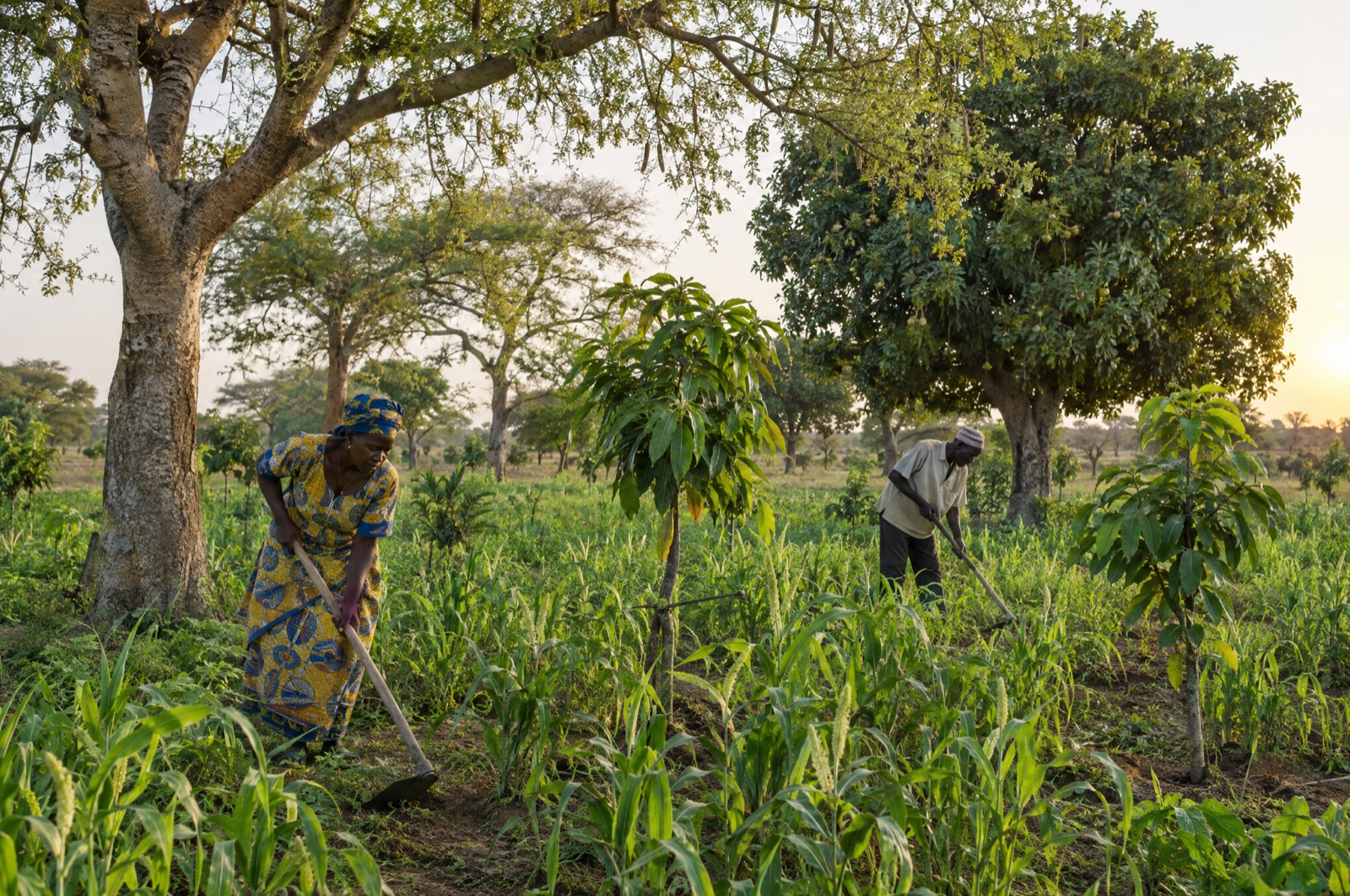
At a glance
- Agroforestry means combining trees with crops or livestock on the same plot of land.
- In Africa, it allows local communities to restore degraded land while continuing to farm it.
- The benefits are tangible: more fertile soil, better water retention, and more varied income from fruit, wood and fodder.
- Some trees, such as Faidherbia albida, naturally fertilise the fields they grow in.
- Successful projects depend on training farmers and on choosing tree species together with them.
In the Sahel, some millet fields are dotted with tall trees whose branches stand bare during the rainy season. The farmer hasn't forgotten them. These trees shed their leaves at exactly the moment the crops need them, dropping them to the ground as a natural fertiliser.
This partnership between tree and field has a name: agroforestry. Long dismissed as an old-fashioned traditional practice, it is now one of the most promising responses to land degradation in Africa.
Its great strength can be summed up in one idea: restoring the land without ever having to stop farming it.
What is agroforestry?
Agroforestry covers all the practices that deliberately combine trees with crops or livestock on the same land. The tree is no longer the field's rival; it becomes its partner.
For an introduction to the basic principles, our article on agroforestry in 4 key questions covers the fundamentals.
The main forms of agroforestry in Africa
Parkland systems. Trees scattered across fields, such as shea, néré or Faidherbia albida in West Africa. This is the most widespread form in the Sahel.
Agroforestry gardens. Plots with several layers growing one above the other: tall fruit trees, shrubs, food crops and low-growing plants. They are found particularly in Madagascar and in humid regions.
Hedgerows and windbreaks. Rows of trees along the edges of fields that shield crops from the wind and reduce erosion.
Silvopasture. Combining trees with grazing land, where the trees provide shade and fodder for animals.
Why does agroforestry restore the land?
Trees feed the soil
Fallen leaves break down and enrich the soil with organic matter. Some species, the legumes, capture nitrogen from the air and fix it in the ground. Faidherbia albida is the best-known example: in several countries in Southern and West Africa, maize and millet yields are markedly higher beneath its canopy than in open fields.
Roots hold water and soil in place
Deep roots stabilise the soil, reduce erosion by rain and wind, and help water soak into the ground. In drought-prone regions, this better-retained water often makes the difference between a harvest and a lost crop.
Shade protects crops
As the climate grows ever hotter, the dappled shade of trees reduces evaporation and heat stress on plants. It creates a microclimate that is kinder to crops and animals alike.
Key point
Agroforestry doesn't force a choice between producing and protecting. It lets a family feed itself today while rebuilding fertile soil for the next generation.
How do local communities make agroforestry their own?
Farmer-managed natural regeneration: the Sahel example
In Niger and Burkina Faso, farmers have re-greened millions of hectares since the mid-1990s. Their method: spot the shoots sprouting from the stumps of felled trees, protect them, prune them and let them grow up in the middle of their fields.
This re-greening didn't come from a major international programme. It grew out of farmers noticing that their harvests and incomes rose alongside the trees.
Trees that earn an income
The key to adoption is economic. A mango, cashew, coffee or moringa tree yields products that can be sold. Dead wood is used for cooking, leaves for fodder. Every tree becomes an extra source of income, and therefore something the family takes care to protect.
This is what sets agroforestry apart from plantations imposed from outside: the trees belong to the people who live from them.
Training: an essential step
Choosing the right species, managing competition between trees and crops, pruning at the right time: agroforestry has to be learned. Lasting projects invest as much in training as in seedlings.
The limits to be aware of
Agroforestry takes time: a fruit tree needs several years before it bears fruit. Without support during that period, without access to water for young seedlings and without secure land rights for farmers, projects often fail.
What tangible results has agroforestry achieved in Africa?
| Benefit | Effect observed on the ground |
|---|---|
| Soil fertility | More organic matter and nitrogen, less need for chemical fertilisers |
| Water | Better infiltration, replenished groundwater, crops less vulnerable to drought |
| Income | Fruit, wood, fodder and spices diversify sources of income |
| Food | Fruit and leaves enrich meals, especially during the lean season |
| Biodiversity | Return of birds, pollinators and soil life |
| Climate | Carbon stored in trees and soils |
By strengthening local production, agroforestry also contributes to communities' food sovereignty, making them less dependent on outside markets.
It is also one of the 8 solutions to tackle deforestation, as it makes it possible to grow more on existing land without clearing new forest.
How does LIFE support agroforestry?
LIFE's Sapousse programme, launched in 2016, follows exactly this approach. Rather than planting isolated forests, it provides families with "economic" trees suited to their local land, planted alongside their crops.
In Madagascar, 400 families in the Anosy, Itasy and Bongolava regions each received 500 seedlings: ravintsara, mango, tapia, cinnamon and coffee trees, making 200,000 trees in all. The fruit and cash-crop species provide a steady income while the trees restore the soil.
The planting goes hand in hand with other activities: distributing farming tools and green manure, creating vegetable gardens, and training in sustainable agriculture and green entrepreneurship. More than 14,000 people have been supported in Senegal, Mali, Benin, Morocco, Madagascar, Lebanon, Bangladesh and Indonesia. The results are published in LIFE's activity reports.
These projects are part of the wider movement for reforestation in Africa, driven by one conviction: a tree that feeds people is a tree that stays standing.
Your gift and your French tax relief
Donations to LIFE's agroforestry projects qualify for 66% French tax relief. Work out what your gift really costs you →
Plant a tree that feeds a family
For 2 euros, you fund a fruit or cash-crop tree planted among a family's crops. For 15 euros a month, you support all of LIFE's agroforestry projects.
Support agroforestry with LIFE →Frequently asked questions
What is a simple definition of agroforestry?
It means growing trees on the same plots as crops or pasture, so that each benefits the other: the trees enrich the soil and protect the crops, and the fields stay productive.
What are the advantages of agroforestry in Africa?
It improves soil fertility, retains water, reduces erosion, shields crops from heat and diversifies family incomes through fruit, wood and fodder.
Which trees are used in African agroforestry?
Among the most common are Faidherbia albida, shea, néré, moringa, mango, cashew and baobab. In Madagascar, coffee, cinnamon and ravintsara are also planted.
Does agroforestry increase crop yields?
Yes, in the medium term. Under certain fertilising trees such as Faidherbia albida, cereal yields are markedly higher. The first few years do call for patience, though, while the trees grow.
What is the difference between agroforestry and reforestation?
Reforestation aims to recreate a forest. Agroforestry brings trees into farmland that continues to be cultivated. The two complement each other in the fight against land degradation.
Ready to help?
I start a fundraiser
Support the causes close to your heart by starting an online fundraiser with LIFE.
Raising funds for a charity has never been easier!