Food sovereignty: why we help communities feed themselves
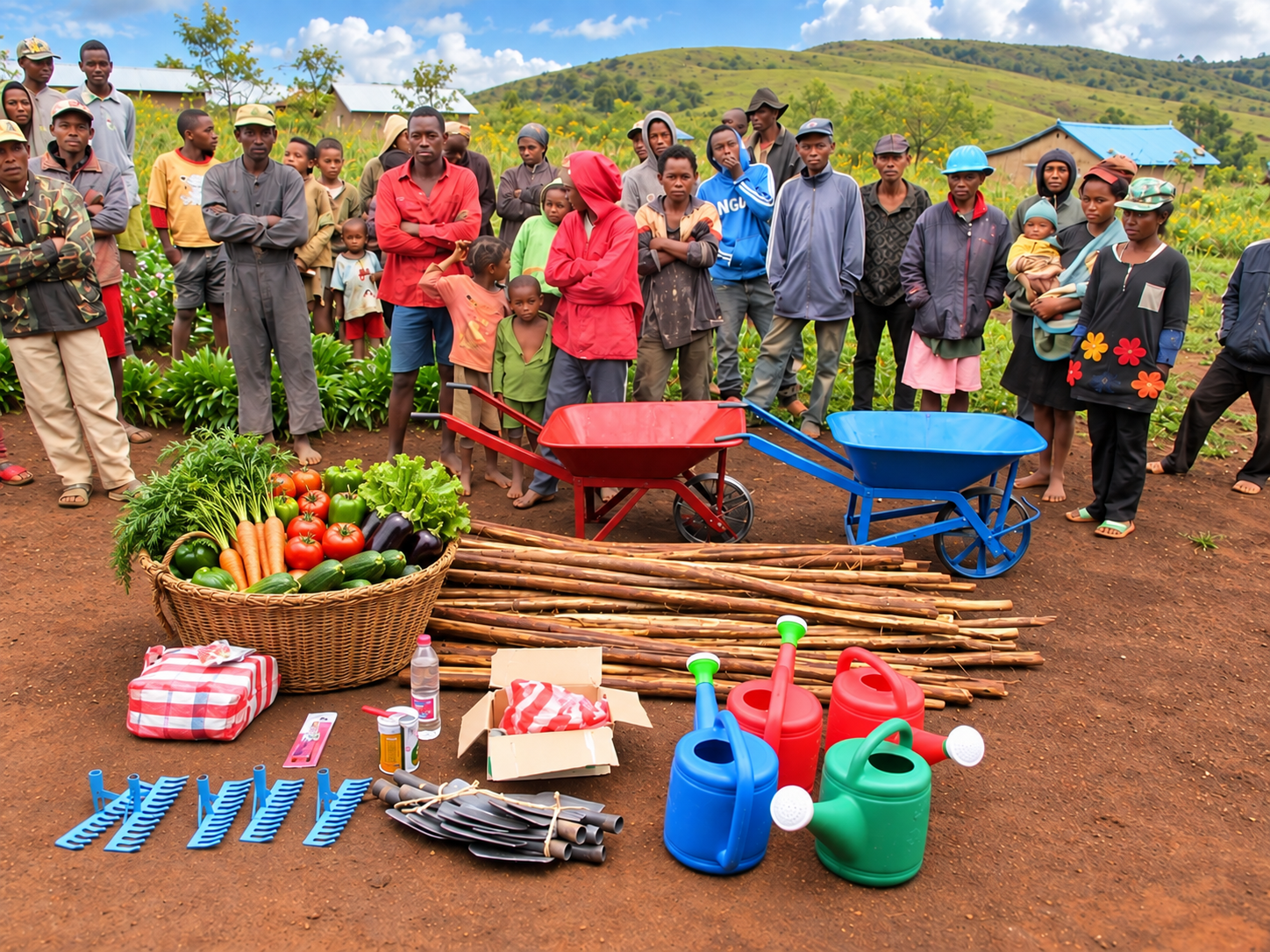
At a glance
- Food sovereignty is the right of peoples to set their own agricultural and food policies, without dumping onto other countries.
- The concept was coined by the international peasant movement Via Campesina in 1996, on the sidelines of the World Food Summit in Rome.
- It differs from the FAO's idea of food security: security is about access to food, sovereignty is about the power to produce it.
- Africa imports around 50 billion dollars of food a year, yet it holds 60% of the world's uncultivated arable land.
- NGOs such as LIFE support food sovereignty through wells, resilient seeds, farmer training and local cooperatives.
In 2026, 309 million people in Africa face food insecurity, and the continent imports around 50 billion dollars of food every year. This paradox plays out on a continent that holds 60% of the world's uncultivated arable land. The heart of the problem is not how much food exists worldwide, but the power of communities to produce their own food.
That is exactly what food sovereignty is about. The concept was coined in 1996 by the international peasant movement Via Campesina and has since become a reference framework for alternative agricultural policies. This guide explains what the concept covers, how it differs from food security, what its pillars are and how humanitarian NGOs help put it into practice. It is part of our series on food security.
What is food sovereignty?
The benchmark definition was introduced in April 1996 by the international peasant movement Via Campesina, during the World Food Summit organised by the FAO in Rome. It has since been taken up in UN texts and political debate and, more recently, in the official names of the French and Italian Ministries of Agriculture.
“Food sovereignty is the right of each nation to maintain and develop its own capacity to produce its basic foods, respecting cultural and productive diversity.” — Via Campesina, 1996
Three things set this concept apart from a mere technical definition.
It is a collective right. Food sovereignty is exercised by a people, a community, a country. It cannot be reduced to an individual right to be fed.
It is a “concept in action”. Via Campesina is clear on this: it is not an academic construct but a political movement driven by farmers in both the Global South and the North, with real mobilisations (including the International Day of Peasant Struggle on 17 April).
It is a response to unregulated free trade. The concept emerged in reaction to the neoliberal policies of the 1990s, which pushed countries in the Global South to open their farm markets to subsidised imports from the North, ruining their small-scale farming.
How does it differ from food security?
The two ideas have existed side by side since 1996 and are often confused. Yet they complement each other and operate on different levels.
| Criterion | Food security (FAO) | Food sovereignty (Via Campesina) |
|---|---|---|
| Year | 1996 (FAO Summit, Rome) | 1996 (Via Campesina, on the sidelines of the same summit) |
| Focus | Access to food (downstream) | Power to produce food (upstream) |
| Target | Every individual | Every people and community |
| Where food comes from | Neutral (market, aid, local production) | Local production comes first |
| Global market | Seen as a means of access | Seen as a source of vulnerability |
| Political stance | Institutional (UN) | Activist (peasant movement) |
Food security rests on four dimensions set out by the FAO: availability, access, utilisation and stability. Our dedicated article, food insecurity: causes and lasting solutions, looks at these pillars in detail.
Complementary, not opposed
Via Campesina presents food sovereignty as a precondition for food security. Without the capacity to produce its own food, a country remains exposed to global market shocks, geopolitical crises and the trade policies of agricultural powers. Sovereignty does not replace security: it makes it robust.
What are the 6 pillars of food sovereignty?
The concept was refined at the Nyéléni Forum (Mali, 2007), which set out six guiding principles.
1. Putting local food production first
Feeding the people of a region with what that region produces, before exporting or importing. This means protecting subsistence farming and resisting exclusive specialisation in export crops (coffee, cocoa, cotton).
2. The right to land, water and seeds
Without secure access to these three fundamental resources, small-scale farming is simply impossible. This calls for land reform, recognition of customary land rights and a refusal to let large corporations privatise seeds.
3. Protection against international dumping
Dumping means selling farm produce abroad below local production costs, often thanks to public subsidies. The practice ruins farming communities in the Global South. Food sovereignty requires legitimate trade protections for emerging or fragile agricultural sectors.
4. People's control over agricultural policy
Via Campesina is emphatic: sovereignty belongs to the people, not just the nation. Farmers, consumers and local communities must have a say, not only governments. The movement condemns the hijacking of the concept by some governments that use it to mean purely state sovereignty.
5. The central role of women farmers
More than half of the Sahel's farmers are women. They grow most of the family's food and make the household's nutrition decisions. Without recognition of their role, and without access to land, credit and training, no food sovereignty can hold at scale.
6. Preserving farming knowledge and biodiversity
Farmers' own seeds, traditional techniques suited to local soils, a wide diversity of cultivated varieties: together they form an irreplaceable heritage, threatened by industrial monocultures and patented hybrids.
Why is food sovereignty essential for Africa?
Three facts make the debate especially pressing for the African continent.
309 million Africans face food insecurity, or 1 person in 4, according to the SOFI 2026 report. In absolute terms, Africa now exceeds Asia on this measure.
50 billion dollars of food imports a year, according to African Development Bank estimates. This dependence leaves the continent highly exposed to global market shocks (Covid-19, the war in Ukraine, a rising dollar).
Yet 60% of the world's uncultivated arable land lies in sub-Saharan Africa. The productive potential is huge, but it goes largely untapped for lack of investment, secure land tenure and coherent agricultural policy.
Food sovereignty offers a structural answer: rather than importing on a massive scale, build local production capacity, protect farming communities, secure land rights, train and finance. For an in-depth look at the practical techniques, read our article on sustainable agriculture in Africa, which sets out proven practices.
How do NGOs contribute to food sovereignty?
Humanitarian NGOs have gradually changed their approach. Handing out food meets the emergency; putting local means of production in place tackles the root of the problem.
The principle: “helping people feed themselves” rather than “feeding people”
This shift in perspective changes everything. A food distribution programme ends when the stocks run out. A sustainable farming programme, once in place, keeps producing for decades. That is why NGOs now combine both approaches: emergency relief in the short term, sovereignty in the long term.
Five practical levers
Distributing resilient seeds. After a drought, flood or conflict, farmers often have no seed stock left. Organisations such as the FAO, Action Against Hunger and LIFE distribute seeds suited to local climates to restart the farming cycle. The choice of variety is strategic: local farmers' varieties rather than patented hybrids that depend on costly inputs.
Building water infrastructure. Wells, boreholes, drip irrigation, small hillside reservoirs: access to water is the main limiting factor for farming in the Sahel. LIFE, for example, equipped the village of Wibga in Burkina Faso with a water supply system benefiting 2,000 people, alongside market gardening.
Training in agroecological techniques. Hands-on workshops on zaï pits, intercropping, agroforestry and post-harvest storage. Peer-to-peer training (farmer to farmer) is particularly effective and lasting.
Supporting local cooperatives. Working capital, bulk purchase of tools, help with marketing: cooperatives let smallholders share costs and negotiate better prices.
Setting up community seed banks. These shared facilities conserve and spread local farmers' varieties, securing their future and keeping producers independent of commercial seed companies.
An important distinction: projects vs dependency
A successful food sovereignty project is measured by its ability to make itself unnecessary. The end goal is for the community to carry on without the NGO. It is the opposite of permanent dependency on aid. This philosophy runs especially deep in integrated programmes that combine water, farming, education and microfinance.
Focus: LIFE's farming work in the countries where we operate
LIFE works in 25 countries with an integrated approach that links humanitarian emergency relief with support for food sovereignty. Three concrete examples illustrate this twofold work, with more detail on our key figures page.
In Burkina Faso (Wibga), building a drinking water supply system made it possible to develop irrigated market gardening, directly benefiting 2,000 people. The project brings together water access, farming and better nutrition.
In Cambodia, 50 water towers built and regular food distributions reaching 46,000 people are supporting a revival of subsistence farming in deprived rural areas.
In the Sahel, distributions of resilient seeds after recurring droughts allow farmers to restart their harvests rather than relying on food aid for the long term.
The challenges of building food sovereignty in the Global South
Despite growing recognition of the concept, three major obstacles remain.
Insufficient funding. Agriculture receives a disproportionately small share of official development assistance, even though it employs 65% of the Sahel's population.
International trade rules. Bilateral agreements and the WTO often still force countries in the Global South into lopsided market opening, exposing their producers to competition from subsidised giants. Food sovereignty means renegotiating these frameworks.
The impact of climate change. Droughts in the Sahel, floods in South Asia, salt creeping into coastal soils: climate shocks are making local production ever less certain. The issue is central for Africa, as our dedicated article on solutions to drought in Africa explains.
The 2026 debate: some governments hijacking the concept
Via Campesina condemns governments that use the term “food sovereignty” when what they really mean is “national sovereignty over food security” (protectionism), whereas the original concept champions people's sovereignty led by farmers themselves. This political nuance is key to understanding current debates around French and European farming laws.
How can you support food sovereignty from France?
There are three ways to take action.
Responsible shopping. Choosing Fairtrade-labelled imports (coffee, cocoa, rice, shea) directly supports farmers who practise sustainable agriculture, are paid a fair price and are organised in cooperatives.
Give to an NGO that supports local self-reliance. A one-off or monthly gift to LIFE pays for wells, boreholes, resilient seeds and training. Our in-depth analysis of conflict and food insecurity explains why these long-term approaches are especially urgent in crisis zones.
Raise awareness. The idea is still little known in France. Talking about it with the people around you, sharing articles and supporting local farmers' movements (Confédération paysanne, MODEF) all help to get the issue recognised politically.
Every donation to a recognised NGO qualifies for 66% French tax relief, up to a limit of 20% of taxable income.
Help communities feed themselves
Every gift to LIFE funds long-term projects: wells, boreholes, seeds and farmer training. You're not just paying for one meal. You're giving communities the means to grow their own food for years to come.
Donate to food self-reliance →Frequently asked questions
What exactly is the difference between food sovereignty and food security?
Food security (as defined by the FAO in 1996) means that everyone has physical and economic access to enough safe, nutritious food. It says nothing about where that food comes from. Food sovereignty (as defined by Via Campesina in the same year) adds a political dimension: the right of peoples to shape their own farming and food systems, putting local production first, rather than relying solely on the world market or outside aid. The two ideas go hand in hand: sovereignty is a precondition for lasting food security.
Who came up with the idea of food sovereignty?
The international peasant movement Via Campesina, at its second conference in Mexico in April 1996. The idea was then presented at the World Food Summit in Rome that same year. Today the movement brings together more than 200 farmers' organisations in 80 countries, representing around 200 million small-scale producers. The International Day of Peasant Struggle, on 17 April, commemorates the 1996 Eldorado dos Carajás massacre in Brazil.
Does food sovereignty mean self-sufficiency?
No. Food sovereignty doesn't call for self-sufficiency or closed borders. It calls for the right to choose: which foods to grow, how to grow them, what role imports and exports should play, and how to protect local farming communities. Trade can still happen, but within rules that stop dumping from destroying local agriculture.
Why does food sovereignty matter so much for women?
Because women make up the majority of farmers in many countries of the Global South, particularly in the Sahel, where more than half of the agricultural workforce is female. They produce most of the food families eat and make the household's decisions about nutrition. The FAO estimates that if the gap between men and women in access to farming resources (land, credit, training, tools) disappeared, world hunger would fall by 12 to 17%.
Does the name of France's Ministry of Agriculture really include “food sovereignty”?
Yes. Since 2022 its official title has been the “Ministry of Agriculture and Food Sovereignty”. However, Via Campesina and several farmers' unions say the idea has been hijacked. They argue that the government's approach is about national sovereignty (protecting French supply chains) rather than popular sovereignty (power for farmers and local communities), which is what the term originally meant.
How does an NGO like LIFE actually contribute to food sovereignty?
LIFE works on two levels. In the short term, emergency food distribution (72 million meals since 2009) responds to immediate crises. In the long term, infrastructure projects (wells, boreholes, irrigation systems), farmer training and the distribution of resilient seeds rebuild communities' ability to grow their own food. Our project in Wibga, Burkina Faso, which combines a water supply with market gardening for 2,000 people, shows this joined-up approach in action.
Ready to help?
I start a fundraiser
Support the causes close to your heart by starting an online fundraiser with LIFE.
Raising funds for a charity has never been easier!