What is an NGO? Definition, role and how it differs from an association
In brief
- NGO stands for Non-Governmental Organisation: a not-for-profit body, independent of governments, that works for causes in the public interest.
- In France, almost all NGOs are registered as associations under the 1901 law. “NGO” is not a legal status; it is a label.
- The main difference from an ordinary association is the scale of its work, often international, and its influence in dealings between states and institutions.
- LIFE is a 1901-law association working in 25+ countries: a concrete example of a French humanitarian NGO.
- There are an estimated 10 million NGOs worldwide. In France, around 450 organisations can be considered NGOs in the strict sense.
When people hear "NGO", they often picture the big organisations that step in when disaster strikes. But what exactly does the acronym mean? How is an NGO different from an association, a foundation or an international organisation? And how does it actually work?
This guide answers all these questions, using LIFE as a concrete example throughout.
What exactly is an NGO?
NGO stands for Non-Governmental Organisation. It is a not-for-profit body, independent of governments and international institutions, that works for causes in the public interest.
The term first appeared in 1945, when the United Nations Economic and Social Council used it to describe private organisations that could take part in the UN's work without being governments.
The word has since become widespread. But be careful: NGO is not a legal status. It is a label, a name. Under French law, an NGO does not exist "as an NGO".
How does an NGO exist legally in France?
In France, almost all NGOs are legally associations under the 1901 law. It is the most accessible and flexible structure: just two people can set up an association, with no start-up capital required.
A handful of NGOs choose foundation status instead, but the requirements are far stricter: they need an initial endowment and statutes approved by the Conseil d'État. Fewer than 2% of French NGOs take this route.
LIFE is a registered 1901-law association, recognised as being of public interest. This status allows it to receive donations eligible for French tax relief and to work with full legitimacy in the 25+ countries where it operates.
What is the difference between an NGO and an ordinary association?
Legally, in France, there is none. An NGO is an association. In practice, however, several things set them apart.
Scale of action
An ordinary association often works locally or nationally: a sports club, a neighbourhood society, a cultural group. An NGO usually has an international dimension. It works in at least two countries, partners with organisations abroad, and sometimes takes part in the decision-making of institutions such as the UN or the European Union.
Influence in international relations
Some large NGOs hold observer status at the UN. They take part in international conferences on climate, human rights and development aid. A local amateur theatre group does not have that kind of international standing.
The informal criteria of an NGO
Even without a precise legal definition, an NGO can usually be recognised by these features:
| Criterion | What it means |
|---|---|
| Not for profit | No profits distributed to members |
| Independent of the state | Not under government control |
| Public interest | Works for causes beyond its own members |
| International dimension | Works in at least two countries |
| Mixed funding | Donations, grants, corporate sponsorship |
In practice
Coordination SUD, the platform that brings together French international solidarity NGOs, estimates that around 450 organisations in France can genuinely be called NGOs. Out of 1.5 million registered associations, that gives a sense of what the term really implies.
NGO, association, foundation: what are the real differences?
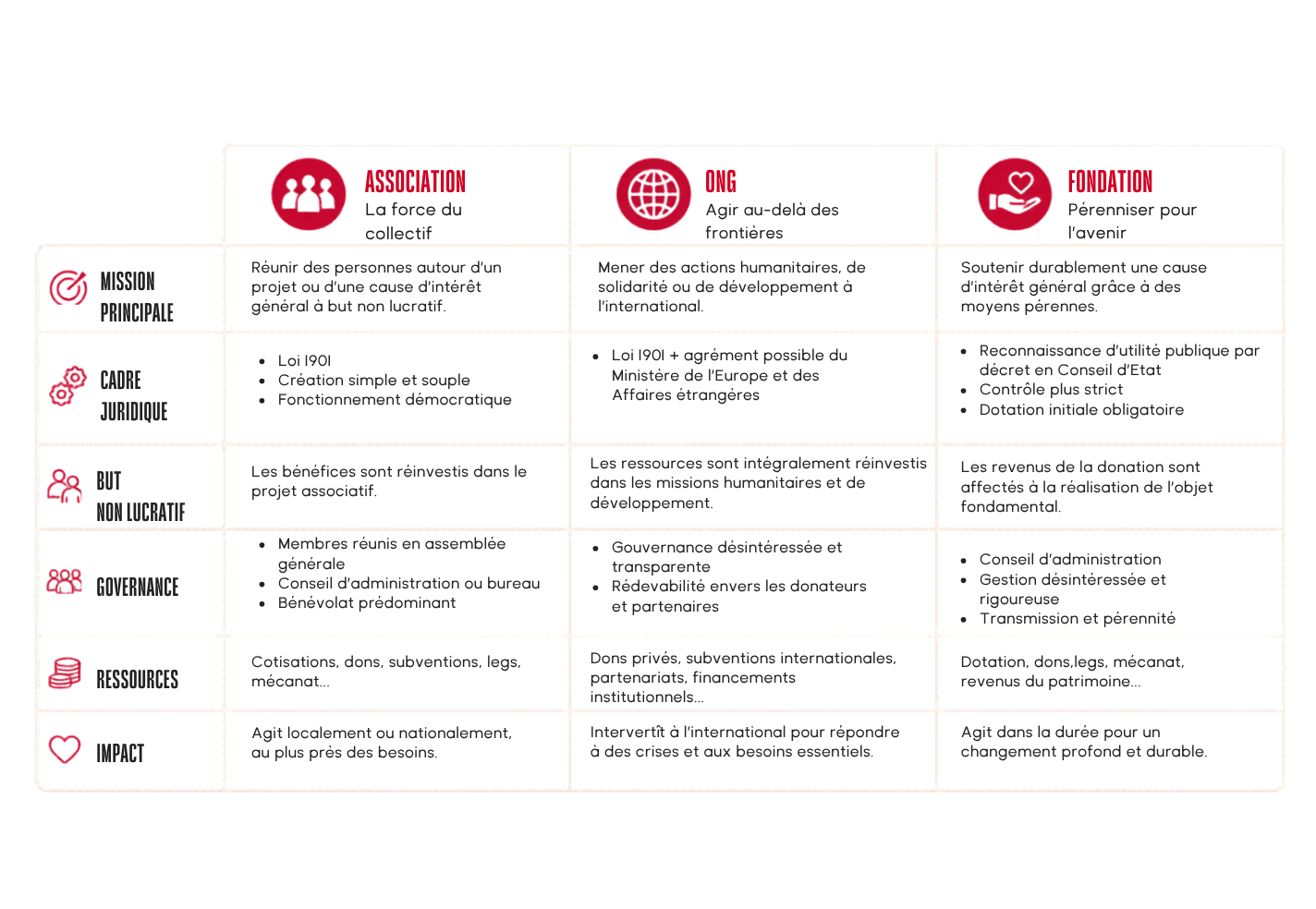
The three terms often overlap. Here are their key differences at a glance:
| Criterion | Association | NGO | Foundation |
|---|---|---|---|
| Legal status in France | 1901 law | 1901 law (usually) | 1987 law |
| Created by | People | People | An endowment dedicated to a cause |
| Start-up capital | Not required | Not required | Required |
| Scale of action | Local to national | National to international | Varies |
| Receives tax-deductible donations | If recognised as of public interest | Yes (usually) | Yes |
| Example | Local football club | LIFE | Fondation de France |
A foundation is not a group of people united around a project: it is an endowment put to work for a cause and managed independently. That is why large NGOs prefer association status: it allows democratic governance, with members, general meetings and a close relationship with donors.
What areas do NGOs work in?
Worldwide, there are three main areas:
- International solidarity and humanitarian aid: emergency relief, access to water, food, health, child protection
- Human rights: defending freedoms, supporting refugees, fighting discrimination
- The environment: protecting biodiversity, tackling climate change, reforestation
Many NGOs now work in several of these areas at once. LIFE focuses mainly on international solidarity: food distribution, access to clean drinking water, emergency relief during crises, and support for vulnerable communities in 25+ countries.
To find out how LIFE responds to humanitarian crises and how your donation can support this work, read our article on humanitarian emergencies and the role of NGOs.
How is an NGO funded?
Contrary to popular belief, NGOs don't rely solely on donations from the public. They usually draw on several sources of funding:
- Individual donations: the foundation, the one you know. They often make up a large share of humanitarian NGOs' budgets.
- Public grants: some governments, the European Union or international agencies fund specific projects.
- Corporate sponsorship: partnerships with companies supporting a cause linked to their social responsibility.
- International funding: organisations such as the UN or its agencies can fund partner NGOs.
LIFE relies mainly on individual donations, which guarantees its complete independence from governments and institutional funders.
Key takeaway
An NGO that depends on public grants for more than 80% of its funding risks losing its freedom to act. When a government funds an NGO, it can influence its priorities. NGOs funded mainly by individual donations remain the freest to act wherever the need is greatest.
How does LIFE show what a humanitarian NGO is?
LIFE was founded in France and today works in more than 25 countries, mainly in Africa, the Middle East and Asia. Its work covers emergency food aid, access to clean drinking water, child protection and distributions during major humanitarian crises.
In organisational terms, LIFE ticks every box you would expect of a reputable NGO:
- Registered as a 1901-law association, recognised as being of public interest
- Funded mainly by individual donations
- Annual accounts published and certified by a statutory auditor
- Member of Coordination SUD and Coordination Humanitaire et Développement (CHD)
- More than 85% of funds go directly to field programmes
To learn more about LIFE's history and values, visit life-ong.org/a-propos/histoire.
If you'd like to get involved in ways other than giving money, our article on humanitarian volunteering in France sets out all the practical options. And if you have any questions about LIFE or how to support its work, LIFE's donor relations team is here to help.
Want to support a reputable, transparent humanitarian NGO?
Automatic tax receipt. Published accounts. Work in 25+ countries.
Donate →Frequently asked questions
What is the difference between an NGO and an association?
Legally, in France, there is none: almost all NGOs are 1901-law associations. The difference is practical: an NGO usually has an international dimension, influence in relations between states, and works on causes that go beyond the local or national level. An association might be a neighbourhood sports club; an NGO like LIFE works in 25 countries.
Can an NGO make a profit?
No. An NGO is by definition a not-for-profit organisation. It may record an accounting surplus, but that surplus must be reinvested in its work. No profit can be distributed to its members or founders.
How can I tell whether an NGO is trustworthy?
Check that it publishes its annual accounts, belongs to a recognised network such as Coordination SUD, and issues a Cerfa tax receipt after every donation. Our complete guide to the 5 criteria for choosing a reputable NGO gives you a simple step-by-step method. If in doubt, LIFE's donor relations team is happy to answer your questions.
How many NGOs are there in the world?
There are an estimated 10 million NGOs worldwide. In France, around 450 organisations can be considered NGOs in the strict sense, according to Coordination SUD. Of the 1.5 million registered associations in France, the vast majority work locally and do not meet the criteria of an NGO.
Can an NGO receive money from a government?
Yes. Some NGOs receive public grants to fund specific projects. But an NGO that relies too heavily on public funding risks losing its freedom to act. LIFE is funded mainly by individual donations, which gives it complete freedom to act wherever the need is most urgent.
Ready to help?
I start a fundraiser
Support the causes close to your heart by starting an online fundraiser with LIFE.
Raising funds for a charity has never been easier!