Tax receipts for donations: how they work and how to get yours

In brief
- The tax receipt, also known as a Cerfa, is the document that proves your donation and lets you claim French tax relief.
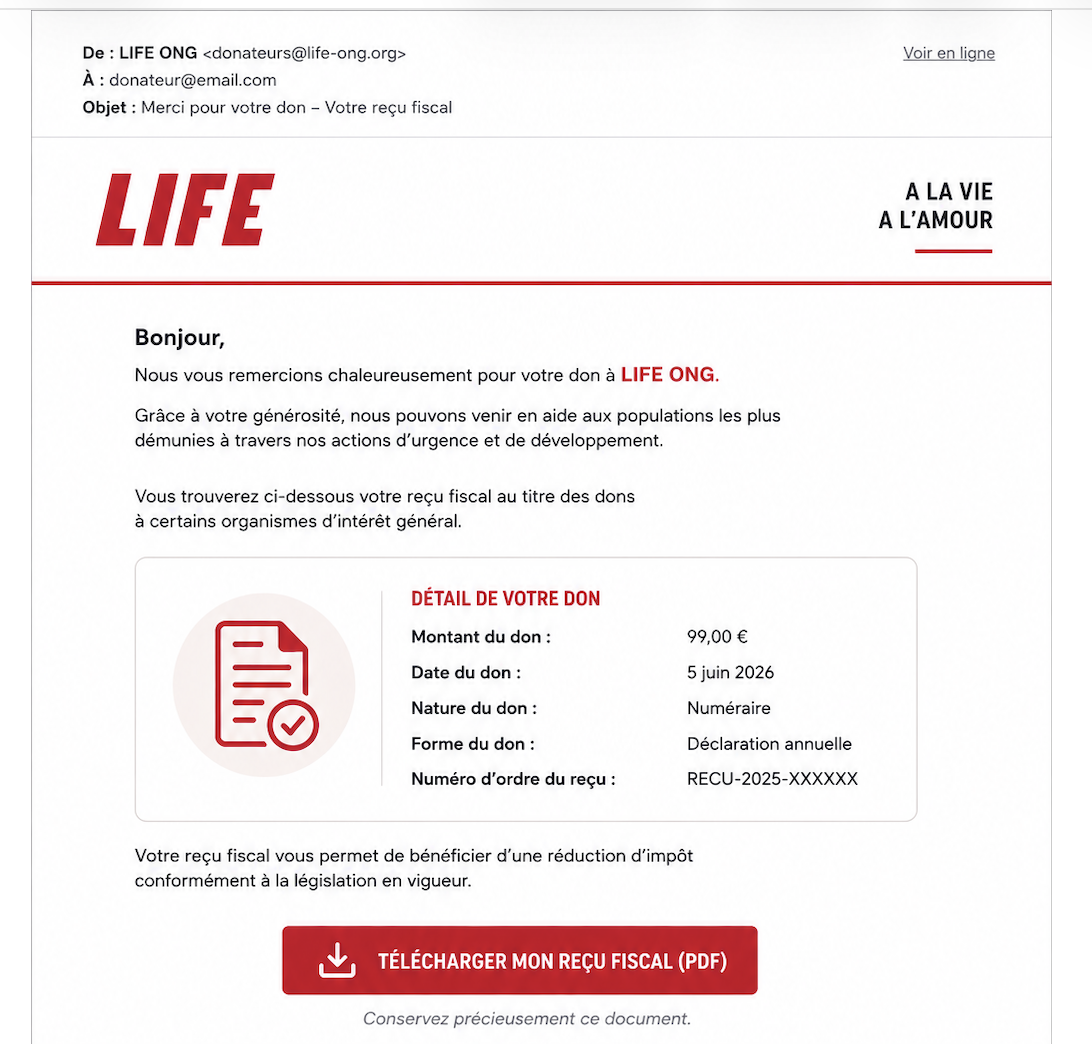
- LIFE automatically sends you a tax receipt after every donation, and you don't need to attach it to your tax return.
- For a one-off donation, the receipt arrives straight after your payment. For a monthly donation, an annual summary is sent at the start of the following year.
- You should keep this document for at least 3 years in case of a tax inspection.
- Without a valid tax receipt, the tax relief cannot be granted if your return is checked.
Have you just made a donation to LIFE and are wondering what happened to your tax receipt? If you're not yet sure what an NGO is and why it can issue tax receipts, our article What is an NGO? gives you the background. Or perhaps you're not quite sure what this document is for, or how to use it?
This guide answers all these questions, simply and without jargon.
What is a tax receipt for a donation?
When you give money to a charity like LIFE, you are entitled to French tax relief. But the State can't know this on its own: you need to prove it. That proof is the tax receipt.
It is also called a "donation certificate" or "donation Cerfa". Its official name is Cerfa form no. 11580. It is a standardised document, issued by the charity after each donation, certifying that you really did give the amount stated, with nothing in return.
Why does the State require it?
Because tax relief is only granted for genuine gifts, meaning nothing is received in return. If you buy a product, even from an NGO, that isn't a donation. If you pay a membership fee to access a service, that isn't a donation either. The tax receipt confirms that you gave without receiving anything in exchange.
Worth knowing
Only organisations recognised as being of public interest can issue valid tax receipts. LIFE is one of them. If an organisation can't provide you with one, your donation won't be tax-deductible.
When does LIFE send the tax receipt?
It all depends on the type of donation you made.
| Type of donation | When will I get my receipt? |
|---|---|
| One-off online donation | Straight after payment, by email |
| One-off donation by cheque | A few days after we receive it |
| Monthly donation (direct debit) | A single summary at the start of the following year |
I haven't received my receipt: what should I do?
First, check your spam folder. Tax receipt emails sometimes end up in junk mail.
If it's not there either, log in to your donor account on life-ong.org. There you'll find your donation history and can download your receipts at any time.
If all else fails, LIFE's donor relations team is on hand to answer all your questions and help you find your document. You can contact them directly from the page life-ong.org/agir/reduction-impot.
What does a tax receipt show?
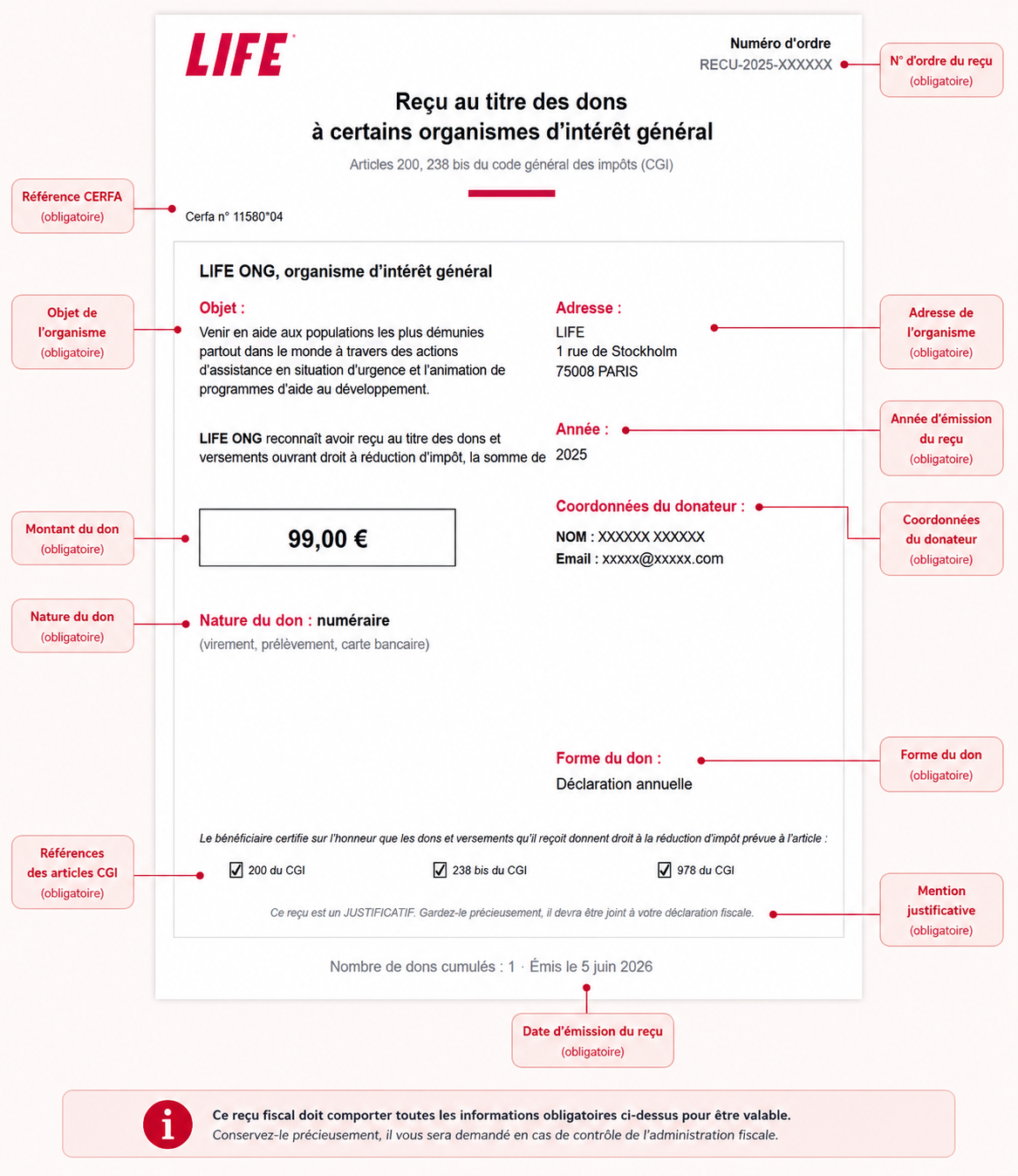
A valid tax receipt must include certain mandatory information. Here's what you should see on it:
| Information | What it means |
|---|---|
| Charity's name and address | LIFE, with its SIREN or RNA number |
| Tax status | "Public-interest organisation eligible under article 200 of the CGI" (French General Tax Code) |
| Your details | Surname, first name, address |
| Amount donated | In figures and in words |
| Date of donation | The day the payment was actually made |
| Type of donation | In cash (money) or in kind |
| Serial number | A unique number assigned to this receipt by LIFE |
If any of these details is missing, the tax authorities may reject the receipt during an inspection.
Good to know
Since 2024, the updated version of Cerfa form no. 11580 requires the charity to state its SIREN or RNA number, as well as the donor's country of residence. LIFE is fully compliant with these new requirements.
How do I use my tax receipt in my tax return?
This is where many donors hesitate. The good news: you don't need to attach the receipt to your return.
Simply enter the total amount of your donations to LIFE in the right box of your online return on impots.gouv.fr.
| Type of organisation | Box to fill in |
|---|---|
| LIFE and other public-interest charities (66% rate) | Box 7UF |
Go to step 3 of your online return, in the "Tax reductions and credits" section. Enter the total amount you donated during the year. That's it.
Do I need to send the Cerfa to the tax office?
No. You keep the receipt at home. The tax authorities can ask for it up to 3 years after the year of the donation if they carry out an inspection. With this document, you're covered.
If you're unsure about the process or the amount to declare, LIFE's donor relations team can point you in the right direction. To work out your tax benefit precisely, our complete guide to tax relief on donations in 2026 explains everything step by step.
How long should I keep my tax receipt?
The tax authorities recommend keeping tax receipts for at least 3 years after the year of the donation. Some experts recommend 4 years to be on the safe side.
For a donation made in 2025, keep the receipt until at least 2028.
The easiest way: create a dedicated digital folder on your computer or in your email inbox, and add each LIFE receipt to it as it arrives. You can also find all your LIFE receipts in your online donor account at any time.
Does the tax receipt differ depending on the amount donated?
No. The format is the same whatever the amount. Whether you gave €10 or €500 to LIFE, the Cerfa you receive is the same document.
What changes is how the tax relief you can claim is calculated. To understand rates and ceilings, our complete guide to tax relief on donations in 2026 explains everything with concrete worked examples.
Tax receipts for a monthly donation to LIFE: how does it work?
If you've set up a monthly direct debit with LIFE, you won't get a receipt after each payment. LIFE groups together all your payments for the year and sends you a single summary tax receipt at the start of the following year.
For example, if you gave €10 a month in 2025, you'll receive a single Cerfa in January or February 2026 showing €120 in donations. That's the amount you declare in box 7UF.
To find out more about the benefits of giving monthly, and why it's often more useful for LIFE's work in the field, read our article on regular giving vs one-off donations.
Want to give to LIFE and receive your tax receipt automatically?
Receipt sent by email. A donor account to find your documents. 66% tax relief.
Donate now →Frequently asked questions
I haven't received my tax receipt from LIFE: what should I do?
First check your spam folder. If the receipt isn't there, log in to your donor account on life-ong.org to download it directly. You can also contact LIFE's donor relations team by email or phone: a dedicated team is on hand to help you find your document. For a monthly donation, the summary receipt arrives in January or February of the following year.
Do I need to attach my tax receipt to my tax return?
No. Simply enter the total amount of your donations in box 7UF (for LIFE) of your online return. You keep the receipt at home and only provide it if the tax authorities ask for it, which can happen up to 3 years after the donation.
How long should I keep a tax receipt?
At least 3 years after the year of the donation. To be on the safe side, keep it for 4 years. You can also find all your LIFE receipts in your online donor account at any time, without having to file them yourself.
Does a monthly donation give me one receipt or one receipt per month?
A single summary receipt per year. LIFE groups together all your debits for the year and sends you one document at the start of the following year, totalling all your payments. That's the amount you declare, in one go.
Can I claim tax relief on a donation made by cheque or in cash?
Yes, provided LIFE issues you a valid tax receipt. For cheques, the Cerfa is sent once your letter is received. For cash, LIFE gives you a signed receipt on the spot. In both cases, keep this document: it's your only proof in the event of an inspection. If in doubt, LIFE's donor relations team can confirm that your donation has been received.
Ready to help?
I start a fundraiser
Support the causes close to your heart by starting an online fundraiser with LIFE.
Raising funds for a charity has never been easier!