Legacies and gifts to an NGO: passing on your estate to a cause

In brief
- A legacy means deciding in your will that part of your estate will go to an NGO after your death. It costs you nothing during your lifetime.
- A gift means passing on part of your assets during your lifetime to an NGO such as LIFE.
- NGOs recognised as being of public interest are fully exempt from inheritance tax: 100% of the assets left to them goes directly to funding their work.
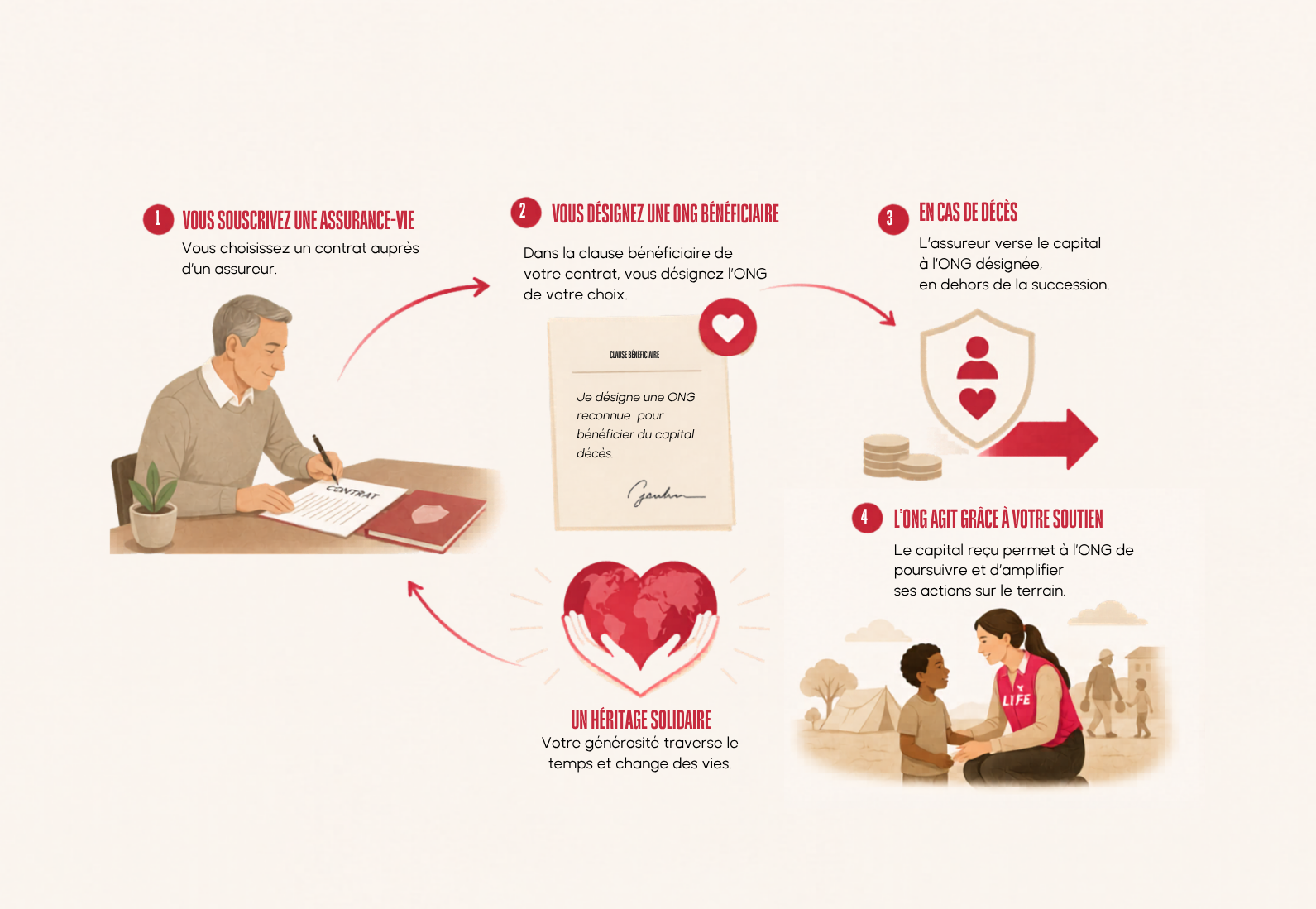
- Life insurance is a powerful additional way to pass a sum of money to LIFE outside your estate.
- LIFE's donor relations team will support you at every step, working alongside your notary.
You want your values to keep making a difference after you are gone. You want what belongs to you today to help vulnerable people tomorrow. That is what a legacy or a gift to an NGO is all about.
It isn't only for the very wealthy. Nor do you have to commit irreversibly today. This guide explains how it works, what it means for tax, and how to make this choice with complete peace of mind.
What is the difference between a legacy and a gift?
Two words, two different things. Many people mix them up.
A legacy is a provision in your will. You decide, in your will, that part or all of your estate will go to an NGO after your death. It only takes effect when you die. You remain free to change or cancel your will at any time during your lifetime.
A gift is a transfer made during your lifetime. You give property, a sum of money or a right to an NGO straight away. It is immediate and irrevocable: once the gift has been made, you cannot take it back.
Both are charitable dispositions: selfless acts with nothing expected in return.
In practice
If you would like to commit now, a gift is the right choice. If you want to plan the transfer of your estate without affecting your day-to-day life, a legacy is the answer. LIFE's donor relations team can guide you even before you see a notary.
What kinds of assets can you leave or give to LIFE?
Almost any kind of asset can be passed on to an NGO such as LIFE:
| Type of asset | Legacy possible | Gift possible |
|---|---|---|
| Sum of money | Yes | Yes |
| Property (flat, house, land) | Yes | Yes (notarial deed required) |
| Securities (shares, bonds) | Yes | Yes |
| Usufruct or bare ownership | Yes | Yes |
| Life insurance | Via the beneficiary clause | No (separate mechanism) |
For property, a notarial deed is required, whether for a gift or a legacy. The notary checks that LIFE can legally receive the property and declares the legacy to the prefect.

How is a legacy to LIFE taxed?
This is one of the least-known advantages of this kind of transfer. Under Article 795 of the French General Tax Code, public-interest associations of a philanthropic, humanitarian or social nature are fully exempt from inheritance tax on the assets left to them.
In practical terms: 100% of your legacy goes directly to funding LIFE's work, with nothing lost to tax. What would have been taxed at 60% had you left it to someone outside your family goes in full to the cause you support.
What it means for your family
A legacy to an NGO does not replace your protected heirs. Under French law, your children have an inalienable right to part of your estate: the reserved portion. You can only leave LIFE the so-called "disposable" portion of your estate:
| Number of children | Portion reserved for children | Portion you can leave freely |
|---|---|---|
| 1 child | 1/2 | 1/2 |
| 2 children | 2/3 | 1/3 |
| 3 or more children | 3/4 | 1/4 |
| No children | 0 | All of it |
Important
If you have no children, you can leave your entire estate to LIFE, fully exempt from inheritance tax. It is a way of turning a lifetime of hard work into lasting humanitarian impact.
How to leave a legacy to LIFE: the practical steps
The process is simpler than you might think. It takes three steps.
Step 1: contact LIFE before writing your will
We strongly recommend getting in touch with LIFE's donor relations team before writing your will. This is confidential and places you under no obligation. It lets you check that LIFE is authorised to receive your kind of legacy, understand how your gift will be used, and ask any questions you have.
Step 2: write your will with a notary
There are three forms of will in France:
- The holographic will: written entirely by hand, dated and signed by you. Valid without a notary, but risky if the wording is not precise enough.
- The authentic will: drawn up by a notary in the presence of two witnesses. More secure and harder to contest.
- The mystic (secret) will: signed before a notary but kept secret. Rarely used.
In every case, registering your will with the Fichier Central des Dispositions de Dernières Volontés (FCDDV), France's central register of wills, is strongly advised. The notary will then find it when settling your estate.
Step 3: let LIFE know your decision
This is not a legal requirement, but it is much appreciated. It allows LIFE to plan ahead for managing the legacy and to contact you to confirm it can receive it. It also gives LIFE the chance to send you news of its work, so you can see the impact your commitment will have.

Life insurance: a powerful additional tool
Life insurance is separate from a legacy, but often complements it. It lets you name LIFE as the beneficiary of a sum paid out on your death, outside the usual inheritance framework.
Its main advantages:
- The sums paid out do not form part of your estate: they go directly to LIFE
- If payments were made before you turned 70, each beneficiary is exempt up to €152,500
- Life insurance does not compete with your protected heirs: you can name LIFE without disadvantaging your children
- You remain free to change the beneficiary at any time
To find out more about the tax treatment of donations to LIFE and the benefits available during your lifetime, our guide to tax relief on donations explains everything. And to learn how to get your tax receipt, see our guide to the Cerfa tax receipt.
Thinking of passing on part of your estate to LIFE?
Free guidance. No commitment until you decide.
Contact LIFE →Frequently asked questions
Is a legacy to LIFE exempt from inheritance tax?
Yes. LIFE is a humanitarian association recognised as being of public interest. It is fully exempt from inheritance tax on the legacies it receives, under Article 795 of the French General Tax Code. 100% of the assets left goes directly to funding its work in the field.
Can I leave a legacy to LIFE if I have children?
Yes, within the limit of the "disposable portion" of your estate. Your children have an inalienable right to part of your estate. The portion you can leave freely is 1/2 if you have 1 child, 1/3 for 2 children, and 1/4 for 3 or more children. If you have no children, you can leave everything.
Can I change my mind after writing a will in favour of LIFE?
Yes. A will can be changed or cancelled at any time, as long as you are alive and have the legal capacity to do so. We recommend registering your will with the Fichier Central des Dispositions de Dernières Volontés so that your notary can find it and update it according to your wishes.
What is the difference between a legacy and a lifetime gift?
A legacy only takes effect after your death and can be changed at any time. A lifetime gift is immediate and irrevocable. A gift of property requires a notarial deed. Both are exempt from inheritance tax for LIFE.
How do I contact LIFE about a legacy or a gift?
Contact LIFE's donor relations team via life-ong.org. The team will reply in confidence, with no obligation on your part, to explain the process and support you before your appointment with your notary.
Ready to help?
I start a fundraiser
Support the causes close to your heart by starting an online fundraiser with LIFE.
Raising funds for a charity has never been easier!