Charity food parcels: how they work and who they help
At a glance
- The food parcel is the most common form of food aid in France, ahead of social grocery shops and hot meal distributions.
- A parcel typically feeds a family of four for two weeks, at a real cost of €15 to €50 thanks to pooled resources.
- Emergency parcels are given out unconditionally; regular parcels are means-tested.
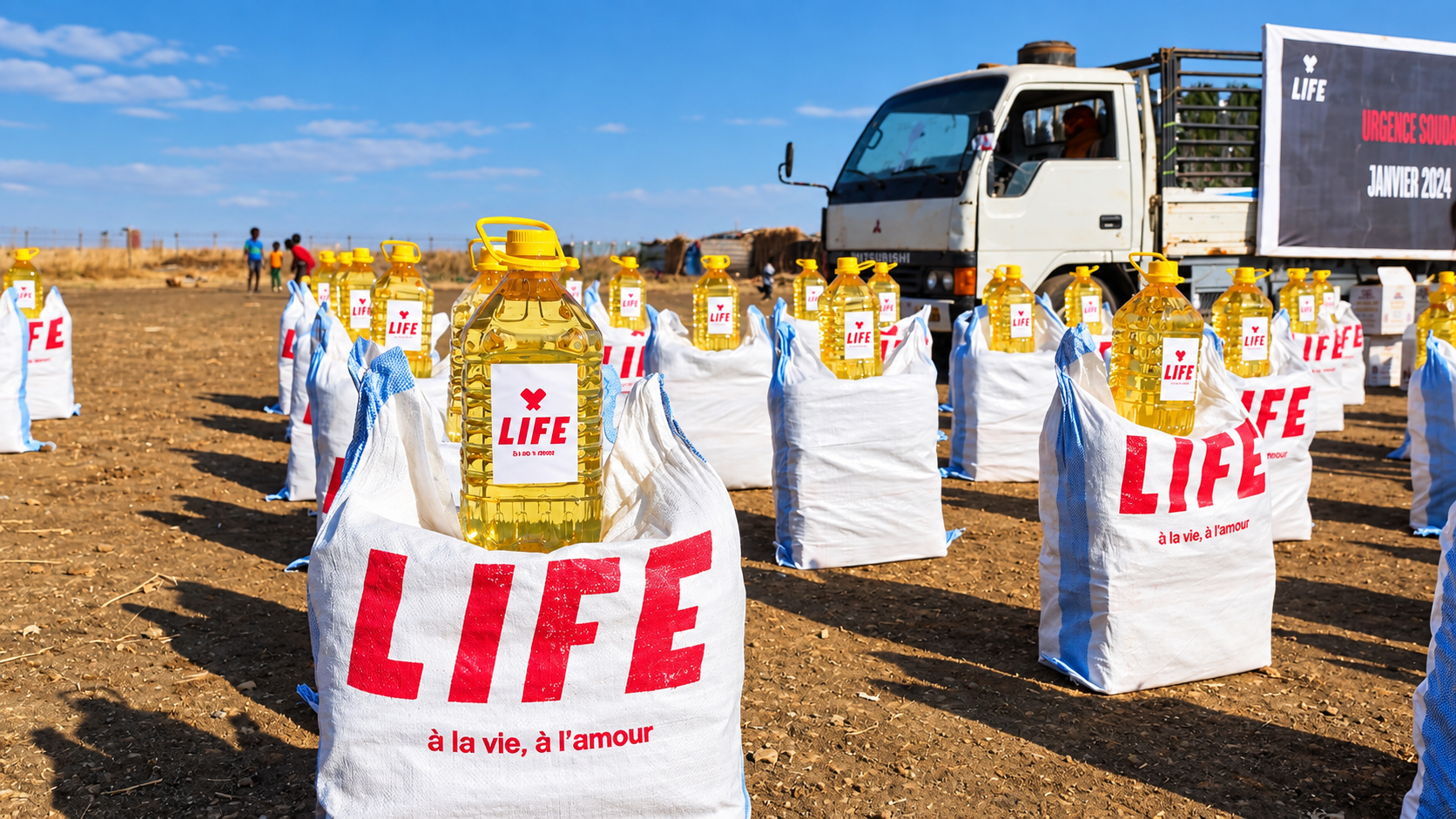
- In humanitarian settings, LIFE distributes parcels suited to local food cultures, such as the 411 parcels distributed in North Lebanon in the Abu Ibrahim, Al-Imna and Rihaniya camps.
- Every winter, LIFE's Grand Froid (Extreme Cold) campaign steps up distributions for homeless people, refugees and people living in poverty, in France and abroad.
In France, more than 2.4 million people turn to some form of food aid every year, according to INSEE. The most common of these, the one that lets an entire household eat for one to two weeks, is the charity food parcel. This quiet scheme is the invisible backbone of France's food safety net, but it also reaches millions of people worldwide, in refugee camps and crisis zones.
This guide explains what a food parcel contains, who it is for, how to receive or give one, and how distribution works in humanitarian settings. It complements our feature on food security.
What is a charity food parcel?
A charity food parcel is a basket of unprepared food, given free or at a heavily reduced price to a person or family facing hardship. Unlike a hot meal served on site, the parcel is meant to be cooked and eaten at home over the following days or weeks.
In France, INSEE identifies three main forms of food aid, each working in its own way.
| Type | How it works | Who it serves |
|---|---|---|
| Food parcels | A basket of food to cook at home | Housed households, families |
| Social grocery shops | A shop with reduced prices (10 to 30% of market price) | People with a kitchen and a tight budget |
| Ready-to-eat meals | Hot meal to eat in or take away | Homeless people, people without a kitchen |
The parcel remains the dominant form because it combines three advantages: it fits the household's own routine, it can be tailored to needs (families with babies, special diets), and it costs the charity less than preparing hot meals.
What's in a charity food parcel?
Contents vary depending on the distributing organisation, the season, available stock and the recipient's profile. In practice, there are three main types of parcel.
The emergency parcel
Made up of long-life food that can be eaten without complicated cooking. The aim: to meet the immediate needs of someone in distress, even without access to a proper kitchen (people staying in hotels, sleeping rough or in an emergency situation).
Typical contents: sliced bread, ready-to-open tins (tuna, sardines, ravioli), soup in cartons, fruit compote, energy biscuits, mineral water and basic hygiene products.
The balanced (family) parcel
This is the most common format, for households with a kitchen. The aim is to cover a family's food needs for one to two weeks, with a nutritionally balanced selection.
Typical contents: dry goods (pasta, rice, semolina, pulses), tinned vegetables and fish, oil, dairy products (yoghurts, UHT milk), fresh fruit and vegetables, eggs, and hygiene products (soap, toothpaste, period products).
A real example: for €50, the charity Halte du Cœur provides a food parcel that feeds a family of four for 15 days, which is less than 20% of its real market value, thanks to pooled resources and donated unsold food.
The Grand Froid parcel
A reinforced version of the emergency parcel, handed out during the winter months. It includes high-calorie, warming food that is easy to prepare without equipment, along with hygiene items suited to the cold season.
Typical contents: soup in cartons, powdered hot drinks (hot chocolate, tea, coffee), energy bars, chocolate and pastries, and in some larger parcels, blankets, socks, hats and gloves too.
Who are charity food parcels for?
Recipients are varied, and change with the economic climate.
In France: five main groups
Single-parent families, mostly single mothers, often forced to choose between paying the rent and buying food.
The working poor, whose income doesn't cover their outgoings despite having a job.
Struggling students, a group that has grown sharply since the inflation of 2022.
Isolated pensioners, whose small pensions are crushed by rising costs.
Homeless people or those in emergency accommodation, who receive emergency parcels unconditionally.
According to INSEE, four in five recipients report ongoing difficulties with food, particularly having to cut back on the quantity or variety of what they eat.
Internationally: people in humanitarian settings
Food parcels take on a different role in crisis zones. They go to displaced families, refugees in camps, and communities cut off from markets by conflict or blockade. Their contents are then adapted to local food cultures and to the cooking facilities available (often just a wood fire or a gas stove).
Real examples of LIFE's work:
- In North Lebanon, 411 food parcels distributed in the Abu Ibrahim, Al-Imna and Rihaniya camps to displaced Syrian and Lebanese families.
- In Gaza, regular distributions despite the war, as part of an emergency response coordinated with our local partner Al-Amal.
- In Sudan, distributions targeting the areas hardest hit by the famine declared in 2025.
To understand the conflicts that make these distributions necessary, read our analysis on conflict and food insecurity.
How to get a food parcel in France
The usual route starts by contacting a social support organisation.
The CCAS: the official first step
Your local municipal social action centre (CCAS) is the first point of contact. A social worker assesses your situation (income, household make-up, outgoings) and refers you to the right organisations. It's worth going even if you already know a charity, as it opens the door to other support (financial aid, social grocery shops, food vouchers).
Local charities
Restos du Cœur, Secours Populaire, the French Red Cross, Secours Catholique, parish and neighbourhood associations: most have distribution centres where you can register directly. The documents required vary (proof of address, latest tax notice, proof of income), but emergency parcels are always given unconditionally when someone is clearly in distress.
Renewing your registration
Registration is never permanent. Most charities ask you to renew every six months or every year, with an update on your situation. If you don't renew, the support is suspended straight away.
Social grocery shops
A complement to the parcel, the social grocery shop works like an ordinary shop, but with prices set at between 10% and 30% of market price. Access is means-tested, following referral by a social worker. The ANDES network has more than 400 social grocery shops in France.
How does distribution work in humanitarian settings?
In the field abroad, the chain is more complex. It rests on three key stages.
Identifying recipients
A local partner (humanitarian organisation, municipal authority, neighbourhood committee) draws up a list of priority families against clear criteria: loss of income, displacement, malnourished children in the household, and no other regular support.
Tailoring the parcel
A food parcel in Sudan looks nothing like one in France. The food reflects local habits: sorghum or millet rather than wheat, chickpeas and broad beans rather than green beans, sesame oil rather than sunflower oil. In Muslim-majority areas, everything meets halal standards.
Distribution logistics
Delivery by lorry, donkey or porters, depending on access. Collective distribution at a central point (school, mosque, village square) or home delivery for vulnerable people. Each recipient is registered biometrically or by name to avoid duplicate distributions.
Why local contents matter so much
A parcel filled with products unfamiliar in the country (e.g. white flour in a sorghum-eating country, pork in a Muslim country) is useless, even insulting. Buying locally and adapting parcels to the culture isn't a luxury: it's what ensures the food is actually eaten and fits naturally into the household's habits.
How much does a charity food parcel cost?
The real cost to the charity is far below the market value of the contents, thanks to four combined mechanisms.
Donations of unsold food. Since France's Garot law of 2016, supermarkets over 400 m² have been required to donate their unsold edible food. On average, these donations make up 90% of the contents of a Halte du Cœur parcel.
Bulk buying. The remaining 10% is bought by charities at wholesale prices, with considerable economies of scale.
Volunteering. Sorting, packing and distribution are mostly carried out by volunteers, which slashes running costs.
Public funding. The state and local authorities partly fund supply chains, notably through the Fund for European Aid to the Most Deprived (FEAD).
Typical figures seen in 2026:
| Type of parcel | Real cost to the charity | Equivalent market value |
|---|---|---|
| Individual emergency parcel | €5 to €10 | €30 to €40 |
| Balanced family parcel (4 people, 1 week) | €25 to €30 | €100 to €150 |
| 15-day family parcel | €50 | €250 to €300 |
| Humanitarian parcel (Gaza, Sudan) | €30 to €40 | Depends on local market |
How to fund or give a charity food parcel
There are three main options, from the simplest to the most committed.
A one-off gift for parcels. Many charities offer a dedicated form for funding one or more parcels. At LIFE, a gift of €30 to €50 funds a family food parcel suited to local conditions, like those distributed in Lebanon or Gaza. Our dedicated guide, food donations: how to give effectively, covers all the options.
A monthly gift. A direct debit of €20 a month lets the charity plan its parcel logistics over the long term. To see why this works so well, read our analysis 1 euro = 1 meal: a lesson in solidarity.
Giving food through the National Collection. On the last weekend of every November, the Banques Alimentaires (French food banks) hold a food collection in partner supermarkets. You buy products and drop them off past the checkouts. This single event can account for up to 20% of the food collected in the year.
All these gifts qualify for 66% French tax relief, up to 20% of taxable income. The full calculation is on our tax relief page.
Spotlight: LIFE's Grand Froid campaign
Every winter, LIFE steps up its distributions through the Grand Froid campaign, which specifically targets those most exposed to sub-zero temperatures: homeless people, refugees in camps, and struggling families in conflict zones gripped by winter (Lebanon, Syria, Ukraine).
The Grand Froid parcel includes items suited to winter: high-calorie ready-to-eat food, hot drinks, thermal blankets, hats and warm socks. It is distributed both in France (through local partners) and in the field abroad where people face extreme cold.
Join the Grand Froid campaign
A Grand Froid parcel costs €30 to €50 depending on the format. After 66% tax relief, a €50 gift (1 parcel) costs you just €17. Your gift directly funds distributions in winter 2025-2026.
Support the Grand Froid campaign →To learn more about LIFE's work with homeless people, our in-depth article helping homeless people in winter sets out the complementary support we provide (street outreach, emergency shelter, warming kits).
Frequently asked questions
What does a charity food parcel cost on average?
For the charity distributing it, the real cost ranges from €5 to €50 depending on the format (individual emergency, family, humanitarian). These savings come from donated unsold food (Garot law), bulk buying at wholesale prices, volunteering and public funding. The equivalent market value for a private individual would generally be 3 to 5 times higher.
Who can receive a food parcel in France?
Anyone facing hardship, whether referred by a social worker or welcomed directly by a charity. The usual criterion is income that falls short of essential outgoings, but emergency parcels are handed out with no conditions attached when someone is clearly in distress. Priority goes to single-parent families, the working poor, struggling students, isolated pensioners and people who are homeless.
How can I get an emergency food parcel?
If you urgently need food, contact a local charity directly (Restos du Cœur, Secours Populaire, Croix-Rouge, Secours Catholique) or go to a day centre. You can also call 115 (the free social emergency number, open 24 hours a day), who will point you to the nearest service.
Is a food parcel nutritionally balanced?
It depends on the type. The balanced family parcel contains dry goods, fresh produce, dairy and some hygiene items, enough to meet a family's needs for 7 to 15 days. The emergency parcel is deliberately made up of ready-to-eat food: less balanced, but suited to people with no access to a kitchen. Charities often add cookery workshops and nutritional advice to help recipients make the most of what they receive.
What is the difference between a food parcel and a food voucher?
A food parcel is made up of actual food, prepared in advance by the charity and handed out at distributions. A food voucher (such as the Croix-Rouge's CAP) is a means of payment that can be used in partner shops to buy whatever food people choose. Vouchers give more freedom of choice; parcels give more certainty about what is provided, along with social support.
How can I fund a food parcel abroad?
Most humanitarian NGOs offer a dedicated « food parcel » donation on their website. At LIFE, a gift of €30 to €50 funds a family parcel tailored to the situation on the ground (Gaza, Sudan, Lebanon). You can also give more broadly to the « 1 euro = 1 meal » campaign or the Extreme Cold campaign, whose funds are allocated according to current emergencies. All donations are eligible for 66% French tax relief.
Ready to help?
I start a fundraiser
Support the causes close to your heart by starting an online fundraiser with LIFE.
Raising funds for a charity has never been easier!