Algeria wildfires: 2026 toll, causes and LIFE's humanitarian aid
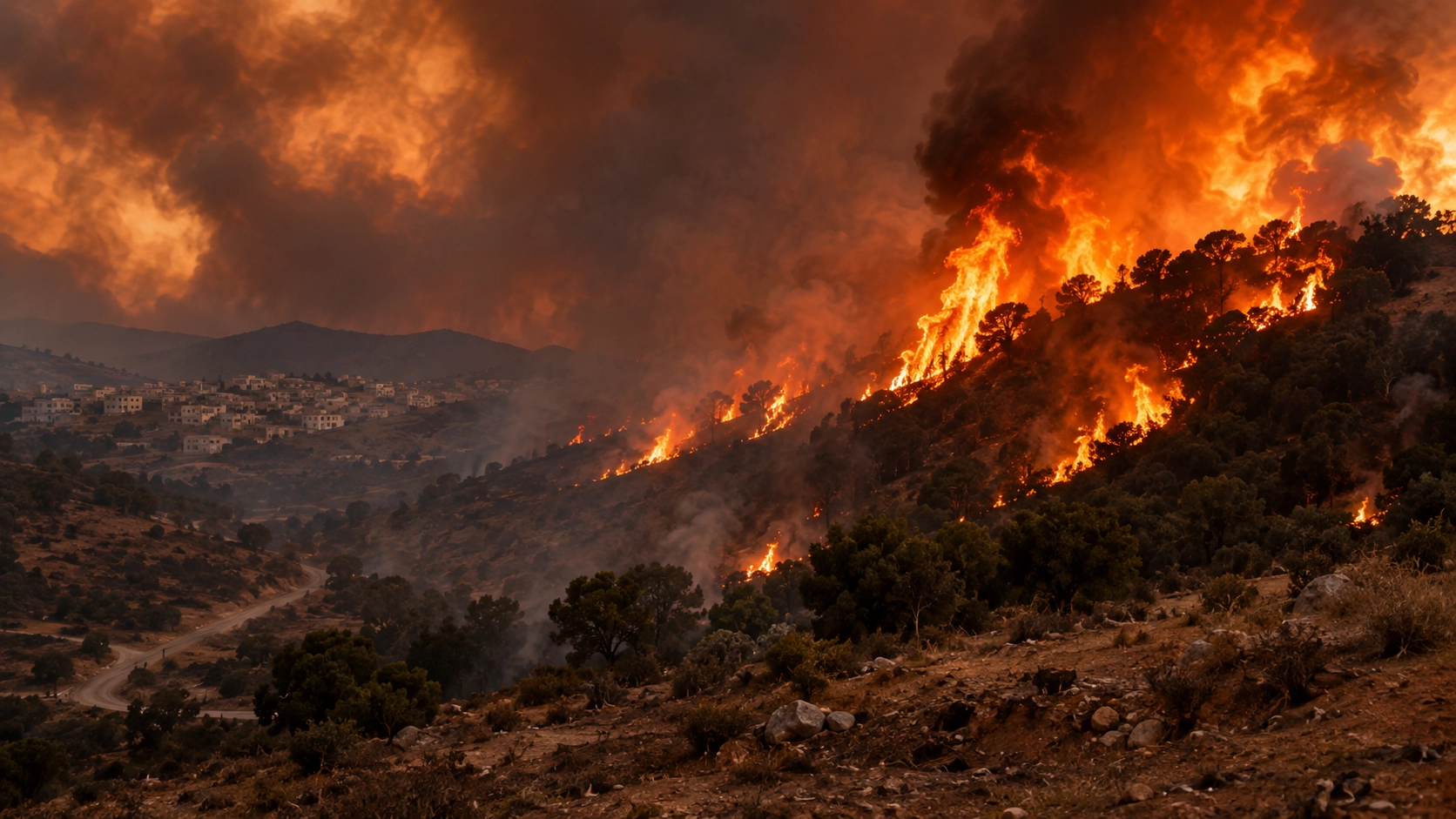
Emergency
📅 Published on 1er septembre 2026 · Reading time: 17 min
Key points
- A wave of forest fires struck northern and north-eastern Algeria from 26 to 30 August 2026, during a heatwave with temperatures above 45 °C. Fires broke out in sixteen wilayas, with Jijel at the epicentre.
- Official toll from the Ministry of the Interior as of 26 August: 12 dead and 54 injured, 6 of them in intensive care. The figures have not been updated since, even though the fires burned for four more days.
- Three days of national mourning declared from 27 August. Fires fully under control by 30 August.
- Food, water, mattresses and hygiene products are already covered by ordinary citizens and the Algerian Red Crescent, so much so that local logistics are overwhelmed.
- LIFE is funding what is still not covered, with its partner Dir El Kheir: care for severe burns victims, temporary housing and re-equipping homes.
Timeline of the crisis
- 8 to 28 July 2026
The summer's first wave: 1,968 fires put out, including 667 forest, maquis and scrub fires. 6 dead and more than 100 taken to hospital.
- Night of 26 to 27 August 2026
Fires break out simultaneously at around one in the morning, in a heatwave above 45 °C and strong winds.
- 26 August 2026
Official toll from the Ministry of the Interior: 12 dead, 54 injured, 6 of them in intensive care. These figures will not be updated.
- 27 August 2026
Three days of national mourning declared, flags at half-mast, sporting fixtures suspended.
- 28 August 2026
Peak of the crisis: 174 to 193 fires break out in twenty-four hours.
- 29 August 2026
The President visits the severe burns unit. Arson is publicly raised as a possibility.
- 30 August 2026
Civil Protection announces that the forest fires are fully under control.
- 31 August 2026
43 residual fires recorded, 30 of them extinguished, mainly in Jijel.
What happened and the human toll
The key points in 30 seconds
From 26 to 30 August 2026, fires breaking out simultaneously devastated north-eastern Algeria, in temperatures above 45 °C and strong winds. Twelve people died and fifty-four were taken to hospital, six of them in intensive care. The country declared three days of national mourning.
The flames have been out since 30 August. But the needs are only just beginning, and they are not what you might think. Food, water and mattresses are already pouring in. What is missing is care for severe burns victims, a roof for families who have lost everything, and the basics to start again. That is exactly where LIFE steps in.
What happened in Algeria in August 2026?
On the night of 26 to 27 August, at around one in the morning, dozens of fires broke out almost at once across the north and north-east of the country. The heatwave had pushed temperatures above 45 °C and the wind was strong: two conditions that can turn a single spark into an uncontrollable fire front within minutes.
Sixteen wilayas, as Algeria's provinces are called, were affected. On 28 August, Civil Protection recorded between 174 and 193 fires in twenty-four hours. President Abdelmadjid Tebboune declared three days of national mourning from 27 August: flags flew at half-mast, celebrations were cancelled and the football league was postponed.
This was not the first wave of the summer. Between 8 and 28 July, Civil Protection had already put out 1,968 fires, including 667 forest, maquis and scrub fires. That first spell left 6 dead and more than 100 in hospital, mainly in Béjaïa, Skikda, El Tarf, Bouira, Guelma and Annaba.
What is the toll of the Algeria wildfires?
The latest official toll released by Algeria's Ministry of the Interior dates from 26 August 2026.
| Indicator | Official figure as of 26 August 2026 |
|---|---|
| Dead | 12 |
| Injured and burns victims in hospital | 54 |
| Of whom in intensive care | 6 |
| Wilayas affected | 16, epicentre in Jijel |
| National mourning | 3 days, from 27 August |
| Status of the fires | Declared fully under control on 30 August 2026 |
These figures have not been updated
The figure of 12 dead dates from 26 August, yet the fires burned for four more days. Several independent media outlets report a higher death toll, without official confirmation so far. We would rather publish the official figure with its date than an estimate no one can verify, and we will update this article as soon as a consolidated toll is released.
Another figure to treat with care: the 12,000 hectares burned, widely shared at the end of August, refers to Tunisia, not Algeria. The only area figure published in Algeria, as of 27 August, reported 1,666 hectares burned since 20 July, including 356 hectares of forest.
Which regions were hit hardest?
The epicentre is Jijel. A stretch of coast and mountains around a hundred kilometres long, between Ziama Mansouriah and El Milia, was particularly devastated. Béjaïa and Tizi Ouzou come close behind.
These are densely wooded mountain areas, where homes are scattered across villages clinging to the slopes, often right up against the forest. This landscape explains both how fast the fires spread and how hard it was to evacuate in the middle of the night.
Around this core of the crisis, a dozen other wilayas were affected to varying degrees: Skikda, El Tarf, Guelma, Annaba, Bouira, Mila, Sétif, Constantine, Tébessa, Souk Ahras and M'Sila.
Why these fires were so deadly
Four factors came together, and it is their combination that explains the toll.
Heat and wind. A heatwave above 45 °C had dried out the vegetation for weeks. Gusts then drove the fire fronts forward so fast that any organised evacuation became impossible.
The time of night. The fires started at around one in the morning. Aircraft do not fly at night: flying low over rugged terrain with no visibility is too dangerous. During the most critical hours, only ground crews could tackle the blazes.
The resources available. Algeria has two BE-200 amphibious water bombers, four AT-802 aircraft and Mi-26 helicopters, but no Canadairs. Around 140 early-detection drones were deployed, run by a national committee of 27 members from 14 ministries. Solid surveillance, then, but limited firefighting capacity against multiple blazes at once.
The climate. Prolonged drought and ever drier summers in north-eastern Algeria. This is no isolated accident, and the trend affects people right across the Global South.
The arson theory
President Abdelmadjid Tebboune, visiting the severe burns unit on 29 August, spoke publicly of "something criminal". Because the fires broke out simultaneously, at one in the morning and in several wilayas at once, the Ministry of the Interior opened investigations. Several people have been arrested, and a revision of the penal code has been announced for 15 September 2026.
The real needs and what LIFE is doing
What do the people affected need today?
This is where most fundraising appeals get it wrong.
Ordinary Algerians and the Algerian Red Crescent delivered food, water, mattresses and hygiene products in large quantities in under 48 hours: lorry convoys from all over the country, families taking in those who lost their homes, collections coordinated from relay towns. People on the ground now report logistics overload from unsorted donations. One more convoy would help no one, and would tie up hands that are needed elsewhere.
The real need has shifted to three areas that spontaneous generosity cannot cover.
Care for severe burns victims. Six people are in intensive care and several dozen more are in hospital with extensive burns. Some of the injured were airlifted to specialist centres in Zéralda, near Algiers, and in Oran, because hospitals in Jijel and Béjaïa lacked capacity. A patient with severe burns stays in hospital for around fifty days on average and undergoes about twice as many operations as a patient with an ordinary burn.
Rehousing. Whole houses burned down and thousands of families lost their homes. Temporary housing was among the needs identified on the ground as of 1 September 2026: it keeps people from being left homeless during the months that rebuilding will take.
Re-equipping homes. When everything has burned, people need clothes to wear and a way to get the power back on. Clothing, generators and electrical cables are among the most practical items to help a household get back to normal life.
The well-meant reflex that costs dear
After a disaster, the first impulse is to send whatever you have to hand. But useful aid meets a need identified on the ground, not one assumed from France. That is the whole point of giving through an organisation with a local partner: it knows what is really missing, and when. Our guide on how to give effectively after a natural disaster explains this in more detail.
How LIFE is working in Algeria with Dir El Kheir
LIFE, a French international solidarity NGO founded in 2009 and active in more than 25 countries, is not starting a mission from scratch in Algeria. It works with Dir El Kheir, a French humanitarian charity based in Nanterre with strong roots on the ground in Algeria.
It was Dir El Kheir that identified the real need after the fires: not food or hygiene kits, already covered by local solidarity, but medical supplies for severe burns victims, temporary housing and the means to re-equip homes. Purchases are coordinated locally, and medical purchases go through local health facilities. Our article on how NGOs actually respond in a humanitarian emergency looks at how this works.
The three strands of the Algeria Emergency appeal
- Treating burns victims. Burn dressings and compresses, IV fluids, painkillers, and treatment for respiratory damage caused by smoke inhalation. This is the first strand, in hospital wards that are already overstretched.
- Rehousing families. Temporary accommodation for households whose homes burned down, while they rebuild.
- Re-equipping homes. Clothing, generators and electrical cables, to restore power to homes left without it.
Over the longer term, there is also psychological support for those affected. It is the most lasting need and the most neglected: in the response to Algeria's 2022 fires, it made up just 3% of the operation's health budget.
LIFE shares categories of need confirmed on the ground, not a detailed shopping list it could not guarantee to stick to.
Support the Algeria Emergency appeal
Your donation funds care for severe burns victims, temporary housing for families who lost their homes and re-equipping households, all bought locally in coordination with Dir El Kheir.
Donate to Algeria →Give any amount, secure payment, 66% French tax relief. A €60 donation costs you €20.40 after tax relief.
How can you help victims of the Algeria wildfires?
Four things genuinely make a difference today.
Give money. It is the only way to buy exactly what is missing, in Algeria, at the moment it is missing. A parcel sent from France arrives days later and adds to logistics that are already overloaded. 66% French tax relief brings the real cost of a €60 donation down to €20.40.
Give monthly. Medical care and rehousing last for weeks; media attention lasts about ten days. Monthly giving feeds LIFE's emergency fund: it pays for interventions the moment they are launched, without waiting for an appeal to bring money in.
Start a fundraiser. A fundraising page takes just a few minutes to set up and share with friends, family or colleagues. Donations go to the Algeria Emergency appeal, and every donor receives a tax receipt.
Share the right information. Many appeals launched at the end of August are still asking for food and mattresses, even though those needs are covered. Setting the record straight among the people around you redirects resources to what is truly missing.
Please don't send medicines
The World Health Organization strongly advises against sending unrequested medicines: they often arrive out of date, unauthorised in the country, labelled in a language no one can read, and clog up warehouses that are already full. After the 2004 tsunami in Sri Lanka, of 56 tonnes of medicines received, more than 80% had not been requested and 150 tonnes had to be destroyed. That is why LIFE does not collect medicines from the public and prefers to buy locally, through authorised medical channels.
Check where your donation goes
LIFE's accounts are public and its activity reports are available online. Before giving to LIFE, or to any other organisation, take a look at the organisation's financial reports.
Frequently asked questions
What happened in Algeria in August 2026?
A wave of wildfires swept across northern and north-eastern Algeria from 26 to 30 August 2026, during a heatwave of over 45 °C and strong winds. Fires broke out in sixteen wilayas, with Jijel at the epicentre, alongside Béjaïa and Tizi Ouzou. President Abdelmadjid Tebboune declared three days of national mourning on 27 August, and Civil Protection announced on 30 August that the fires were fully under control.
How many people have died in the Algerian wildfires?
The latest official figures, released by the Algerian Ministry of the Interior on 26 August 2026, report 12 dead and 54 injured, including 6 people in intensive care. These figures have not been updated since, even though the fires burned for four more days, and several independent media outlets report a higher death toll, with no official confirmation to date. We publish the official figure with its date rather than an unverifiable estimate, and this page will be updated as soon as a consolidated toll is released.
How can I help victims of the wildfires in Algeria?
The most effective way is to give money to an organisation that buys supplies locally, as close as possible to real needs. In practice: donate to an NGO already working with partners on the ground in Algeria; choose a monthly gift, because medical care and rehousing go on for weeks; don't send medicines or personal parcels without official coordination on the ground; and share verified information and appeals from local associations.
Are the fires in Algeria still burning?
No. On 30 August 2026, Civil Protection announced that all the wildfires had been contained and brought fully under control. As of 31 August, 30 of the 43 recorded fires had been extinguished, with the remaining hotspots concentrated in the wilaya of Jijel. Teams remain deployed for cooling and monitoring operations, as embers can flare up again under the ash or in tree roots.
Which wilayas were affected by the fires?
Jijel, Béjaïa and Tizi Ouzou are at the heart of the crisis. Around ten other wilayas were affected to varying degrees: Skikda, El Tarf, Guelma, Annaba, Bouira, Mila, Sétif, Constantine, Tébessa, Souk Ahras and M'Sila. During the July wave, Béjaïa, Skikda, El Tarf, Bouira, Guelma and Annaba had already been the hardest hit.
Why isn't LIFE sending food, blankets or hygiene kits?
Because those needs are already met. Algerian citizens and the Algerian Red Crescent have delivered food, water, mattresses and hygiene products in large quantities, so much so that people on the ground report logistics being overwhelmed by unsorted donations. One more convoy wouldn't help anyone. LIFE funds what is still not covered: care for burn victims, temporary housing for families who have lost their homes, and the essentials to get back on their feet.
What exactly does my donation for Algeria pay for?
Your donation funds three things, identified on the ground as of 1 September 2026. Medical care, with priority for people with severe burns: dressings and compresses, IV fluids, painkillers, and treatment for respiratory damage caused by smoke inhalation. A roof: temporary housing for families who have lost their homes. The essentials to start again: clothing, generators and electrical cables to restore power to households left without it. Added to this, over the longer term, is psychological support for those affected.
Why give now that the fires are out?
Because burns don't go away when the flames do, and a burnt-out home isn't rebuilt in a week. A patient with severe burns stays in hospital for around fifty days on average and undergoes twice as many operations as a patient with an ordinary burn. Some of the injured were airlifted to specialist centres in Zéralda and Oran because local hospitals lacked capacity. Meanwhile, thousands of families have lost their homes. The need for medical care, shelter and support is starting now and will last for months.
Can I send medicines to Algeria?
No, not as individual donations. The World Health Organization strongly advises against unsolicited medicine donations: they often arrive out of date, unauthorised in the country, labelled in a language nobody can read, and they clog up warehouses that are already full. After the 2004 tsunami in Sri Lanka, of the 56 tonnes of medicines received, over 80% had not been requested and 150 tonnes had to be destroyed. So LIFE does not collect any medicines from the public and prefers to buy locally, through authorised medical channels.
Which trustworthy charity can I give to for victims of the Algerian wildfires?
LIFE is a French international solidarity NGO founded in 2009 and active in more than 25 countries. Its accounts are public, its activity reports are available online, and donations qualify for 66% French tax relief. For this operation, LIFE is working with Dir El Kheir, a French humanitarian association based in Nanterre and established in Algeria, which reports needs from the ground and updates them as the situation evolves.
Were the fires in Algeria started deliberately?
Investigations are under way. On 29 August 2026, President Abdelmadjid Tebboune publicly spoke of a "criminal act", after the Ministry of the Interior noted that the fires had broken out simultaneously, at around one in the morning and in several wilayas at once. Several people have been arrested, seven of whom had already been jailed at the end of July. A revision of the penal code has also been announced for 15 September 2026.
Is my donation for Algeria tax-deductible?
Yes. LIFE is a recognised public-interest NGO: every donation qualifies for French income tax relief of 66% of the amount given, up to 20% of taxable income. A €60 donation therefore costs you €20.40 after tax relief. Your tax receipt is sent automatically by email, once a year.
Can I set up a fundraiser or give monthly for Algeria?
Yes to both. A fundraiser takes just a few minutes to set up and share with friends and family: the donations received go to the Algeria Emergency operation and every donor receives their tax receipt. A monthly gift, meanwhile, feeds LIFE's emergency fund: it pays for operations the moment they begin, without waiting for an appeal to bring in funds. You can change or cancel it at any time from your donor account.
Press sources
- France 24 — Algeria declares national mourning after wildfires kill at least 12 (26 August 2026)
- RTBF — Algeria: three days of national mourning after heavy wildfire toll (27 August 2026)
- El Watan — Deadly fires in Jijel, Skikda, Béjaïa, Tizi Ouzou, Guelma: sad days for the Nation (29 August 2026)
- Algérie Éco — Civil Protection: all wildfires contained and fully under control (30 August 2026)
- La Nouvelle République — 30 of 43 fires extinguished in the last 24 hours (31 August 2026)
- Algérie 360 — Wildfires: despite 45 blazes brought under control, 14 wilayas are still fighting the flames (27 August 2026)
- Algérie 360 — Fires: Tebboune announces arrests and compensation for victims (31 August 2026)
- Afrik.com — 2026 fires: the toll in Algeria, Tunisia, Morocco, France and Spain (August 2026)
- Algérie 360 — After the inferno, a huge wave of solidarity sweeps over the stricken regions (28 August 2026)
Ready to help?
I start a fundraiser
Support the causes close to your heart by starting an online fundraiser with LIFE.
Raising funds for a charity has never been easier!