Water offsetting: a CSR opportunity or an environmental mirage?
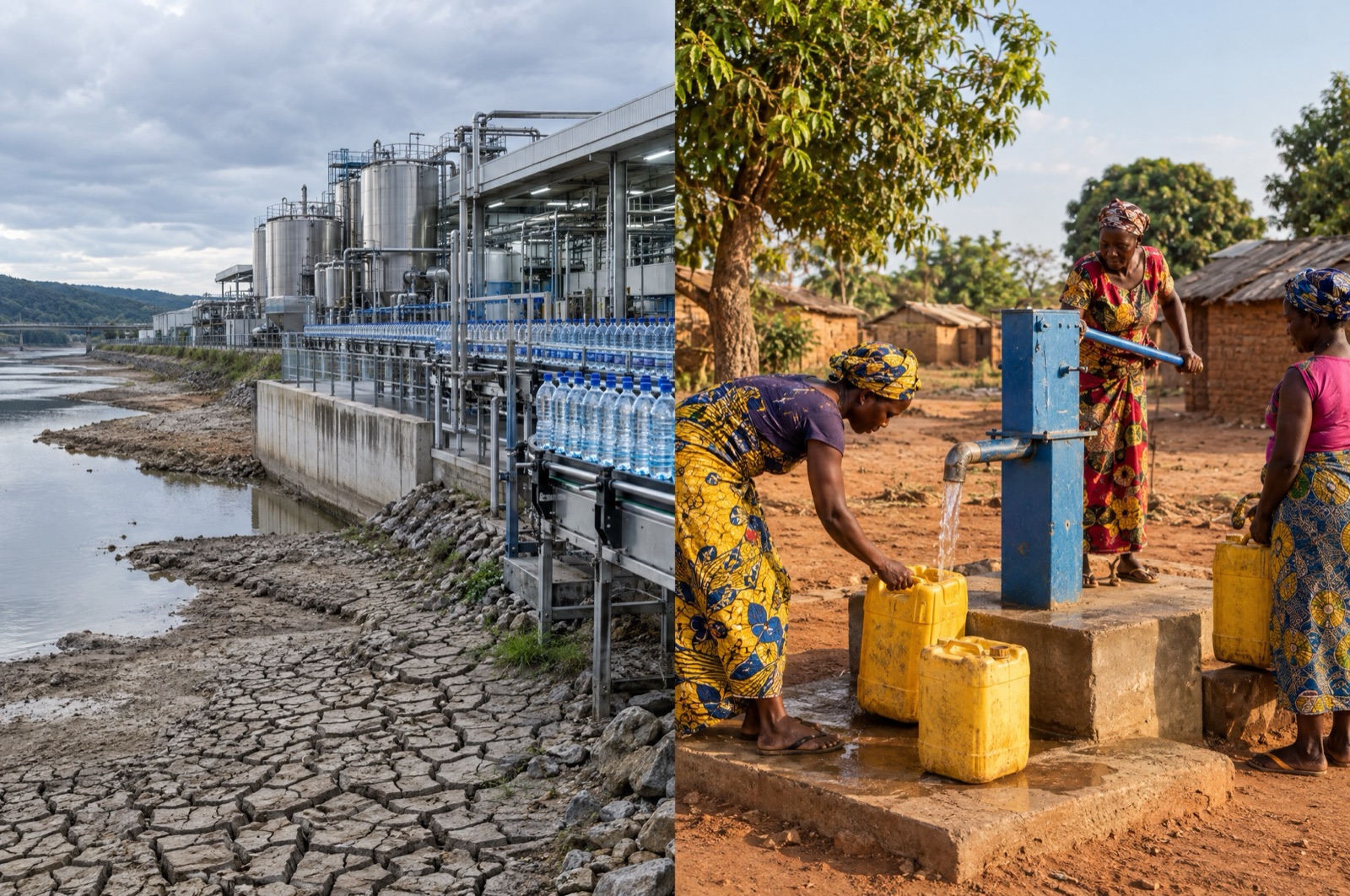
At a glance
- Water offsetting (water offsetting) lets a company fund water points elsewhere so it can claim a 'neutral' or 'positive' water balance.
- Unlike carbon, water is a local resource: a water tower in Togo does not refill an aquifer in India.
- The Vittel (Nestlé Waters) and Plachimada (Coca-Cola) cases show the gap between CSR messaging and reality on the ground.
- The funding gap for universal access to water and sanitation by 2030 stands at 131 to 141 billion dollars a year: private-sector funding remains essential.
- A strong partnership rests on transparency, rejecting the word 'offsetting', long-term funding and the involvement of communities.
Wells opened in Mali and Bangladesh, a glowing CSR report, and a slogan that returns every year: 'water neutral', 'water regenerated', 'water positive'. Behind these phrases, a mechanism modelled on carbon has taken hold in the water sector: offsetting. And that is exactly where the sums start to ring false.
In the world of Corporate Social Responsibility (CSR), drinking water holds pride of place. Opening-ceremony photos, figures on volumes supplied, logos on water points: water infrastructure projects have become pillars of impact communication.
Yet, driven by the concepts of 'water neutrality' (water neutrality) and 'water offsetting', many CSR initiatives run into major methodological limits. According to a World Bank report published in 2024, the annual funding gap for achieving universal access to drinking water and sanitation (UN SDG 6) by 2030 lies between 131 and 141 billion dollars a year. Private-sector funding is therefore essential to close this gap, but the current model of intervention deserves a closer look.
The mechanism: offsetting here what is taken elsewhere
The principle of water offsetting is simple on paper. A company whose industrial activity uses large volumes of water (bottling, textiles, cosmetics, food processing…) uses its CSR budget to fund water access projects in rural areas of Africa or Asia: boreholes, pumps, networks. In return, it adds these 'returned' volumes to its overall water balance, which it can then present as neutral, or even positive.
The practice has spread widely over the past ten years, driven by the same logic as carbon credits. Companies try to replicate this model by measuring the water used in their factories (textiles, food processing, cosmetics…), then funding boreholes on the other side of the world to display a 'neutral balance'. An industrial impact thus becomes an offsettable accounting line, and then a marketing argument.
The illusion: water is not carbon
This is where the reasoning collapses. A tonne of CO2 emitted in Shanghai and a tonne captured in Brazil have, as far as the climate is concerned, the same global effect: the atmosphere is a shared system. Water does not work like that. An aquifer is a local resource, often confined to a specific catchment. Funding water points in an African village does not return a single drop to the French, Indian or Mexican aquifer that the factory keeps drawing from at the same time.
| Carbon | Water | |
|---|---|---|
| Scale of impact | Global: the atmosphere is a shared system | Local: an aquifer is confined to a catchment |
| Offsetting elsewhere | A tonne captured in Brazil balances a tonne emitted in Shanghai | A borehole in Togo does not return a drop to the aquifer drawn down in India |
| Who bears the impact | The whole planet | The people and ecosystem around the factory |
Even so, corporate action remains essential and potentially very valuable, provided its true nature is understood:
- Water, a purely local resource: making a simple T-shirt takes around 2,700 litres of water, a far from negligible footprint. When a factory pumps that water, in India for example, it takes it directly from the region's rivers and soils. The impact of that consumption is therefore 100% local: it is the people and the surrounding ecosystem who bear the consequences directly!
- An impact rooted in place, unlike carbon: while CO2 emissions have a global effect wherever they are released, water obeys a strict physical reality: it stays put. Building water towers in Togo, for example, does not raise an aquifer in India, but it radically changes the lives of the local people who benefit in Togo.
Corporate support for drinking water projects should not be seen as an environmental offsetting mechanism, but as a high-impact social investment. The aim is not to erase an industrial footprint on the other side of the world, but to bring real health and human transformation where the need is most urgent.
Two cases, widely documented by the press and environmental organisations, show this disconnect between messaging and reality on the ground.
Vittel: the aquifer that no longer refills
In the Vosges, Nestlé Waters has for decades drawn on the Lower Triassic sandstone aquifer for its Vittel, Contrex and Hépar brands. Since 2018, organisations such as France Nature Environnement have warned of a chronic deficit in this aquifer, of around one million cubic metres a year in its south-western sector, roughly the volume the company is authorised to extract for bottling and export. In 2024, an investigation by Mediapart, drawing on a report by the French Office for Biodiversity, revealed that 9 of the boreholes operated by Nestlé Waters in the area were running without valid extraction permits. The local authority, for its part, had to consider piping drinking water from another river to keep supplying residents. A few kilometres away, in Volvic, a citizens' group condemns Danone's extraction of up to several million cubic metres of water a year, with summer peaks that continue even during restriction periods.
The borehole affair is no longer just a campaigners' issue: in September 2024, Nestlé Waters signed a judicial public-interest agreement with the Épinal public prosecutor, acknowledging that it had operated 9 boreholes without valid authorisation. The group paid a fine of 2 million euros and undertook to compensate the complainant organisations and restore the affected wetlands. The case is now part of a wider scandal: a Senate inquiry has, in parallel, uncovered Nestlé's use of banned purification treatments on several mineral water brands, a fraud the senators described as 'massive', and a cover-up they partly attribute to the State itself. For a brand whose selling point rests on the 'natural purity' of its source, the gap between the story it sells and the reality now before the courts illustrates, on a quite different scale, the same problem as water offsetting: the distance between what a company says about water and what it actually does with it.
This case goes to the heart of the problem: the same multinational can fund water access on one side of the globe while being accused of draining a local resource on the other, with no accounting or ecological link connecting the two columns.
Plachimada: when a bottling plant becomes a pumping plant
In India, the example most often cited by environmental NGOs is the Coca-Cola plant at Plachimada, in the state of Kerala. Opened in 2000, the plant extracted between 1 and 1.5 million litres of water every day through several boreholes, until the local water table fell drastically.
A campaign led by women from the region's Adivasi communities (India's Indigenous and tribal peoples, among the most economically marginalised in the country) eventually won a closure order in 2004, which took effect two years later. These communities, directly dependent on the aquifer for subsistence farming and drinking water, were the first to suffer as surrounding wells ran dry. On 24 February 2011, the Kerala Parliament voted to create a special tribunal to rule on residents' compensation claims against the American giant. Taking into account agricultural losses, water pollution and illness, total damages were assessed at 48 million dollars, or 34 million euros at the time.
In activist writing on water, the case has become the textbook example of a 'bottling plant' that in practice works as a pumping plant, whatever social responsibility programmes the group may showcase in other parts of the world.
The two cases in figures
| Vittel (Vosges, France) | Plachimada (Kerala, India) | |
|---|---|---|
| Company | Nestlé Waters | Coca-Cola |
| Pressure on the aquifer | Deficit of around 1 million m³ a year | 1 to 1.5 million litres pumped a day |
| What came to light | 9 boreholes without valid authorisation | Drastic fall in the water table, nearby wells run dry |
| Outcome | Judicial agreement in 2024: 2 million euro fine | Closure ordered in 2004, special tribunal set up in 2011 |
| Sums at stake | 2 million euro fine | 48 million dollars in assessed damages |
Why the mechanism persists anyway
If water offsetting survives despite this obvious flaw, it is because it meets a need on both sides.
- For the company: it offers an easy-to-communicate indicator (a figure, a percentage, a 'water positive' logo) without having to question the volume extracted at source.
- For NGOs: it represents welcome funding, in an underfunded sector, for real projects that are useful to the people who benefit from them.
So the problem is not the funding itself: it is a good thing when a company funds water projects. The problem is the word used to describe it. Talking about 'offsetting' suggests that funding a well in Togo somehow cancels out the water taken in India. But there is no real link between the two: they are two separate actions, in two different places, with no physical connection between them. That is not offsetting. It is simply two things happening at the same time, unrelated to each other.
So what does a partnership that stands up look like?
The point is not to dismiss all private funding of water projects: many are sincere, well designed and vital for the communities they serve. It is about telling genuine commitment apart from window dressing. A few criteria help sort one from the other:
- Transparency about the company's own extraction. A serious partner also reports on the volumes it extracts itself and on its efforts to reduce them at source, not just on the projects it funds elsewhere.
- No use of the words 'offsetting' or 'neutrality'. A water access project can be presented as a contribution or a solidarity partnership, never as cancelling out, on paper, an impact located in another catchment.
- Long-term funding. Many companies fund the building of a water point, the photogenic moment, and stop there. But boreholes break down and pumps wear out: maintenance, training a local technician and spare parts all need ongoing funding. A strong partnership funds the long haul, not just a one-off payment that looks good in that year's CSR report.
- Involving local communities from the outset, based on their real needs, not on a communications calendar set at head office.
- Clear governance of the partnership, in which the NGO keeps a say over how the projects it delivers are used in external communications.
Businesses: let's build a water partnership that stands up
Transparency, long-term funding, community involvement: talk to the LIFE team about your water access project.
Contact the LIFE team →Frequently asked questions
What is water offsetting?
It is when a company that uses a lot of water funds water access projects elsewhere (boreholes, pumps, networks) and adds these 'returned' volumes to its water balance, which it then presents as neutral, or even positive.
Why can't water be offset like carbon?
CO2 has a global effect, wherever it is emitted. An aquifer, by contrast, is a local resource confined to a catchment. Funding a borehole in Togo does not return a single drop to the aquifer a factory keeps drawing from in India.
Should companies stop funding wells?
No. Their contribution is essential: the funding gap for universal access to water and sanitation stands at 131 to 141 billion dollars a year. But this support should be seen as a high-impact social investment, not as an environmental offset.
How can you tell a serious water partnership?
The company is open about its own water withdrawals. The words “offsetting” and “neutrality” are nowhere to be found. Maintenance is funded for the long term. Communities are involved from the very start. And governance is clear, giving the NGO a say.
Ready to help?
I start a fundraiser
Support the causes close to your heart by starting an online fundraiser with LIFE.
Raising funds for a charity has never been easier!