In-kind vs financial donations: which makes the bigger difference?
At a glance
- An in-kind donation means giving goods or services rather than money: clothes, food, equipment or professional skills.
- A financial donation remains the most flexible and useful option for an NGO like LIFE, which works in 25+ countries.
- Both types qualify for French tax relief, provided the charity is recognised as being of public interest.
- LIFE mainly accepts financial donations, which let it respond to emergencies anywhere in the world without logistical constraints.
- LIFE's donor relations team is on hand to help you find the way of giving that best suits your situation.
You'd like to give to an NGO, but you're wondering whether sending clothes or food would be more useful than a bank transfer. Or perhaps you're simply not sure what an "in-kind donation" means and how it differs from a regular donation.
This guide untangles it all in plain terms, starting from the real needs of a humanitarian NGO like LIFE.
What exactly is an in-kind donation?
An in-kind donation is a non-financial contribution. Instead of sending money, you give goods or a service, free of charge and without expecting anything in return.
In practice, it can take several forms:
- Physical goods: clothes, food, medicines, IT equipment, furniture, vehicles
- Food supplies: tinned goods, dry products, prepared meals
- Skills-based sponsorship: a company lets employees help the charity during their working hours (accounting, communications, logistics...)
- Premises or equipment: free use of a space or of equipment
An in-kind donation contrasts with a financial donation (or cash donation), which simply means transferring a sum of money into the charity's account.
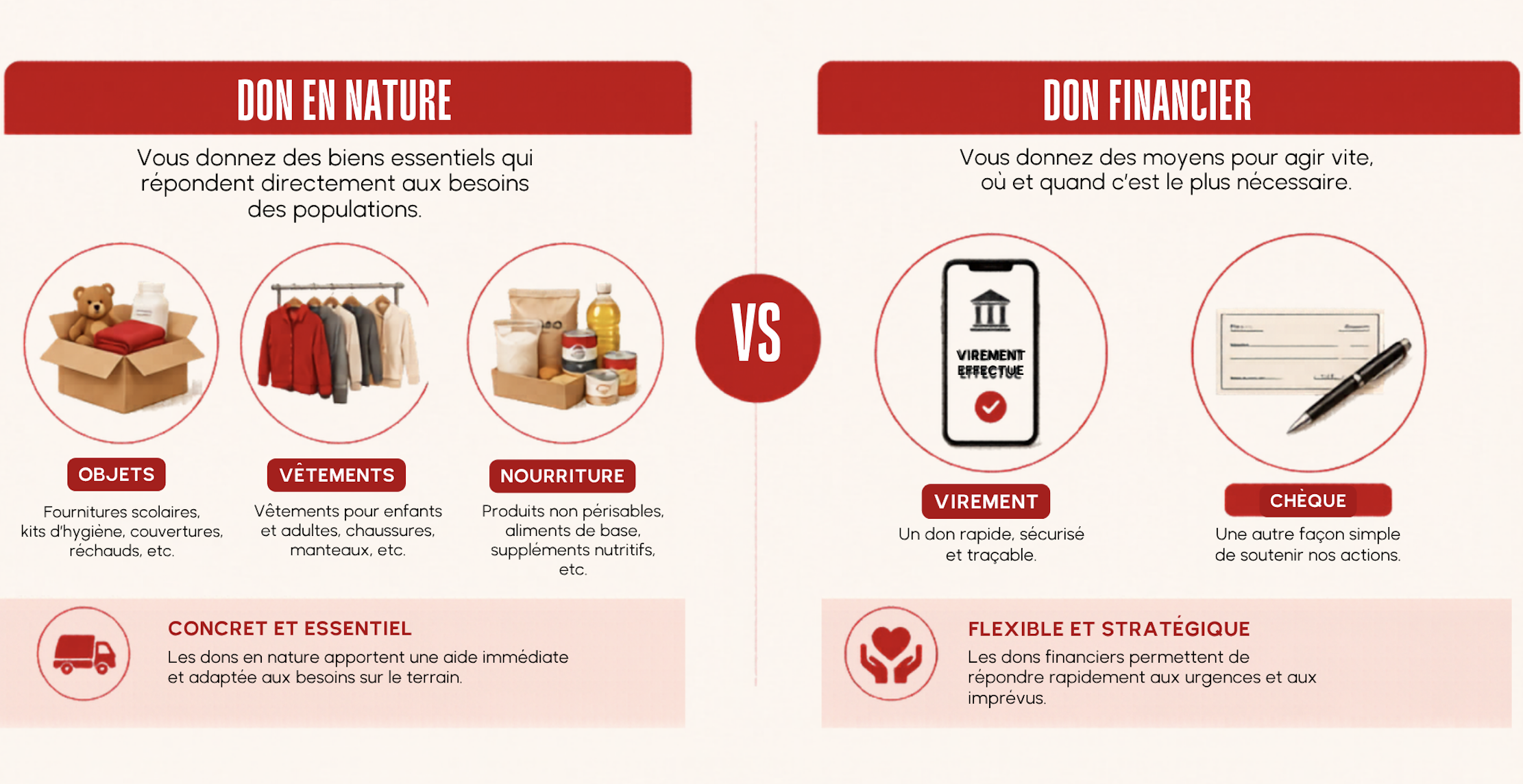
In-kind or financial donation: what difference it really makes to an NGO
The distinction isn't just theoretical. It has very real, practical consequences for how an NGO can use your support.
Why financial donations are often more useful to LIFE
Money is universal and flexible. When LIFE receives a financial donation, it can use it exactly where the need is most urgent: buying food suited to the nutritional needs of a specific population, paying for an emergency team's transport, or funding local partners who know the ground.
When you send clothes or tinned food from France to a country in crisis, several problems arise: sorting, storage, international shipping, customs, and sometimes goods that don't match local needs. These logistics costs can exceed the value of the goods themselves.
That's why the vast majority of humanitarian NGOs working internationally, LIFE included, strongly favour financial donations.
When in-kind donations really make sense
In-kind donations remain valuable in specific situations:
- Organised local collections: a charity collecting food in your town to distribute locally can handle in-kind donations perfectly well.
- Skills-based sponsorship: a company that lends its employees to help an NGO with its accounting or communications creates real, targeted value.
- Emergencies close to home: during disasters in France or Europe, well-targeted essential items can be delivered quickly.
Key takeaway
An in-kind donation is no less worthy than a financial one. But for an NGO like LIFE, working in 25+ countries, it creates logistical constraints that money doesn't. A €50 donation lets LIFE buy exactly what a family needs, right where they need it.
Do in-kind donations qualify for tax relief?
Yes, under certain conditions. An in-kind donation to a charity recognised as being of public interest qualifies for French tax relief, just like a financial donation. The same rates apply:
| Type of organisation | Relief rate | Cap |
|---|---|---|
| Public-interest charities (including LIFE) | 66% | 20% of taxable income |
The difference from a financial donation: the donor must estimate the value of the item themselves, based on the purchase price for a new item or the market value for a second-hand one. The charity then checks this estimate before issuing the tax receipt.
Important
If an in-kind donation is deliberately overvalued to obtain excessive tax relief, the fine can reach 25% of the sums fraudulently stated on the tax receipts. The valuation must be honest and verifiable.
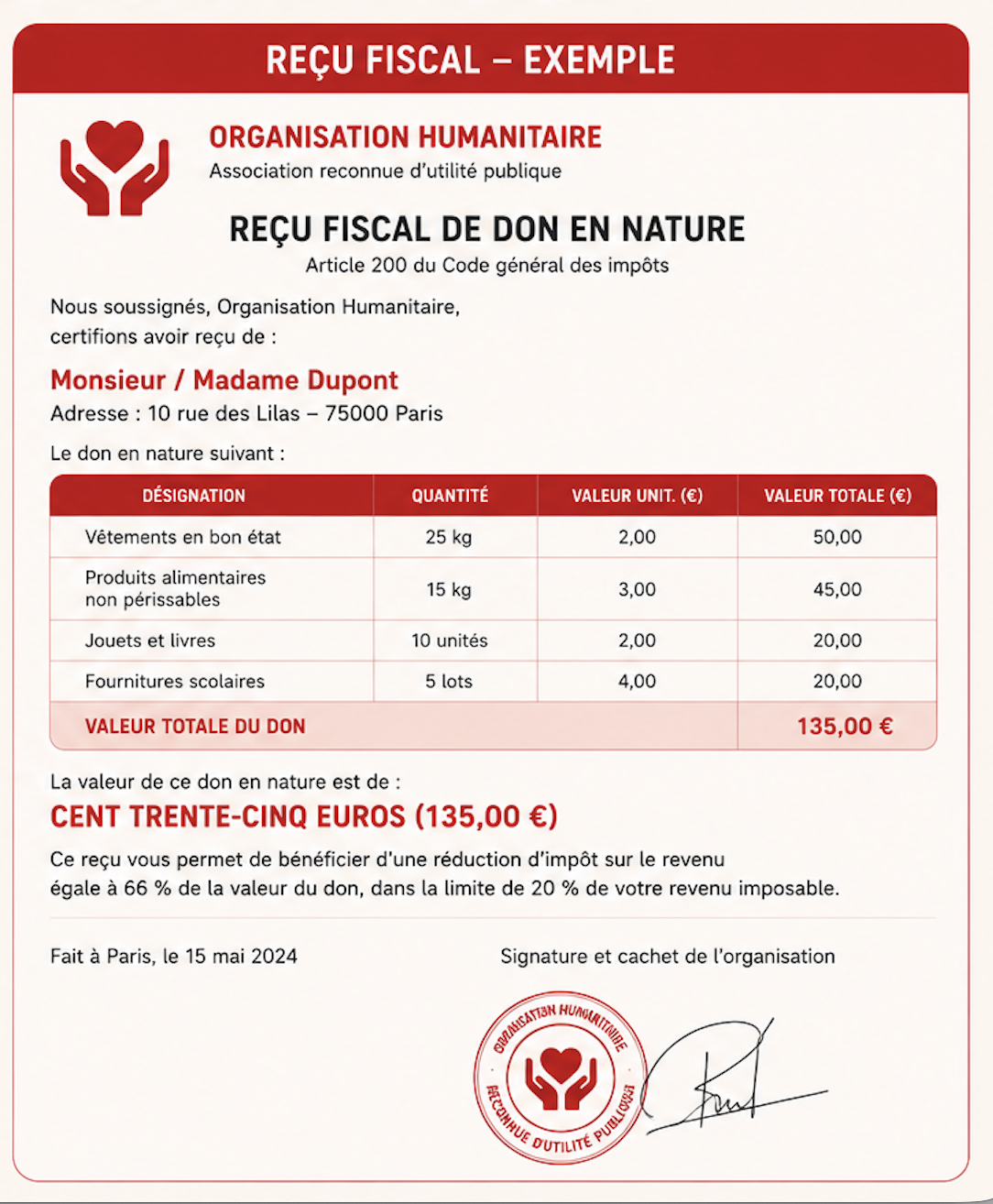
What donations LIFE accepts
LIFE is mainly set up to receive financial donations. This is what allows it to act as effectively and quickly as possible in the 25 countries where it works.
Financial donations to LIFE:
- Are used where the needs are most urgent
- Allow goods to be bought locally, avoiding transport costs and supporting local economies
- Qualify for 66% French tax relief
- Are traceable through freely available activity reports and published accounts
For skills-based sponsorship or specific partnerships, LIFE's donor relations team can look at requests case by case and point you towards the best option.
To understand regular versus one-off giving, our article Regular vs one-off donations: what impact for a charity? compares the two in detail.
Full comparison: in-kind vs financial donations
| Criterion | In-kind donation | Financial donation |
|---|---|---|
| Form | Goods, food, services, skills | Bank transfer, direct debit, cheque |
| Flexibility of use | Limited (use of the donated item) | Complete |
| Logistics | Complex for the NGO | No constraints |
| Tax relief | Yes, same rates | Yes, same rates |
| Tax receipt | Yes, on estimated value | Yes, on exact amount |
| Ideal for | Local collections, skills-based sponsorship | International NGOs like LIFE |
| Suited to LIFE | Special cases (sponsorship) | Yes, preferred option |
To choose a trustworthy charity before you give, our guide 5 criteria for choosing an NGO sets out a complete method. And to discover how a food parcel can change a family's life, read our article on emergency food aid.
Want to support LIFE in the most effective way?
Automatic tax receipt. 66% French tax relief. Every euro traced in the field.
Donate →Frequently asked questions
What's the difference between an in-kind donation and a financial donation?
A financial donation is a payment of money. An in-kind donation is a non-monetary contribution: goods, food, services or professional skills. Both can qualify for French tax relief if the charity is recognised as being of public interest.
Can I send clothes or food to LIFE?
LIFE works mainly internationally and is set up to receive financial donations, which let it buy locally what communities need. For in-kind donations or specific partnerships, contact LIFE's donor relations team, who can look into your request.
Does an in-kind donation qualify for tax relief?
Yes, provided the charity is recognised as being of public interest and issues a tax receipt. The relief rate is the same as for a financial donation: 66% of the amount, up to 20% of taxable income. The donor must estimate the item's value and the charity must validate it.
What is skills-based sponsorship?
It's a form of in-kind donation where a company lets employees help a charity during their working hours. The deductible value is the full employment cost, and the company receives 60% tax relief. For charities like LIFE, this kind of support is especially valued for skills in communications, logistics or accounting.
How do I value an in-kind donation for my tax return?
Valuation is up to the donor. For a new item, it's the purchase price (as invoiced). For a second-hand item, it's the estimated market value at the time of the donation. The charity checks this estimate before issuing the tax receipt. If in doubt, LIFE's donor relations team can guide you through the process.
Ready to help?
I start a fundraiser
Support the causes close to your heart by starting an online fundraiser with LIFE.
Raising funds for a charity has never been easier!