
Food insecurity: understanding the causes and the lasting solutions
- Food insecurity is not just about being hungry: it is unstable or inadequate access to healthy food, measured along 4 dimensions (availability, access, utilisation, stability).
- 2.1 billion people live in moderate or severe food insecurity in 2026, or one person in four.
- The causes are interlocking: conflict, climate, poverty, economic shocks and food waste reinforce one another.
- The planet produces enough to feed 12 billion human beings, 50% more than the current population.
- Lasting solutions combine emergency relief, resilient agriculture and the empowerment of local communities.
In 2026, global agricultural output amounts to 4,600 kilocalories per person per day. Enough to feed 12 billion human beings, 50% more than the world’s population. And yet 2.1 billion people live in moderate or severe food insecurity, and two famines were officially declared in the same year for the first time in UN history: in Gaza and in Sudan.
That paradox sums up the nature of the problem on its own. Food insecurity is not a production issue. It is an issue of access, stability, conflict and inequality. This guide reviews the official definition, the 4 dimensions that structure it, its root causes and the levers for action, from emergency giving to the lasting solutions led by NGOs.
What exactly is food insecurity?
Food insecurity is the opposite of food security, a concept defined by the FAO at the 1996 World Food Summit:
“Food security is achieved when all people, at all times, have physical and economic access to sufficient, safe and nutritious food that meets their dietary needs and food preferences for an active and healthy life.”
That definition rests on four pillars, known as the 4 dimensions of food security. A single failing pillar is enough to tip a household into insecurity.
| Dimension | What it covers | Example of breakdown |
|---|---|---|
| Availability | Sufficient production, stocks and imports | A drought that destroys a harvest |
| Access | Economic and physical means to obtain food | Soaring prices, a market destroyed by conflict |
| Utilisation | Nutritional quality, drinking water, cooking, health | Diarrhoea that prevents nutrient absorption |
| Stability | Consistency of the three previous dimensions over time | War that makes access unpredictable |
Food insecurity, hunger, malnutrition: three different things
These three terms are often confused, wrongly so.
Hunger is a physical sensation linked to an acute or chronic calorie deficit. It is a symptom.
Food insecurity is a condition, with several degrees of severity, describing the difficulty of gaining stable access to an adequate diet. Someone in moderate food insecurity skips meals or compromises on the quality of their diet, without necessarily feeling hungry.
Malnutrition covers nutritional deficiencies (wasting, stunting, anaemia) but also overweight and obesity. You can be well fed in calories and severely malnourished in micronutrients (iron, iodine, vitamin A).
How is food insecurity measured?
Two international scales serve as references. They do not measure the same thing and they complement each other.
The FAO’s FIES scale: 4 levels
The Food Insecurity Experience Scale assesses the subjective perception of households through a standardised questionnaire.
- Food security: stable and sufficient access.
- Mild insecurity: worry about being able to obtain food.
- Moderate insecurity: compromises on diversity or quality, meals skipped.
- Severe insecurity: prolonged deprivation, whole days without eating.
The IPC/CH framework: 5 phases
The Integrated Food Security Phase Classification (IPC/CH) measures objective severity on the ground, with precise thresholds for calories, mortality and acute malnutrition. It is the reference tool for triggering humanitarian alerts.
| Phase | Name | Meaning |
|---|---|---|
| 1 | Minimal | Food security assured |
| 2 | Stressed | Fragile situation, preventive aid |
| 3 | Crisis | Humanitarian assistance required |
| 4 | Emergency | Rising mortality, massive aid needed |
| 5 | Famine | Collapse of livelihoods |
In 2025, 1.4 million people were classified in IPC 5 (famine) according to the GRFC 2026, notably in Gaza, South Sudan, Sudan, Haiti, Mali and Yemen.
How many people are food insecure worldwide in 2026?
The most recent figures come from the SOFI 2026 report (FAO, IFAD, WHO, WFP, UNICEF) and the Global Report on Food Crises 2026 (GRFC).
- 645 million people are chronically undernourished (7.8% of the world’s population).
- 2.1 billion face moderate or severe food insecurity (1 person in 4).
- 2.7 billion cannot afford a healthy diet (1 person in 3).
- 266 million face acute food insecurity across 47 countries (GRFC 2026).
- 1.4 million are in a catastrophic situation (IPC 5), with acute hunger doubling in 10 years.
For a full reading of these figures and how they have evolved, our dedicated article sets out world hunger in 2026: figures, causes and actions.
What are the root causes of food insecurity?
Five factors combine and reinforce one another. Rarely isolated, they form the equation that plunges a population into crisis.
Armed conflict, the number one driver
This is the shared conclusion of every UN agency: conflict is the leading cause of acute food insecurity in the world. It destroys harvests, cuts trade routes, displaces farmers and collapses local currencies. According to the WFP, 40% of civil wars originate in competition over scarce resources, food among them. The link is so structural that we devote a dedicated article to it: conflict and food insecurity.
Climate disruption
Prolonged droughts in the Sahel, floods in South Asia, cyclones in the Caribbean, the El Niño phenomenon: extreme weather events destroy crops and make subsistence farming increasingly uncertain. SOFI 2026 projections estimate that by 2030, 56% of people suffering from hunger will live in Africa, a particularly exposed continent.
Poverty and structural inequality
A healthy diet costs an average of 4.28 PPP dollars a day worldwide, a sum out of reach for a third of humanity. Gender inequality makes the picture worse: women have more restricted access to land, credit and farming tools. As a result, 26.1% of women are food insecure compared with 24.2% of men. The FAO estimates that if this gap disappeared, hunger would fall by 12 to 17%.
Economic shocks and price volatility
Post-Covid inflation, the war in Ukraine that sent cereal prices soaring, rising energy costs, trade tensions: the mechanics of food prices have become unstable. In parallel, official development assistance has fallen back to its 2016 level, according to the GRFC 2026, even as needs have doubled in ten years.
Food waste
A third of the food produced worldwide is lost or wasted, according to the FAO. This covers on-farm losses, logistics losses and household waste in wealthy countries. In volume, that waste would be enough to feed several billion people. It is the most thoroughly documented paradox of global food insecurity.
Focus on Palestine: the anatomy of extreme food insecurity
The Palestinian case concentrates every factor at its maximum. In 2025, famine was officially declared in the Gaza governorate by the IPC, an extremely rare event. Three mechanisms combine.
The destruction of farming infrastructure. The bombardments from 2023 to 2025 destroyed a major share of the Gaza Strip’s cultivated land, greenhouses, irrigation wells and farm roads. Local production now covers only a residual fraction of needs.
Restrictions on humanitarian access. Food convoys were heavily limited during the most intense phases of the conflict, with crossing points often closed or subject to lengthy checks. Aid does arrive, but in insufficient volumes and irregularly.
Mass displacement of the population. More than 90% of Gazans have been displaced at least once. This severs ties with the usual distribution points, scatters families and makes food security structurally unstable.
LIFE has been working in Gaza for more than 10 years in partnership with the local association Al-Amal. More than 62,500 hot meals were distributed there despite the war in 2025 (source: Ouest-France, May 2025). For a complete, operational overview, see our page dedicated to the Palestine emergency.
An IPC 5 is triggered when at least 20% of households face extreme food shortage, when more than 30% of children suffer from acute malnutrition and when mortality exceeds 2 per 10,000 per day. Gaza and Sudan crossed those thresholds simultaneously in 2025.
What lasting solutions exist against food insecurity?
Responding to the emergency is necessary, but not sufficient. Five structural levers have proven their worth.
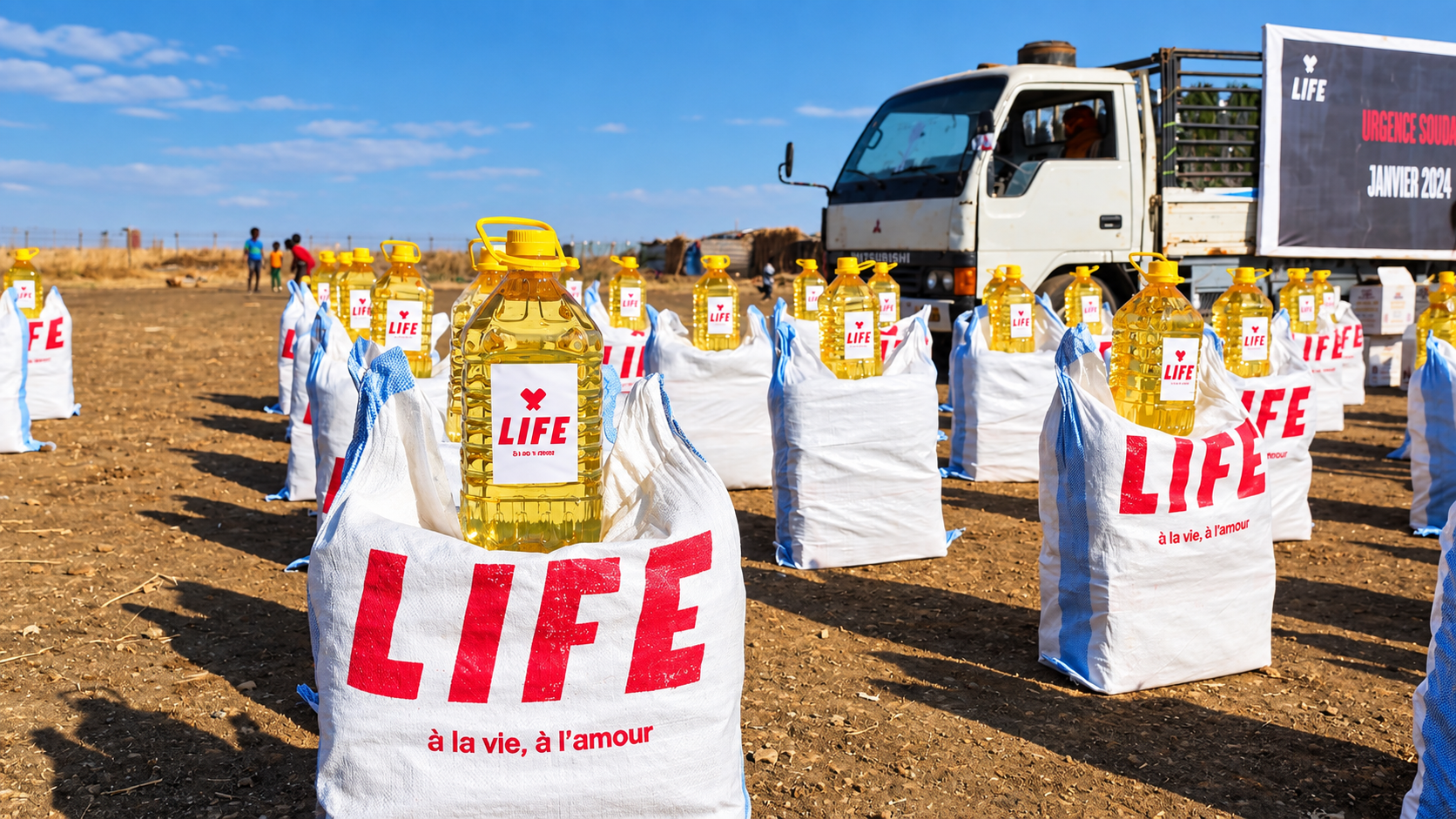
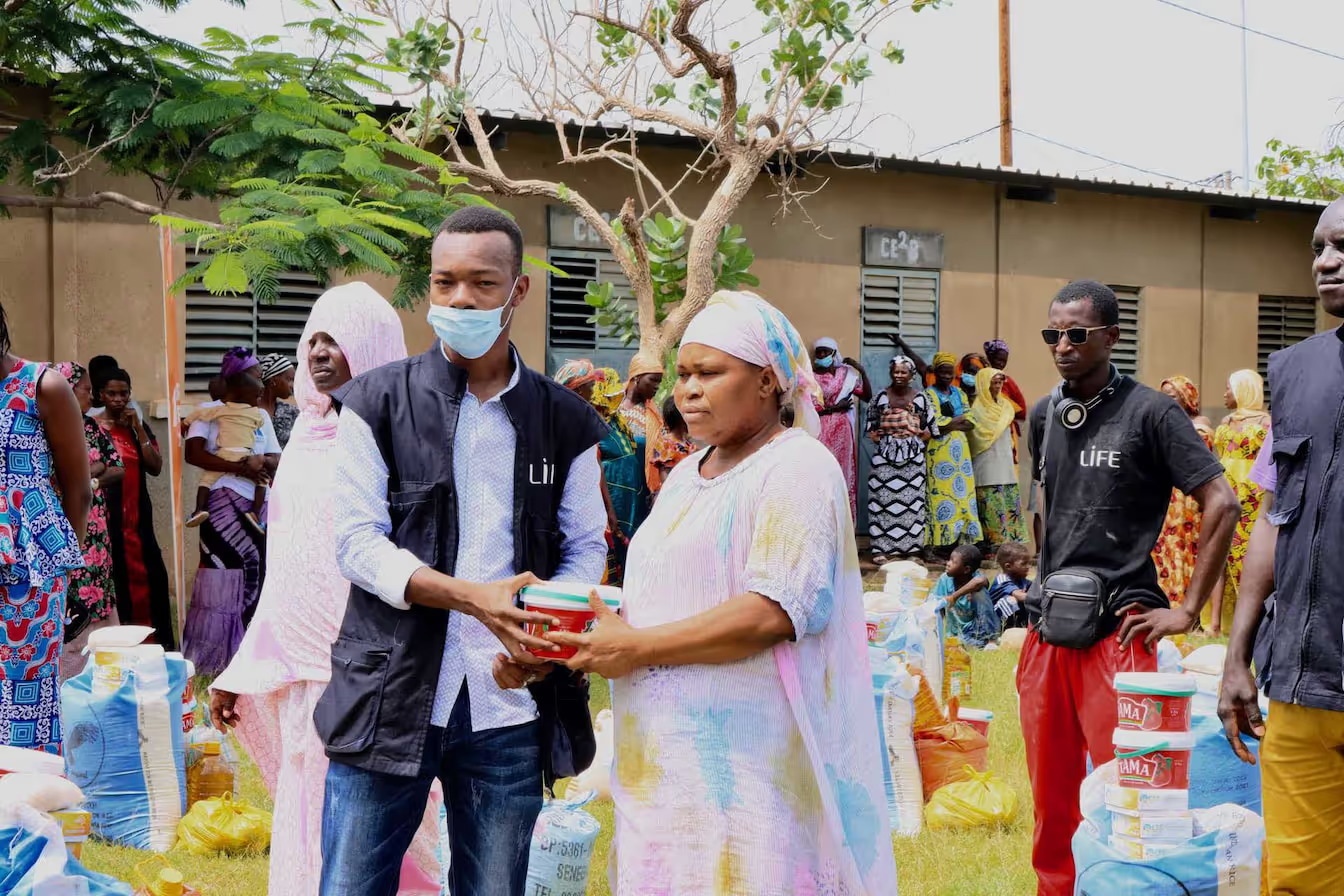
Targeted emergency relief. Food distributions, mobile kitchens, electronic vouchers: the immediate response remains indispensable in crisis zones. It is the core of what a humanitarian emergency NGO such as LIFE does, working in Gaza, Sudan and Lebanon.
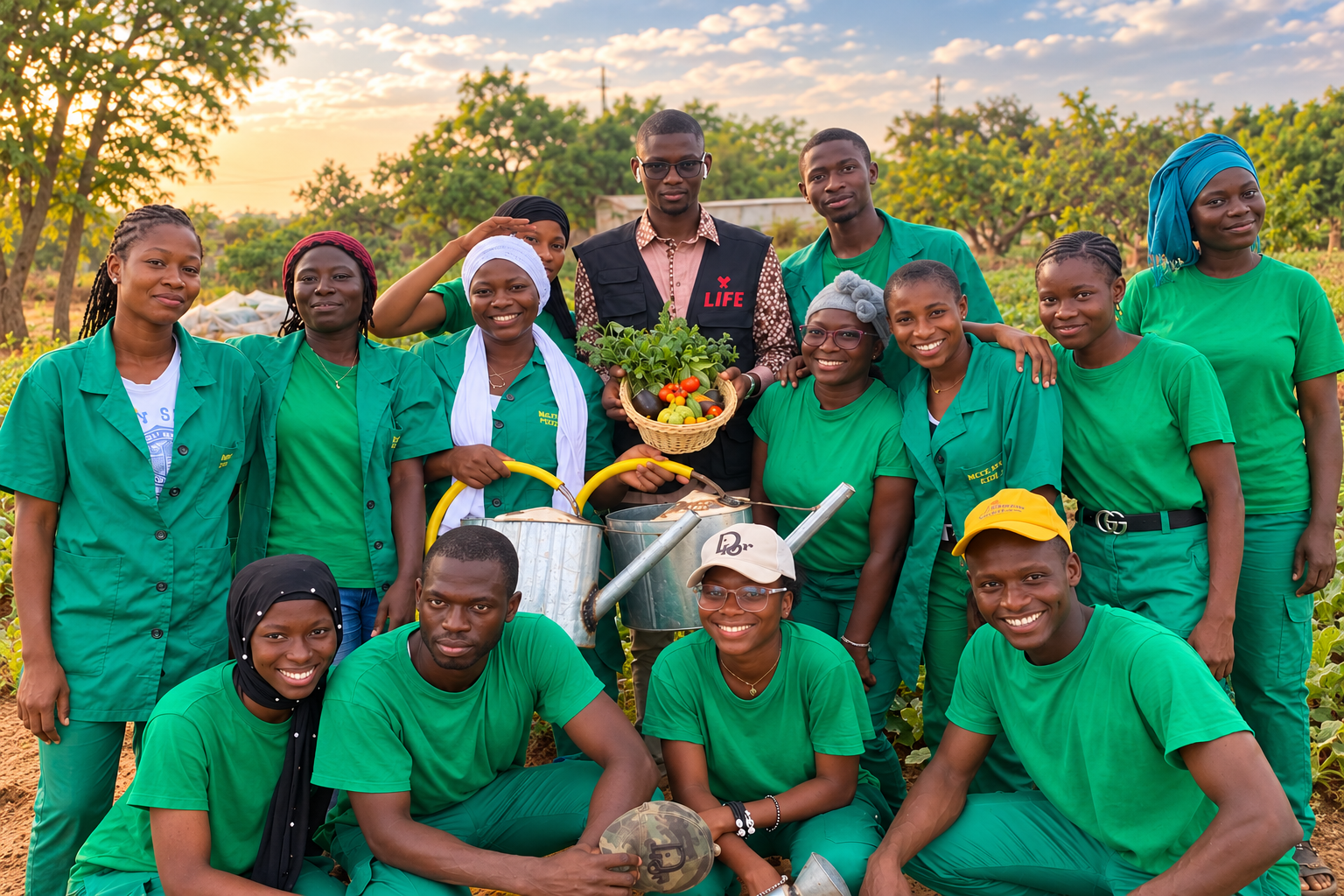
Resilient, local agriculture. Training in agroecological techniques, distribution of drought-resistant seeds, support for agroforestry, construction of irrigation wells: these medium-term investments rebuild communities’ food sovereignty. They make it possible to move from giving to recovery.
The empowerment of women. Improving women’s access to land, agricultural credit and vocational training is one of the most effective levers documented by the FAO. For an equal investment, a woman farmer diversifies her production more and improves the nutrition of the children in her household.
Social protection and access to rural employment. Cash transfer programmes, safety nets, school canteens, rural employment guarantees: these schemes create a floor that stops fragile households from tipping into severe insecurity when shocks hit.
The fight against food waste. Better post-harvest logistics in the global South, reduced household waste in the global North, redistribution of unsold food through food banks: every tonne recovered is a tonne that is no longer missing.
How can you act against food insecurity from France?
At the individual level, three forms of action are particularly useful.
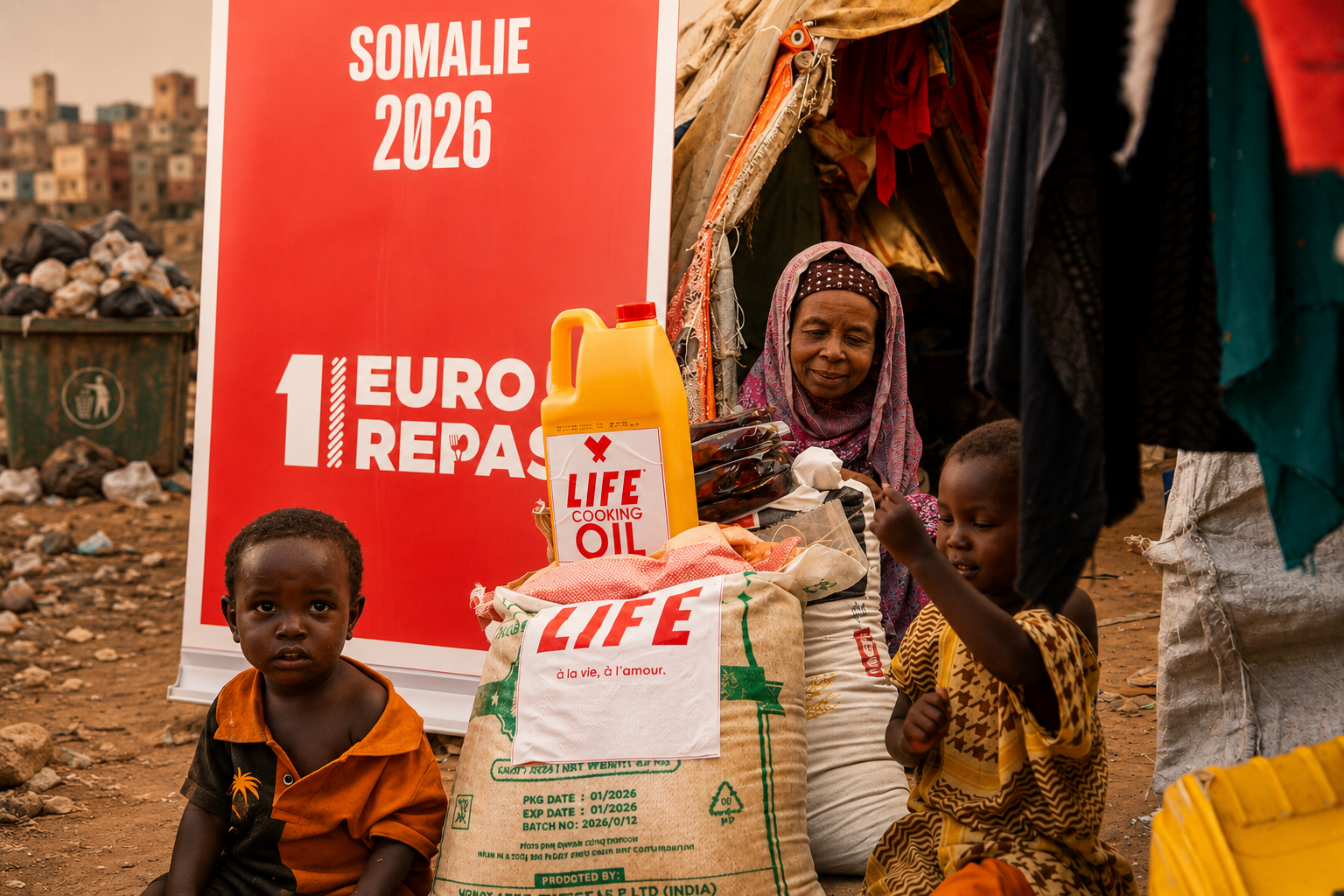
Give to a specialised NGO. A one-off donation directly funds a distribution. LIFE’s “1 euro = 1 meal” campaign funds a full meal for every euro given, in the most critical field locations. To understand in detail how that figure holds up, read our analysis 1 euro = 1 meal: how one euro can feed a person.
Switch to monthly giving. A standing order gives the NGO the visibility it needs to plan bulk purchases and sign contracts with local suppliers. It is the most effective format for turning generosity into lasting action.
Claim your tax relief. Every donation to LIFE entitles you to a 66% income tax reduction, up to 20% of your taxable income. A monthly donation of €20 costs €81.60 net over the year.
LIFE’s “1 euro = 1 meal” campaign funds food distributions in 25 countries, including Gaza, Sudan and Lebanon. Your donation becomes a real meal for someone living in food insecurity.
Offer a meal today →What is the difference between food security and food sovereignty?
Food security guarantees every individual physical and economic access to sufficient, healthy food, without taking a position on where that food comes from. Food sovereignty, a more recent concept (1990s), adds the requirement that populations be able to define their own farming and food systems, without depending exclusively on the world market or on outside aid. Sovereignty aims at autonomy; security aims at access.
Who suffers most from food insecurity today?
In proportional terms, sub-Saharan Africa is the worst affected region: 66.6% of its population cannot afford a healthy diet according to SOFI 2026. In absolute numbers, Asia still counts nearly 292 million undernourished people. At household level, women, children under 5 and isolated rural populations are the most vulnerable.
Is France affected by food insecurity?
Yes. According to CRÉDOC and recent surveys, around 16% of French people reported not eating their fill in 2024, a figure that has risen since the inflation crisis of 2022. Les Restos du Cœur distributed 161 million meals in 2024-2025. Food insecurity is therefore not a strictly foreign phenomenon.
Can food insecurity be eradicated completely?
Technically yes: the planet produces enough to feed 12 billion people. Politically, it remains a distant objective. SDG 2, set by the United Nations, targets “Zero Hunger” by 2030, but current projections do not expect it to be met. It will depend on resolving conflicts, responding to climate disruption and the scale of the social protection policies put in place.
How can one individual really make a difference?
At the individual level, regular giving to a specialised NGO is the most effective lever. A monthly donation of €20 funds around 240 meals a year within structured campaigns such as “1 euro = 1 meal”. Across a community, a company or a family, these accumulated small gestures fund complete programmes. Raising awareness among those around you and cutting household food waste are two important complementary levers.
Why was Gaza officially declared to be in famine in 2025?
Famine (IPC phase 5) was triggered by the combination of three simultaneous factors exceeding the thresholds: more than 20% of households in extreme food shortage, more than 30% of children in acute malnutrition and hunger-related mortality above 2 per 10,000 per day. Those conditions resulted from the destruction of farming infrastructure, restrictions on humanitarian access and the mass displacement of the population.
.png)