
Food sovereignty: why helping communities feed themselves matters
.png)
- Food sovereignty is the right of peoples to define their own agricultural and food policies, without dumping onto other countries.
- The concept was coined by the international peasant movement Via Campesina in 1996, alongside the World Food Summit in Rome.
- It differs from the FAO’s food security: security concerns access to food, sovereignty concerns the power to produce it.
- Africa imports around 50 billion dollars of food products a year, even though it holds 60% of the planet’s uncultivated arable land.
- NGOs such as LIFE support food sovereignty through wells, resilient seeds, agricultural training and local cooperatives.
In 2026, Africa counts 309 million people in food insecurity and imports around 50 billion dollars of food products a year. This paradox plays out on a continent that holds 60% of the planet’s uncultivated arable land. The heart of the problem does not lie in the global availability of food, but in the power of communities to produce their own food.
That is precisely what food sovereignty covers, a concept coined in 1996 by the international peasant movement Via Campesina and since become a reference framework for alternative agricultural policies. This guide explains what the concept covers, how it differs from food security, what its pillars are and how humanitarian NGOs contribute to putting it into practice. It is part of our section devoted to food security.
What is food sovereignty?
The reference definition was introduced in April 1996 by the international peasant movement Via Campesina, at the World Food Summit organised by the FAO in Rome. It has since been taken up in UN texts, in political debate and, more recently, in the names of the French and Italian agriculture ministries.
“Food sovereignty is the right of each country to maintain and develop its own capacity to produce its basic food, while respecting cultural and agricultural diversity.” — Via Campesina, 1996
Three elements set this concept apart from a simple technical definition.
It is a collective right. Food sovereignty is exercised at the scale of a people, a community, a country. It does not come down to an individual right to be fed.
It is a “concept for action”. Via Campesina insists on this point: it is not an academic construct, but a political dynamic carried by farmers in the global South and North alike, with concrete mobilisations (including the International Day of Peasant Struggle, on 17 April).
It is a response to unregulated free trade. The concept was born in reaction to the neoliberal policies of the 1990s, which pushed countries of the South to open their agricultural markets to subsidised imports from the North, ruining their peasant farming.
How does it differ from food security?
The two notions have coexisted since 1996 and are often confused. Yet they are complementary and operate on different levels.
| Criterion | Food security (FAO) | Food sovereignty (Via Campesina) |
|---|---|---|
| Year | 1996 (FAO Summit, Rome) | 1996 (Via Campesina, alongside the same summit) |
| Focus | Access to food (downstream) | Power to produce food (upstream) |
| Target | Every individual | Every people, every community |
| Origin of food | Neutral (market, aid, local production) | Priority to local production |
| Global market | Seen as a factor of access | Seen as a factor of vulnerability |
| Political stance | Institutional (UN) | Activist (peasant movement) |
Food security rests on four dimensions established by the FAO: availability, access, utilisation and stability. Our dedicated article food insecurity: causes and lasting solutions looks at these pillars in detail.
Food sovereignty is presented by Via Campesina as a precondition of food security. Without the capacity to produce for itself, a country remains vulnerable to global market shocks, geopolitical crises and the trade policies of agricultural powers. Sovereignty does not replace security: it makes it robust.
What are the 6 pillars of food sovereignty?
The concept was refined at the Nyéléni Forum (Mali, 2007), which set out six structuring principles.
1. Priority to local food production
Feeding the inhabitants of a territory first with that territory’s production, before exporting or importing. This implies preserving subsistence farming and resisting exclusive specialisation in export crops (coffee, cocoa, cotton).
2. The right to land, water and seeds
Without secure access to these three fundamental resources, peasant production is not possible. This requires land reform, recognition of customary land rights and a refusal of seed privatisation by large corporations.
3. Protection against international dumping
Dumping means selling agricultural products abroad at prices below local production costs, often thanks to public subsidies. This practice ruins peasant farming in the countries of the South. Food sovereignty implies legitimate trade protection measures for emerging or fragile agricultures.
4. Popular control of agricultural policy
Via Campesina insists: sovereignty is popular, not only national. It is farmers, consumers and local communities who must have a say, not states alone. The movement denounces the hijacking of the concept by certain governments that use it to mean a strictly state-level sovereignty.
5. The central role of women farmers
More than half of Sahelian farmers are women. They produce the majority of family food and take the household’s nutritional decisions. Without recognition of their role, without access to land, credit and training, no food sovereignty holds at scale.
6. Preserving peasant knowledge and biodiversity
Farmer seeds, traditional techniques adapted to local soils, the diversity of cultivated varieties: these elements form an irreplaceable heritage, threatened by industrial monocultures and patented hybrids.
Why is food sovereignty essential for Africa?
Three figures make the debate particularly crucial for the African continent.
309 million Africans in food insecurity, or 1 person in 4, according to the SOFI 2026 report. On this measure, Africa has now overtaken Asia in absolute terms.
50 billion dollars of food imports a year, according to African Development Bank estimates. This dependence makes the continent hypersensitive to global market shocks (Covid-19, war in Ukraine, a rising dollar).
60% of the planet’s uncultivated arable land is nonetheless located in sub-Saharan Africa. The productive potential is immense, but poorly used for lack of investment, secure land tenure and coherent agricultural policy.
Food sovereignty proposes a structural answer: rather than importing on a massive scale, develop local production capacity, protect peasant farming, secure land tenure, train and finance. To go deeper into the concrete techniques, see our article on sustainable farming in Africa, which details the proven practices.
How do NGOs contribute to food sovereignty?
Humanitarian NGOs have gradually shifted their approach. Distributing food answers the emergency, but installing the local means to produce it answers the root of the problem.
The principle: “helping people feed themselves” rather than “feeding them”
This shift in perspective changes everything. A food distribution programme ends when stocks run out. A sustainable farming programme, once in place, keeps producing for decades. That is why NGOs today combine both approaches: emergency in the short term, sovereignty in the long term.
Five concrete levers
Distributing resilient seeds. After a drought, a flood or a conflict, farmers often have no seed stock left. NGOs such as the FAO, Action Against Hunger or LIFE distribute seeds adapted to local climates to restart the agricultural cycle. The choice of varieties is strategic: local farmer varieties rather than patented hybrids dependent on costly inputs.
Building water infrastructure. Wells, boreholes, drip systems, hillside reservoirs: access to water is the primary limiting factor for farming in the Sahel. LIFE, for example, equipped the village of Wibga in Burkina Faso with a water supply system benefiting 2,000 people, with associated market gardening.
Training in agroecological techniques. Practical workshops on zaï, intercropping, agroforestry and post-harvest storage. Peer-to-peer training (farmer to farmer) is particularly effective and lasting.
Supporting local cooperatives. Funding working capital, bulk purchase of tools, support with marketing: cooperatives allow small producers to pool their costs and negotiate better prices.
Creating community seed banks. These collective structures conserve and spread local farmer varieties, guaranteeing their continuity and producers’ autonomy from commercial seed companies.
A successful food sovereignty project is measured by its ability to disappear. The ultimate aim is for the community to be able to continue without the NGO. This is the opposite of a logic of permanent dependency. The philosophy is particularly present in integrated programmes that combine water, agriculture, education and microfinance.
Focus: LIFE’s agricultural work in its countries of operation
LIFE works in 25 countries with an integrated approach that links humanitarian emergency response and support for food sovereignty. Three concrete examples illustrate this dual action, detailed on our key figures page.
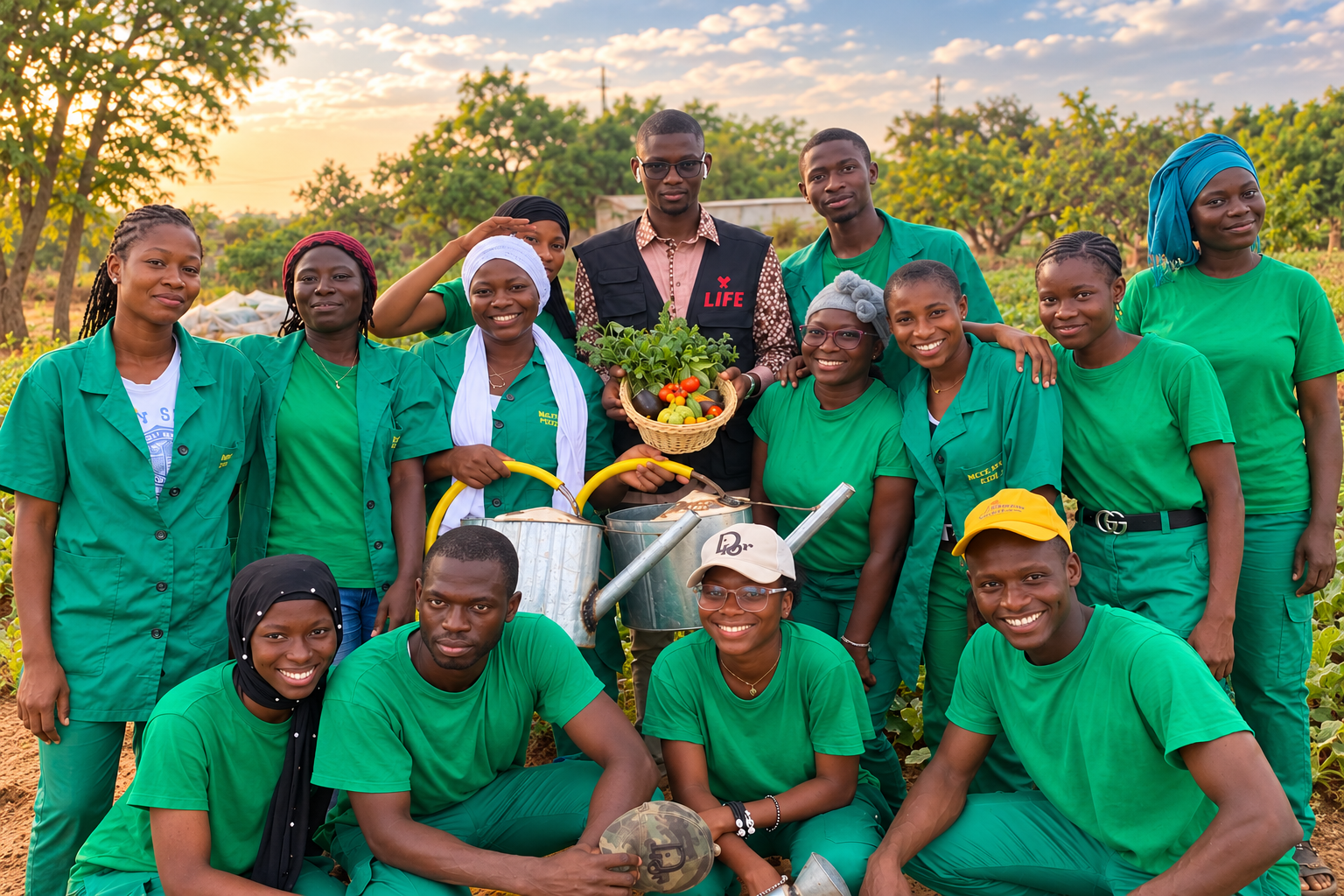
In Burkina Faso (Wibga), building a drinking water supply system made it possible to develop irrigated market gardening, with direct benefit for 2,000 people. The project combines water access, agriculture and improved nutrition.
In Cambodia, 50 water towers built and regular food distributions reaching 46,000 people support a recovery of subsistence farming in disadvantaged rural areas.
In the Sahel, distributions of resilient seeds after cyclical droughts allow farmers to restart their harvests rather than depend lastingly on food aid.
The obstacles to building food sovereignty in the global South
Three obstacles remain structural despite growing recognition of the concept.
Insufficient funding. Agriculture receives a disproportionately small share of official development assistance, even though it employs 65% of the Sahelian population.
International trade rules. Bilateral agreements and the WTO often continue to impose asymmetric trade opening on countries of the South, exposing their producers to competition from subsidised giants. Food sovereignty implies renegotiating these frameworks.
The impact of climate change. Droughts in the Sahel, floods in South Asia, salinisation of coastal soils: climate shocks make local production increasingly uncertain. The subject is central for Africa, as our dedicated article on solutions to droughts in Africa sets out.
Via Campesina denounces the use of the term “food sovereignty” by governments that in fact give it the meaning of “national sovereignty over food security” (protectionism), whereas the original concept values the popular sovereignty carried by farmers themselves. This political nuance is essential to grasp the current debates around French and European agricultural law.
How can you support food sovereignty from France?
Three forms of action are available.
Responsible consumption. Choosing fair-trade labelled imported products (coffee, cocoa, rice, shea butter) directly supports farmers who practise sustainable agriculture, are paid a fair price and are organised into cooperatives.
Donating to an NGO that supports local autonomy. A one-off or monthly donation to LIFE funds wells, boreholes, resilient seeds and training. Our detailed analysis conflict and food insecurity explains why these structural approaches are particularly urgent in crisis zones.
Raising awareness. The concept remains little known in France. Talking about it, sharing articles and supporting local farming movements (Confédération paysanne, MODEF) helps give the subject political recognition.
Any donation to a recognised NGO qualifies for a 66% tax reduction, within the limit of 20% of taxable income.
Every donation to LIFE funds long-term projects: wells, boreholes, seeds, agricultural training. You are not only funding a meal, you are funding communities’ future capacity to produce their own food.
Donate for food autonomy →What exactly is the difference between food sovereignty and food security?
Food security (defined by the FAO in 1996) means physical and economic access to sufficient, safe and nutritious food for every person, without taking a position on where that food comes from. Food sovereignty (defined by Via Campesina the same year) adds a political dimension: the right of peoples to define their own agricultural and food systems, primarily through local production, without depending exclusively on the world market or on outside aid. The two notions are complementary: sovereignty is a precondition of lasting food security.
Who invented the concept of food sovereignty?
The international peasant movement Via Campesina, at its second conference held in Mexico in April 1996, then presented at the World Food Summit in Rome the same year. The movement today brings together more than 200 farming organisations in 80 countries, representing around 200 million small producers. The International Day of Peasant Struggle, on 17 April, commemorates the El Dorado dos Carajás massacre in Brazil in 1996.
Is food sovereignty the same as self-sufficiency in isolation?
No. Food sovereignty does not advocate autarky or closing borders. It asks for the right to choose: which foods to produce, how to produce them, what room to leave for imports and exports, how to protect local peasant farming. Trade remains possible, but within a regulated framework that does not destroy local agriculture through dumping.
Why does food sovereignty particularly concern women?
Because women make up the majority of farmers in many countries of the South, notably in the Sahel where more than half of the agricultural workforce is female. They produce the majority of family food and take the household’s nutritional decisions. The FAO estimates that if the gap in access to agricultural resources (land, credit, training, tools) between men and women disappeared, world hunger would fall by 12 to 17%.
Does the name of the French agriculture ministry really include “food sovereignty”?
Yes, since 2022 the ministry has officially been called the “Ministry of Agriculture and Food Sovereignty”. However, Via Campesina and several farming unions denounce a hijacking of the concept, arguing that the government’s approach amounts to national sovereignty (protecting French supply chains) rather than the popular sovereignty (the power of farmers and local communities) meant by the original term.
How does an NGO like LIFE concretely contribute to food sovereignty?
LIFE combines two levels of action. In the short term, emergency food distribution (72 million meals since 2009) responds to immediate crises. In the long term, infrastructure projects (wells, boreholes, irrigation systems), agricultural training and distributions of resilient seeds rebuild communities’ capacity to produce their own food. The Wibga project in Burkina Faso, which combines a water supply system with market gardening for 2,000 people, illustrates this integrated approach.