
Emergency food aid: how NGOs feed people in crisis zones

- 266 million people were facing acute food insecurity across 47 countries in 2025, according to the GRFC 2026.
- The WFP (World Food Programme) is the world’s leading actor: 152 million people assisted in 2023 across nearly 80 countries.
- An emergency response follows a standardised five-step process: alert, planning, procurement, distribution, monitoring.
- Five aid formats complement each other: dry rations, hot meals, electronic vouchers, cash transfers and therapeutic nutrition kits.
- LIFE works in 25 countries through local partners and has distributed more than 72 million meals in 15 years, including over 62,500 in Gaza in 2025.
According to the Global Report on Food Crises 2026 (GRFC), 266 million people were facing acute food insecurity in 2025, spread across 47 countries. Two famines were officially declared the same year for the first time in UN history, in Gaza and Sudan. Faced with these emergencies, humanitarian food aid mobilises thousands of NGOs, UN agencies and local partners every day, with standardised methods and well-drilled supply chains.
This guide explains what emergency food aid is, how it is triggered, who delivers it, in what forms it is distributed and how you can contribute from France. It complements our section devoted to food security.
What exactly is emergency food aid?
Emergency food aid covers all the systems put in place to feed, as a priority, populations threatened by famine, conflict or disaster. It differs from so-called “development” food aid, which aims to strengthen food resilience over the long term (agricultural training, rural infrastructure, social safety nets).
Three broad categories make up the field of emergency aid.
Crisis food aid covers mass distributions in the days and weeks following a trigger (war, cyclone, extreme drought, earthquake).
Therapeutic nutritional aid specifically targets children with severe acute malnutrition, using ready-to-use therapeutic foods (RUTF). Our dedicated article child malnutrition: causes and consequences looks at these protocols in detail.
Post-crisis aid supports populations in the following months to prevent a nutritional relapse, with tapering distributions and recovery programmes.
How does an emergency food aid operation work?
A typical operation follows a standardised five-step sequence. Depending on the country, the scale and the trigger, the loop can take anywhere from 24 hours (WFP pre-positioning) to several weeks.
Step 1: alert and assessment
An early warning system detects the risk: IPC/CH indicators shifting, reports from local partners, satellite imagery, market prices collapsing or soaring. Rapid assessment teams are deployed on site to quantify needs: how many people, which vulnerable profiles, which geography, which access routes are possible.
Step 2: drawing up the action plan
The local UN office or the lead NGO designs an operations plan: budget, duration, standard rations, available humanitarian corridors, means of transport (trucks, helicopters, donkeys, boats). The plan is validated and passed on to the Office for the Coordination of Humanitarian Affairs (OCHA), which coordinates the actors involved.
Step 3: procurement and logistics
The WFP and the major NGOs do not start from scratch. The WFP has emergency depots pre-positioned in Italy, Panama, Ghana, Dubai and Malaysia, allowing delivery within 24 hours to most points on the globe. Food kits, energy biscuits and medical equipment are shipped as a priority.
Step 4: targeted distribution
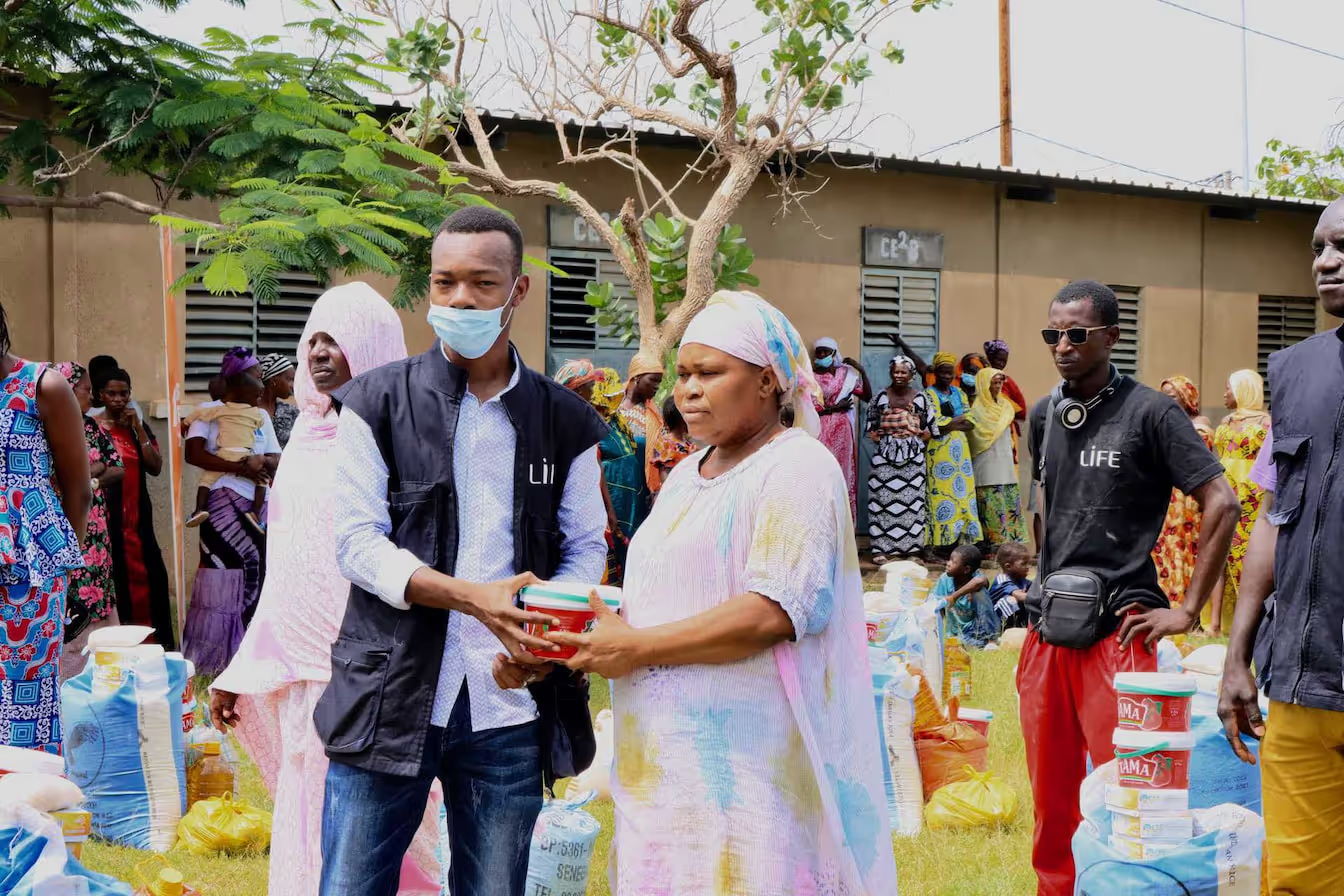
On the ground, distribution relies on local teams: volunteers, partner associations, municipal authorities. Each beneficiary is identified (biometric fingerprint, card, list) to avoid duplicate distributions. The format chosen depends on the context: dry rations in hot areas without a cold chain, hot meals in refugee camps, electronic vouchers where markets are functioning.
Step 5: monitoring and evaluation
Post-distribution monitoring measures actual coverage, beneficiary satisfaction, ration use and nutritional progress. This data feeds into adjustments to the plan and into accountability towards donors.
Who are the actors in emergency food aid?
The ecosystem is structured across three levels: coordinating UN agencies, international field NGOs, and local implementing partners.
UN agencies and clusters
The WFP (World Food Programme) is the world’s leading actor. Winner of the 2020 Nobel Peace Prize, it assisted 152 million people in 2023 across 80 countries. In 2025, it distributed 2.3 million tonnes of food and paid out 2.2 billion dollars in cash transfers and vouchers. Every day it deploys 5,000 trucks, 132 aircraft and 20 ships. The WFP also co-leads the Food Security Cluster (with the FAO), which coordinates all food actors in crisis zones.
UNICEF works on acute child nutrition, supplying ready-to-use therapeutic foods.
UNHCR manages the specific food needs of refugee camps.
International NGOs
Action Against Hunger specialises in emergency nutrition and is active in around forty countries.
Médecins Sans Frontières systematically integrates a nutritional component into its emergency medical interventions.
The Red Cross and Red Crescent coordinate large-scale distributions through their national networks.
LIFE, a French humanitarian NGO founded in 2009, works in 25 countries with local partners such as Al-Amal in Gaza. Our dedicated article the role of NGOs in the fight against world hunger details the strategies deployed by these actors.
Local partners, an essential link
They are often the forgotten link in the chain, even though they are its pivot. An international NGO cannot distribute effectively without the local associations that know the terrain, the languages and the cultural codes, and that hold the necessary access. This is why LIFE systematically works with local partners such as Al-Amal in Gaza, present for more than 20 years in the Strip’s orphanages.
Since 2005, the UN humanitarian response has been organised into thematic “clusters”: Food Security, Nutrition, Health, WASH (water and hygiene), Logistics, and so on. Each cluster is led by a lead agency (the WFP for Food Security, UNICEF for Nutrition) which coordinates the NGOs working on that theme in order to avoid duplication and cover every need.
Which emergency food aid formats are used?
Five formats complement each other depending on the context, security, the state of local markets and the profile of beneficiaries.
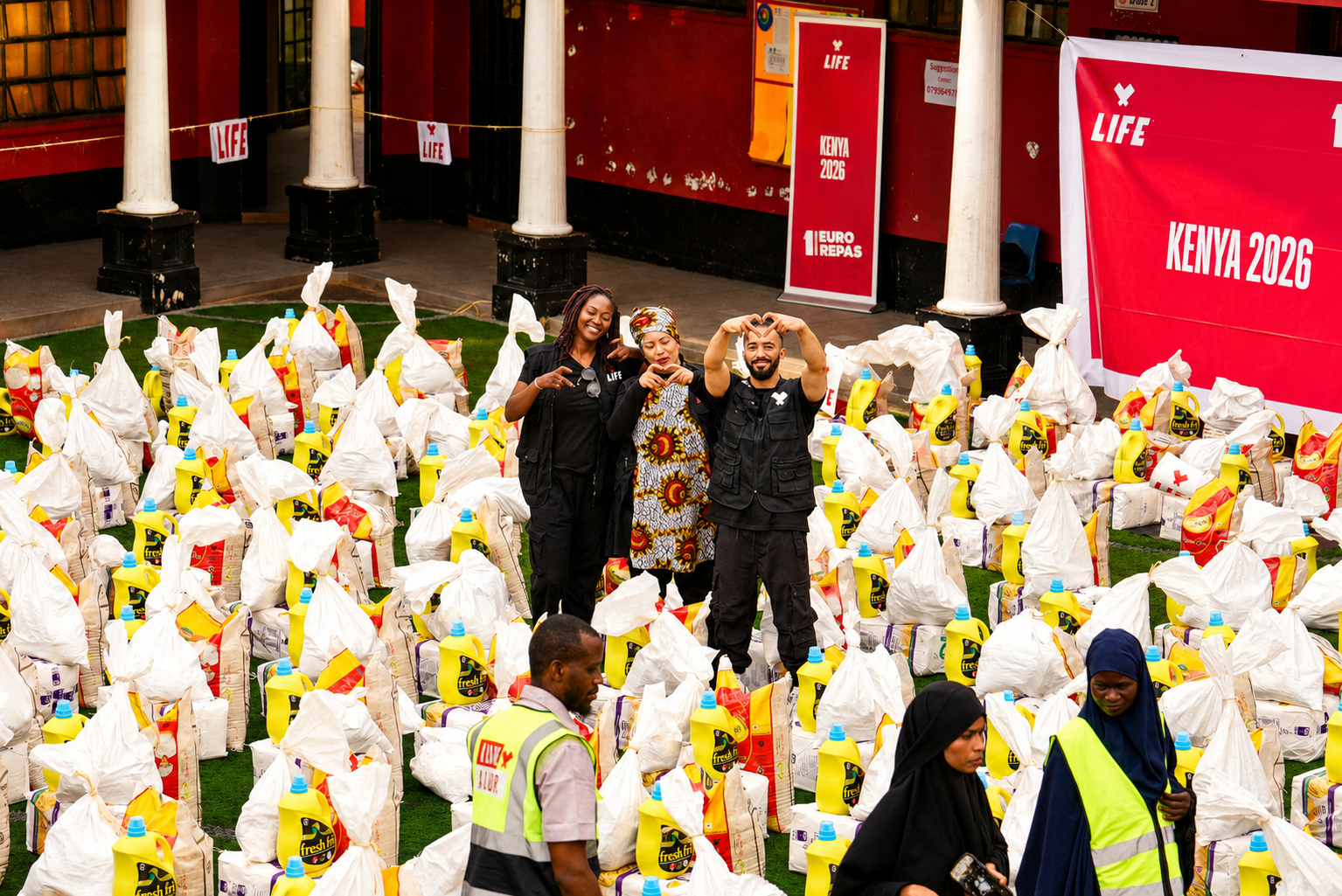
Dry rations. Rice, beans, vegetable oil, salt, sugar. A standardised composition covering around 2,100 kcal per person per day, non-perishable, transportable and cookable by the beneficiary themselves. This is the format most used in mass distribution.
Cooked hot meals. Useful in refugee camps, in emergency shelters or for people with no means of cooking (displaced people, homeless people). The psychological effect is major: a hot meal signals dignity and a return to normality.
Electronic vouchers. The NGO provides an electronic credit usable with partner retailers. Beneficiaries choose their own products, which preserves their dignity, and the local economy is supported rather than bypassed. This is the preferred format where local markets are still functioning.
Cash transfers. A direct payment by mobile or card allows beneficiaries to buy according to their real needs (sometimes non-food needs, such as rent or medical treatment). In 2025, the WFP paid out 2.2 billion dollars in this form.
Therapeutic nutrition kits. Ready-to-use therapeutic foods (Plumpy’Nut) for children with severe acute malnutrition. Treatment is outpatient and home-based, with a recovery rate above 90% when care starts early.
A closer look at the main emergency fronts in 2026
Six situations concentrate humanitarian food efforts today.
Gaza has been living through the worst food crisis in its history since 2023, with a famine officially declared by the IPC in 2025. More than 90% of residents have been displaced at least once. LIFE distributed more than 62,500 hot meals there in 2025 despite the war (source: Ouest-France, May 2025).
Sudan is experiencing the second famine officially declared in 2025, against the backdrop of a war launched in April 2023 that has displaced more than 13 million people. It is today the world’s largest humanitarian crisis by volume.
Yemen has combined civil war and blockade for nearly ten years. Massive child malnutrition, destroyed agricultural infrastructure, a collapsed economy.
Haiti tipped into a major crisis in 2024-2025 under pressure from armed groups. The WFP is calling for 332 million dollars in funding to maintain its operations until April 2027.
The Democratic Republic of the Congo combines conflict in the east, mass displacement, and outbreaks of cholera, malaria and Ebola. The WFP provided food rations there to tens of thousands of people in 2025.
The Sahel (Burkina Faso, Mali, Niger, Chad) is the region where acute malnutrition is advancing fastest, under the combined effect of droughts, terrorism and the collapse of basic services.
Why is it so hard to deliver aid in a crisis zone?
The obstacles are concrete and permanent. Understanding their nature helps measure the value of a successful distribution.
Security. Humanitarian convoys are regularly targeted or attacked, despite their explicit markings. The number of aid workers killed reached historic records in 2024-2025 (Gaza, Sudan, Ukraine).
Access. Blockades, checkpoints, refused transit permits, informal taxes imposed by armed groups: a convoy that does not arrive is as serious as a convoy that was never sent. In Gaza, crossing points were often closed during the most intense phases of the conflict.
Logistics. Destroyed roads, collapsed bridges, closed airports, unusable railways. The WFP sometimes deploys donkeys, yaks or helicopters when no other option is available.
The cold chain. Some nutritional products and medicines require an unbroken cold chain, a major challenge in desert areas or during power cuts.
Funding. According to the GRFC 2026, global humanitarian aid has fallen back to its lowest level since 2016, while needs have doubled in ten years. Recent cuts to American and European aid have deepened the budget crisis.
It is no longer “do NGOs know how to feed people in crisis zones”: the method is proven. The real question is: “will we have the funding to keep operations running?” Every individual donation carries new weight in a context of massive public aid withdrawal.
LIFE in emergency zones: results and method
LIFE has been working in crisis zones since 2009. Its method combines three principles.
A systematic local partner. In Gaza, the Al-Amal association identifies beneficiaries and coordinates distributions. This approach applies in every country of intervention.
A short purchasing chain. When local markets are functioning, LIFE buys on site, which shortens logistics and supports the local economy.
Reinforced traceability. Electronic voucher systems where possible, named beneficiary lists, regular reporting to donors. Our dedicated analysis of the traceability of donations in Gaza explains this system in detail.
The measurable results: 72 million meals distributed since 2009, across 25 countries, with a peak of 8 million meals in a single month during Ramadan 2023. Recent distributions have been covered by BBC News Afrique (March 2025), RFI (April 2025), Ouest-France (May 2025), Beur FM and La Nouvelle Tribune.
How can you support emergency food aid from France?
Three forms of action are open to any individual.
A one-off donation directly funds a distribution under way. A 100€ donation through the LIFE campaign “1 euro = 1 meal” funds 100 full meals on the most critical fronts. Our dedicated guide food donation: how to give effectively reviews all the options.
A monthly donation gives the NGO the visibility it needs to plan operations and negotiate framework contracts with its suppliers. A 20€ monthly payment represents around 240 meals over the year.
A donation targeted at one emergency. LIFE runs dedicated appeals for ongoing emergencies, notably Gaza and Sudan. For the Palestinian emergency, see the page dedicated to helping Palestine in 2026.
All donations qualify for a 66% tax reduction, within the limit of 20% of taxable income. A monthly donation of 20€ comes to 81.60€ net over the year.
Every euro given to LIFE funds a full meal distributed in a crisis zone: Gaza, Sudan, Lebanon, Yemen. Local partners guarantee delivery to the people who need it most.
Support the LIFE emergency appeal →What is the difference between emergency food aid and development aid?
Emergency food aid responds in the days and weeks following a trigger (war, disaster, declared famine) and aims to save lives immediately. Development aid builds a population’s food security over the long term: agricultural training, seed distribution, borehole construction, stronger social safety nets. The two are complementary: without development aid, food crises return in cycles.
How many people does the WFP help each year?
In 2023, the WFP assisted 152 million people in nearly 80 countries. In 2025, the agency distributed 2.3 million tonnes of food and paid out 2.2 billion dollars in cash transfers or electronic vouchers. The WFP is the largest humanitarian organisation in the world and won the 2020 Nobel Peace Prize for its work against hunger.
How long does an emergency food aid operation take to start?
Thanks to emergency depots pre-positioned in Italy, Panama, Ghana, Dubai and Malaysia, the WFP can deliver a first response within 24 hours to most points on the globe. For a larger-scale operation involving procurement, logistical mobilisation and coordination between actors, full deployment generally takes one to four weeks.
Is giving money more effective than sending food?
Almost always yes. NGOs buy at wholesale prices, often locally, which cuts the cost by half or two thirds compared with shipping goods from France. Local purchasing also supports the economy of the country of intervention. Shipping goods from France is only relevant in very specific cases (products unavailable on site, a total market blockade).
Why do some NGOs use electronic vouchers rather than rations?
Three reasons. The dignity of beneficiaries, who choose their products according to their tastes, needs and religious requirements. Support for the local economy, which keeps running instead of being bypassed by mass imports. Traceability, since every transaction generates an auditable record. This format is preferred wherever local markets are still functioning, which is the case in a majority of current crises.
Is 2026 a harder context than before for food aid?
Yes, according to the GRFC 2026. Needs have doubled in ten years (266 million people in acute food insecurity in 2025) while global humanitarian aid has fallen back to its lowest level since 2016. Recent budget cuts by major public donors create a scissor effect that makes individual donations all the more strategic for keeping current operations running.