
Solidarity food parcels: how they work and who they help
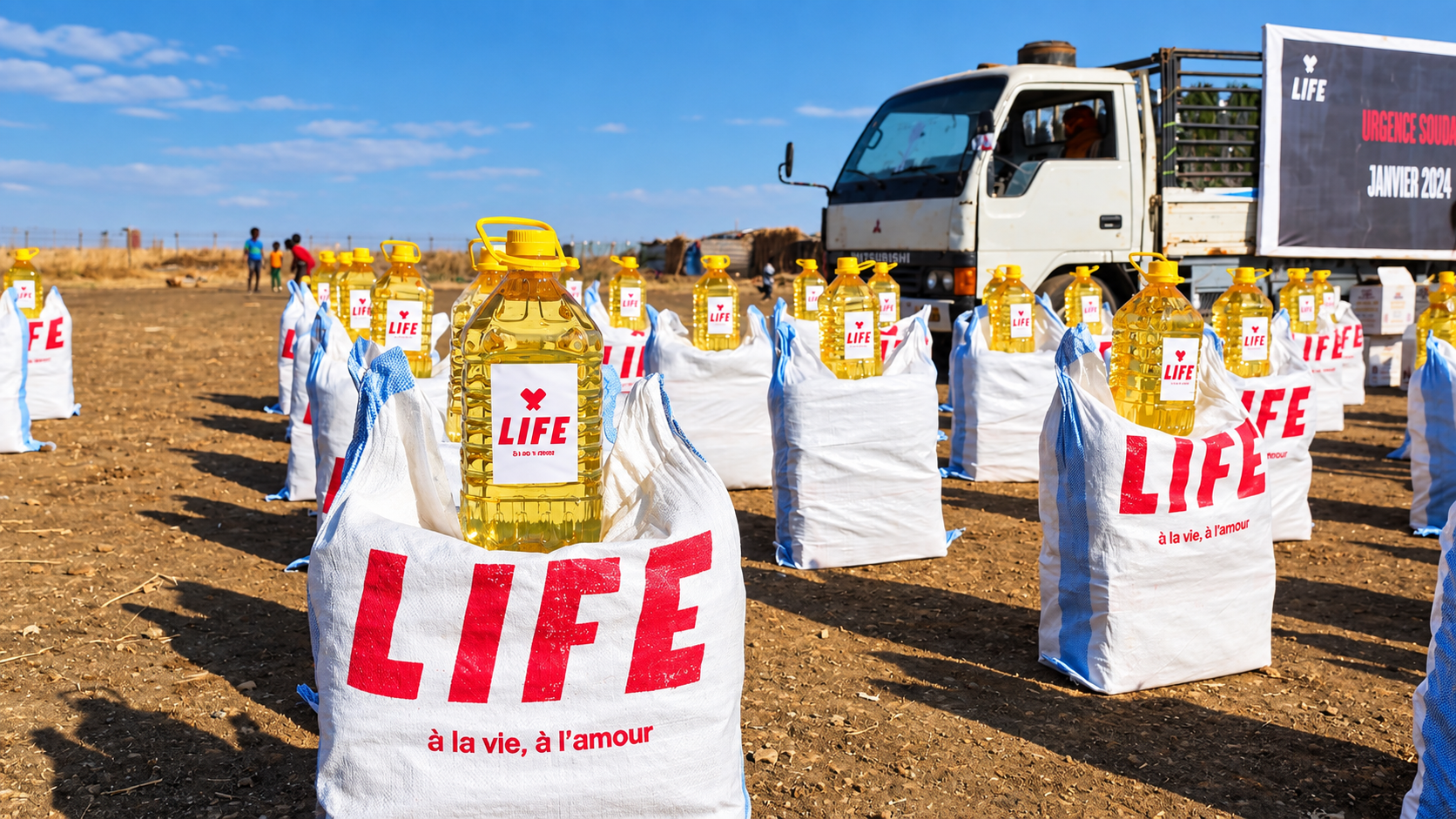
- The food parcel is the most widespread form of food aid in France, ahead of solidarity grocery stores and hot meal distributions.
- A parcel generally feeds a family of four for two weeks, at a real cost of 15 to 50€ thanks to pooled resources.
- Emergency parcels are distributed without conditions; recurring parcels are subject to means testing.
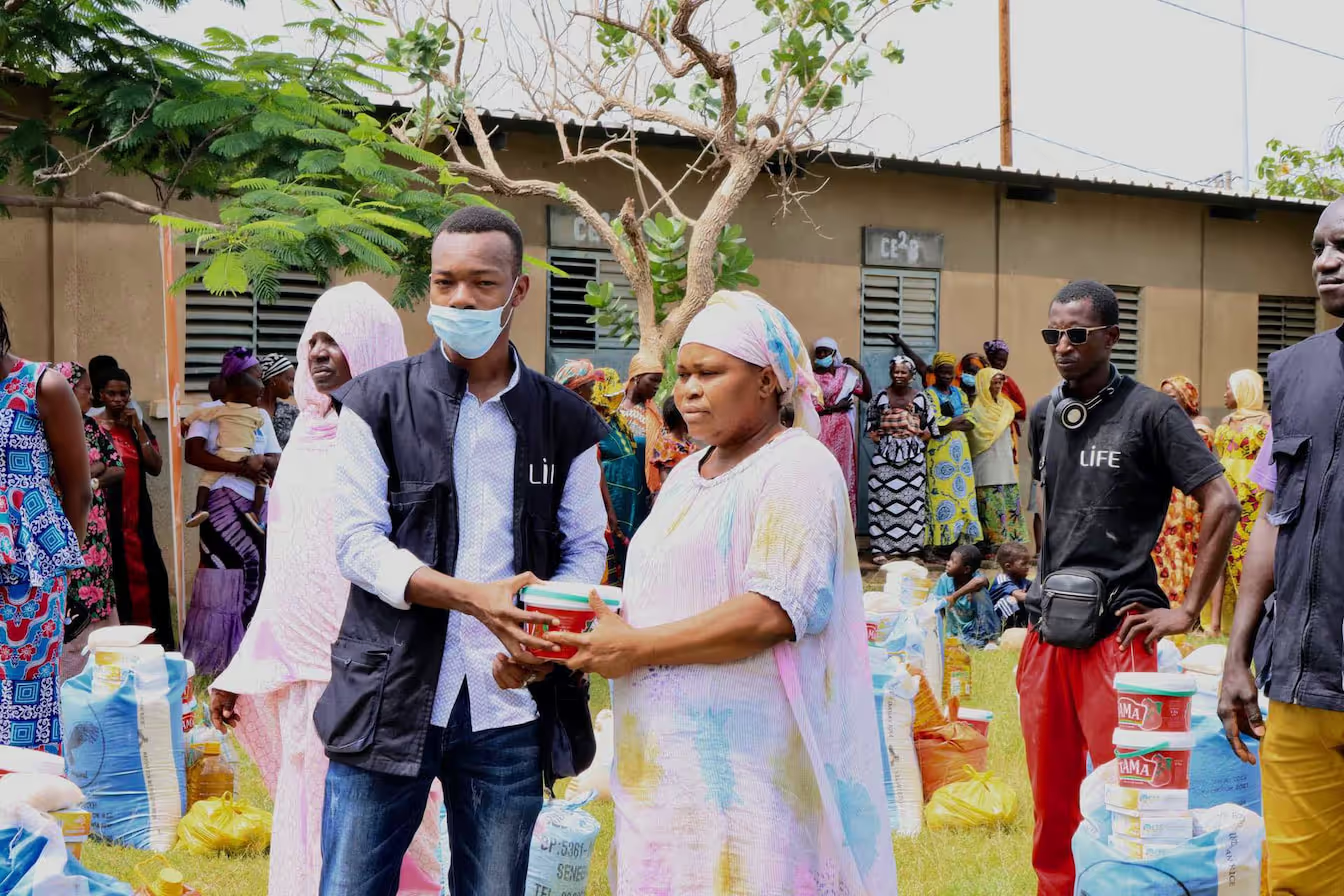
- In humanitarian zones, LIFE distributes parcels adapted to local food cultures, such as the 411 parcels distributed in North Lebanon in the Abu Ibrahim, Al-Imna and Rihaniya camps.
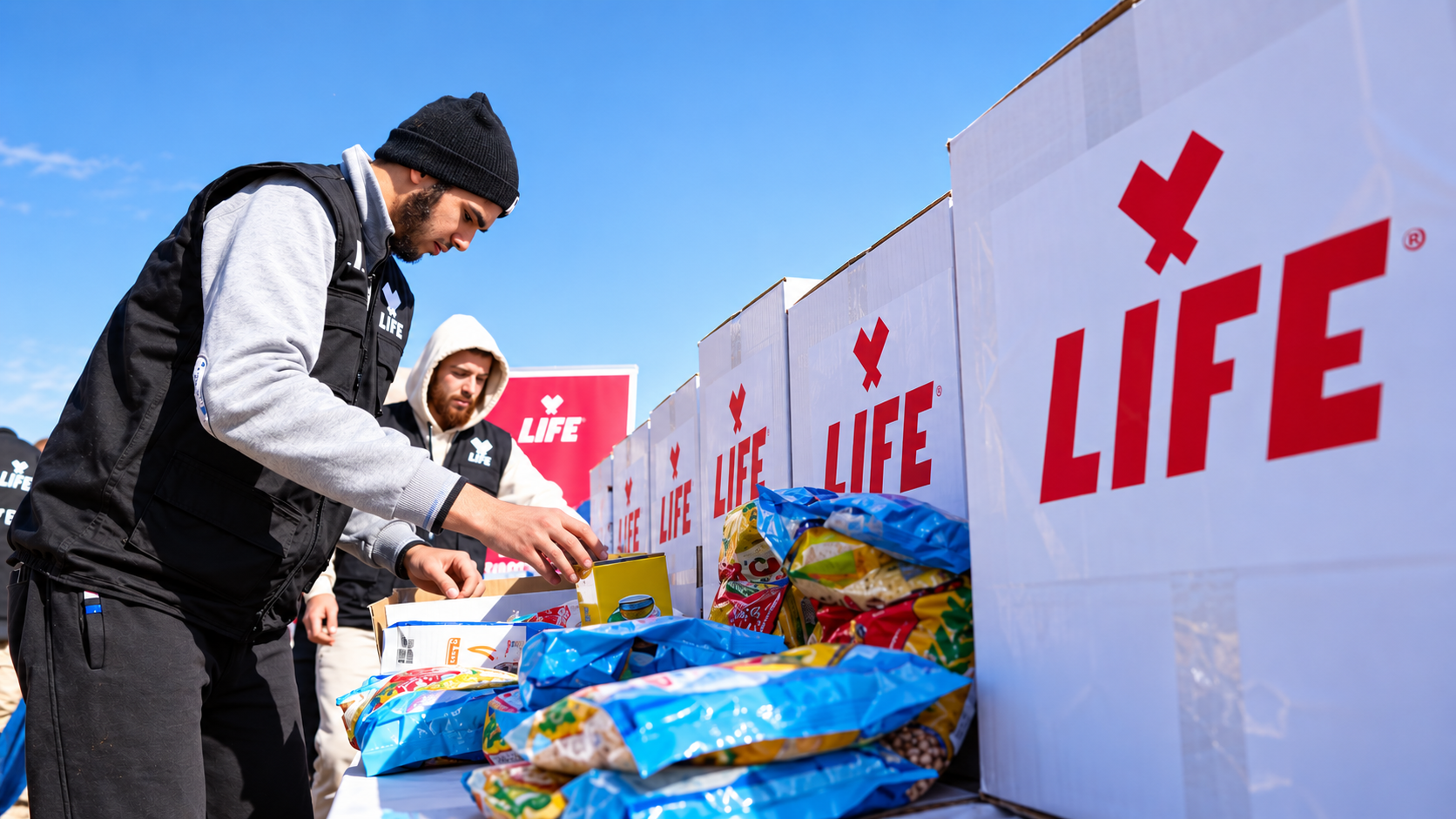
- LIFE’s Grand Froid (Deep Winter) campaign reinforces distributions every winter for homeless people, refugees and families in precarious situations in France and abroad.
In France, more than 2.4 million people turn to some form of food aid every year, according to INSEE. The most widespread of these forms of aid, the one that allows an entire household to eat for one to two weeks, is the solidarity food parcel. This discreet system is the invisible backbone of the French food safety net, but it also concerns millions of people internationally, in refugee camps and crisis zones.
This guide explains what a food parcel contains, who it is for, how to receive or fund one, and how distribution works on humanitarian fronts. It complements our section devoted to food security.
What is a solidarity food parcel?
A solidarity food parcel is a basket of unprepared food, given free or at a heavily reduced price to a person or family in a precarious situation. Unlike a hot meal served on site, the parcel is meant to be cooked and eaten at home, in the days or weeks that follow.
In France, INSEE distinguishes three broad forms of food aid, each with its own logic.
| Form | How it works | Who it is for |
|---|---|---|
| Food parcels | A basket of food to cook at home | Housed households, families |
| Solidarity grocery stores | A shop with reduced prices (10 to 30% of market price) | Recipients with a kitchen and a tight budget |
| Ready-to-eat meals | Hot meal on site or to take away | Homeless people, people without a kitchen |
The parcel remains the dominant form because it combines three advantages: it respects the household’s own rhythm, it allows a composition adapted to specific needs (families with babies, special diets), and it costs the charity less than preparing hot meals.
What does a solidarity food parcel contain?
The composition varies according to the distributing organisation, the season, available stocks and the recipient’s profile. Three main types of parcel exist in practice.
The emergency parcel
Made up of food that is long-lasting and ready to eat without complex cooking. The aim: to cover the immediate needs of a person in distress, including someone with no access to an equipped kitchen (people housed in hotels, people on the street, emergency situations).
Typical contents: sliced bread, ready-to-open tins (tuna, sardines, ravioli), carton soup, fruit purée, energy biscuits, mineral water and basic hygiene products.
The balanced (family) parcel
This is the most common format, intended for households with a kitchen. The aim is to cover a family’s food needs for one to two weeks, with a nutritionally balanced composition.
Typical contents: dry goods (pasta, rice, semolina, pulses), tinned vegetables and fish, oil, dairy products (yoghurt, UHT milk), fresh fruit and vegetables, eggs, hygiene products (soap, toothpaste, sanitary protection).
A concrete example: for 50€, the charity Halte du Cœur provides a food parcel that feeds a family of four for 15 days, representing less than 20% of the real market value thanks to pooled resources and donations of unsold goods.
The Grand Froid winter parcel
A reinforced version of the emergency parcel, distributed during the winter months. It includes calorie-dense, warming products that are easy to prepare without equipment, along with hygiene items suited to the cold season.
Typical contents: carton soups, powdered hot drinks (chocolate, tea, coffee), energy bars, chocolate, pastries, and in some extended parcels blankets, socks, hats and gloves.
Who are solidarity food parcels for?
The recipients are varied and shift with the economic context.
In France: five dominant profiles
Single-parent families, mostly lone mothers, often forced to choose between rent and food.
The working poor, whose income does not cover their outgoings despite having a job.
Students in precarious situations, a group growing very fast since the inflation of 2022.
Isolated pensioners, whose small pensions have been crushed by rising costs.
People with no home or in emergency accommodation, who receive emergency parcels without conditions.
According to INSEE, four recipients out of five report persistent difficulties with their diet, notably the need to reduce quantities or the variety of food.
Internationally: recipients in humanitarian zones
Food parcels take on a different dimension in crisis zones. They are distributed to displaced families, to refugees in camps, and to populations cut off from markets by conflict or blockade. The composition is then adapted to local food cultures and to the cooking facilities available (often a simple wood fire or a gas stove).
Concrete examples of LIFE operations:
- In North Lebanon, 411 food parcels distributed in the Abu Ibrahim, Al-Imna and Rihaniya camps for displaced Syrian and Lebanese families.
- In Gaza, regular distributions despite the war, as part of an emergency operation coordinated with local partner Al-Amal.
- In Sudan, distributions targeted at the areas worst hit by the famine declared in 2025.
To understand the conflicts that make these distributions necessary, see our analysis conflict and food insecurity.
How can you obtain a food parcel in France?
The usual route starts with contacting a social support body.
The CCAS, the official entry point
Your local Centre communal d’action sociale (CCAS) is the first port of call. A social worker assesses your situation (income, household composition, outgoings) and directs you to the appropriate organisations. This step is useful even if you already know a charity, because it opens access to other schemes (financial aid, solidarity grocery stores, food vouchers).
Local charities
Restos du Cœur, Secours Populaire, the French Red Cross, Secours Catholique, parish or neighbourhood associations: most run distribution centres where you can register directly. The paperwork required varies (proof of address, latest tax notice, proof of income), but emergency parcels are always provided without conditions in cases of obvious distress.
Renewing your file
Registration is never permanent. Most charities require renewal every six months or every year, with an updated account of your situation. Failing to renew leads to immediate suspension of the aid.
Solidarity grocery stores
A complement to the parcel, the solidarity grocery store works like a conventional shop, but with prices set at between 10% and 30% of market price. Access is means-tested, on referral from a social worker. The ANDES network counts more than 400 solidarity grocery stores in France.
How does distribution work in humanitarian zones?
On international fronts, the chain is more complex. It rests on three key stages.
Identifying recipients
A local partner (humanitarian association, municipal authority, neighbourhood committee) draws up the list of priority families, based on precise criteria: loss of the household breadwinner, displacement, presence of malnourished children, absence of any other regular support.
Adapting the parcel’s composition
A food parcel in Sudan looks nothing like a parcel in France. The goods reflect local habits: sorghum or millet rather than wheat, chickpeas and broad beans rather than green beans, sesame oil rather than sunflower oil. In majority-Muslim areas, the whole parcel meets halal requirements.
Distribution logistics
Delivery by truck, donkey or porters depending on accessibility. Collective distribution at a central point (school, mosque, village square) or door-to-door for vulnerable people. Biometric or named registration of each recipient to avoid duplicate distributions.
A parcel made up of products unknown in the country (for example white flour in a sorghum-growing country, or pork in a Muslim country) is useless, even insulting. The principle of local purchasing and cultural adaptation of parcels is not a luxury: it is what guarantees that the food will actually be eaten and fit into the household’s habits.
How much does a solidarity food parcel cost?
The real cost to the charity is far below the market value of the contents, thanks to four cumulative mechanisms.
Donations of unsold goods. Since the 2016 Garot law, supermarkets larger than 400 m² have been required to donate their edible unsold stock. These donations cover on average 90% of the contents of a Halte du Cœur parcel.
Bulk purchasing. The remaining 10% is bought by charities at wholesale prices, with considerable economies of scale.
Volunteering. Sorting, preparation and distribution are carried out mainly by volunteers, which cuts running costs sharply.
Public subsidies. The State and local authorities partly fund supply chains, notably through the European Fund for Aid to the Most Deprived (FEAD).
Orders of magnitude observed in 2026:
| Type of parcel | Real cost to the charity | Equivalent market value |
|---|---|---|
| Individual emergency parcel | 5 to 10€ | 30 to 40€ |
| Balanced family parcel (4 people, 1 week) | 25 to 30€ | 100 to 150€ |
| 15-day family parcel | 50€ | 250 to 300€ |
| Humanitarian parcel (Gaza, Sudan) | 30 to 40€ | Depending on local market |
How can you fund or offer a solidarity food parcel?
Three main formats exist, from the simplest to the most committed.
A one-off donation earmarked for “parcels”. Many charities offer a dedicated form that lets you fund one or several parcels. At LIFE, a donation of 30 to 50€ funds a family food parcel adapted to the field, like those distributed in Lebanon or Gaza. Our dedicated guide food donation: how to give effectively reviews all the options.
A monthly donation. A 20€ monthly payment allows the charity to plan its parcel logistics over time. To understand how effective this format is, see our analysis 1 euro = 1 meal: a lesson in solidarity.
Donations in kind through the National Collection. Every last weekend of November, the Banques Alimentaires organise a food collection in partner supermarkets. You buy products and leave them at the checkout exit. A single day can represent up to 20% of the food collected over the whole year.
All these donations qualify for a 66% tax reduction within the limit of 20% of taxable income, raised to 75% within a 1,000€ limit for organisations helping the most deprived (the Coluche scheme). The detailed calculation is set out on our tax reduction page.
Focus: the LIFE Grand Froid campaign
Every winter, LIFE steps up its distributions through the Grand Froid campaign, which specifically targets the people most exposed to sub-zero temperatures: homeless people, refugees in camps, and families in precarious situations in winter conflict zones (Lebanon, Syria, Ukraine).
The Grand Froid parcel includes components suited to winter conditions: calorie-dense ready-to-eat food, hot drinks, thermal blankets, hats and warm socks. It is distributed both in France (through local partners) and on international fronts exposed to extreme cold.
A Grand Froid parcel costs 30 to 50€ depending on the format. After the 66% tax reduction, a 50€ donation (1 parcel) comes to 17€ net. Your donation directly funds the distributions of winter 2025-2026.
Support the Grand Froid campaign →To go further into LIFE’s work with homeless people, our detailed article helping homeless people through winter sets out the complementary measures (street outreach, emergency accommodation, heating kits).
What is the average price of a solidarity food parcel?
For the charity distributing it, the real cost ranges from 5 to 50€ depending on the format (individual emergency, family, humanitarian). This saving is possible thanks to donations of unsold goods (the Garot law), bulk purchasing at wholesale prices, volunteering and public subsidies. The equivalent market value for an individual buyer would generally be three to five times higher.
Who can receive a food parcel in France?
Anyone in a precarious situation, referred by a social worker or received directly by a charity. The criteria are generally insufficient income relative to outgoings, but emergency parcels are distributed without conditions in cases of obvious distress. Priority groups are single-parent families, the working poor, students in precarious situations, isolated pensioners and people without a home.
How can you obtain a food parcel in an emergency?
If you are in immediate food distress, contact a frontline charity directly (Restos du Cœur, Secours Populaire, the Red Cross, Secours Catholique) or go to a day centre. You can also call 115 (the free social emergency number, available 24/7), which will direct you to the nearest facility.
Is a food parcel nutritionally balanced?
It depends on the format. The balanced family parcel contains dry, fresh and dairy products plus a hygiene component, to cover a family’s needs for 7 to 15 days. The emergency parcel is deliberately made up of ready-to-eat products, less balanced but suited to people with no access to a kitchen. Charities often add cooking workshops and nutritional advice to help recipients make the most of the contents.
What is the difference between a food parcel and a food voucher?
The food parcel is made up of physical goods prepared in advance by the charity and handed over at a distribution. The food voucher (such as the Red Cross CAP) is a payment token usable in partner shops to buy food freely. The voucher offers more freedom of choice; the parcel offers more certainty about the contents and more social support.
How can you fund a food parcel internationally?
Most humanitarian NGOs offer an earmarked “food parcel” donation on their website. At LIFE, a donation of 30 to 50€ funds a family parcel adapted to the field (Gaza, Sudan, Lebanon). You can also support the “1 euro = 1 meal” campaign or the Grand Froid campaign more broadly, whose funds are allocated according to ongoing emergencies. All donations qualify for a 66% tax reduction.