
Water and health: how access to water reduces childhood diseases

- According to the WHO, 1.4 million people die every year from a lack of safe drinking water, sanitation and hygiene. Around 1,000 children under 5 die from these causes every day.
- 88% of diarrhoea deaths are attributable to unsafe water, inadequate sanitation and poor hygiene (UNICEF/WHO).
- Contaminated water transmits cholera, dysentery, typhoid, hepatitis A and polio. Drinking-water contamination alone causes 505,000 diarrhoeal deaths every year (WHO).
- The vicious circle is little known: repeated bouts of diarrhoea deprive children of the nutrients they need to grow, which weakens them and makes them more vulnerable.
- A protected well, latrines and handwashing with soap (which cuts diarrhoea by more than 40%) form the trio that breaks this cycle.
It is one of the most direct links in all of global public health: the water a child drinks largely determines their chances of survival. Not in an abstract way, but through precise, well-documented biological mechanisms. Understanding how water kills makes it possible to understand why a well saves.
Which diseases does unsafe water transmit?
Contaminated water is not simply “dirty”: it is a transmission vector for a whole family of diseases. According to the WHO, microbiological contamination of drinking water can transmit diarrhoea, cholera, dysentery, typhoid fever and polio.
The mechanism is almost always the same, and it is important to understand it: faecal matter, human or animal, contaminates the water source. The pathogens it contains are ingested when people drink or cook. They then attack the digestive system.
That is why surface water, in a pond or an open river, is so dangerous: nothing protects it from run-off, livestock or open defecation. A drilled well, by contrast, reaches an underground water table that is naturally protected.
According to the WHO, 1.4 million people die every year because of a lack of safe drinking water and inadequate sanitation and hygiene systems. Microbiological contamination of drinking water alone causes around 505,000 deaths from diarrhoeal diseases every year. The vast majority of these deaths occur in low- and middle-income countries.
Why are children the first victims?
Around 1,000 children under five die every day worldwide from causes linked to unsafe water, lack of sanitation and insufficient hygiene. This figure, put forward by the WHO and UNICEF, deserves a closer look at its causes.
Three factors explain why young children are so over-exposed.
1. An immature immune system. An adult can absorb a bacterial load that will floor a two-year-old. Their defences are not yet built.
2. Rapid dehydration. This is the decisive point. It is not diarrhoea itself that kills, but the loss of water it causes. A small body becomes dehydrated within hours, whereas an adult will hold out for several days.
3. Maximum exposure. Children play on the ground, put their hands in their mouths, and drink whatever water is available without a second thought.
The result: according to the World Bank, around 446,000 children under five die of diarrhoea every year, which represents 9% of all child deaths worldwide.
The vicious circle between water, diarrhoea and malnutrition
Here is the mechanism least known to the general public, and yet one of the most destructive. People believe diarrhoea is a passing episode. In reality, in a young child, each episode leaves a lasting mark.
According to the WHO, in low-income countries children under three experience an average of three diarrhoeal episodes per year. And each of these episodes deprives them of the nutrients they need to grow.
The circle then sets in: contaminated water causes diarrhoea, diarrhoea prevents the absorption of nutrients, undernutrition weakens immune defences, and the weakened child falls ill more easily at the next contact with contaminated water. Each turn of the wheel makes them more vulnerable.
This explains a phenomenon that often puzzles people: in some regions, food can be distributed without malnutrition receding, quite simply because the problem is not only food intake, but the body’s inability to absorb it. Without clean water, nutrition does not follow.
Solving water means acting upstream of health, nutrition and growth. That is why water access projects are considered one of the most cost-effective public health interventions there is. Our article Donating for safe water: the best cost-to-impact action sets out this calculation in detail.
The 3 levers that push back childhood diseases
The good news is that these diseases are preventable. According to UNICEF and the WHO, 88% of diarrhoea deaths worldwide are attributable to unsafe water, inadequate sanitation and poor hygiene. In other words, by acting on these three levers, the vast majority of the problem is eliminated.
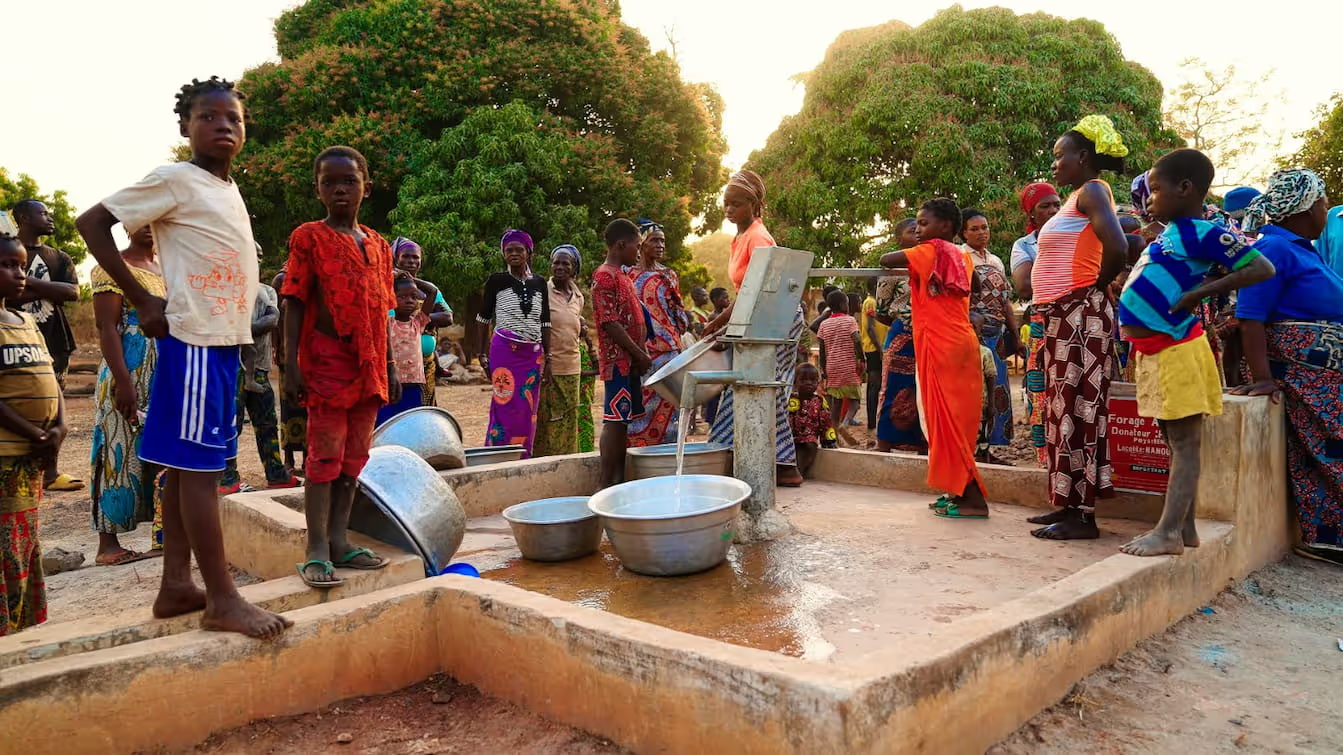
1. Water protected at the source. This is the role of the drilled well: reaching an underground water table sheltered from surface contamination, rather than drawing from a pond exposed to run-off and livestock.
2. Suitable sanitation. Without latrines, faecal matter goes back to contaminating water sources and the cycle starts again. That is why water and sanitation are inseparable. Our article Sanitation and hygiene: the water-health-education trio explores this point further.
3. Hygiene, and above all handwashing. It is the most cost-effective act in all of public health: according to UNICEF and the WHO, handwashing with soap reduces diarrhoeal diseases by more than 40%. But water still has to be available to wash your hands, which brings us back to point 1.
These three levers only work together. Clean water without latrines, or latrines without water to wash hands, are not enough to break the cycle.
What a well concretely changes in a village
When a village gains access to protected water, the health effects are not long in coming. Diarrhoeal episodes become rarer, children finally absorb their nutrients, medical consultations and costs fall, and the growth of the youngest picks up again.
The effect goes beyond health alone. A child who is no longer permanently ill can go to school. A mother who no longer spends her days caring for the sick or fetching water can work. A village that spends less on healthcare can invest elsewhere.
This is the logic that structures Life ONG’s water programme. A village well, drilled to around 20 metres and fitted with a pump, serves about 500 people, and its specifications include a laboratory analysis of the water’s drinkability before any consumption. Funding amounts to €2,650 in Africa, or around €901 after the 66% tax reduction. To understand the full course of the works, our article Building a well in Africa: steps, costs and real impact details each phase.
Discover Life ONG’s water programme. A well serves around 500 people, with laboratory testing of water quality. €2,650 in Africa, or €901 after tax reduction. Donor relations team available.
Discover the water programme →Which diseases are caused by unsafe water?
According to the WHO, microbiological contamination of drinking water can transmit diarrhoea, cholera, dysentery, typhoid fever and polio. This contamination alone causes around 505,000 deaths from diarrhoeal diseases every year worldwide.
How many children die because of unsafe water?
Around 1,000 children under five die every day worldwide from causes linked to unsafe water, lack of sanitation and insufficient hygiene (WHO/UNICEF). In total, the WHO estimates that 1.4 million people die every year for these reasons, the vast majority in low- and middle-income countries.
Why does diarrhoea kill young children?
It is not diarrhoea itself that kills, but the dehydration it causes. A small body becomes dehydrated within hours where an adult would hold out for several days. Added to this are an immature immune system and greater exposure, as children play on the ground and put their hands in their mouths.
What is the link between water and malnutrition?
According to the WHO, in low-income countries children under three experience an average of three diarrhoeal episodes per year, and each one deprives them of the nutrients they need to grow. A vicious circle sets in: contaminated water causes diarrhoea, which prevents the absorption of nutrients, which weakens the child and makes them more vulnerable to the next illness.
How can water-related childhood diseases be reduced?
Three levers work together: water protected at the source (a drilled well reaching an underground water table), suitable sanitation (latrines) and hygiene. According to UNICEF and the WHO, handwashing with soap alone reduces diarrhoeal diseases by more than 40%, and 88% of diarrhoea deaths are attributable to these three factors combined.