
Drought in Africa: causes, consequences and lasting solutions

- Drought is no longer an isolated accident in Africa: it is becoming structural. According to the UN, at least 1.5 billion people have been directly affected by drought since the start of the century, at an economic cost of around 124 billion dollars.
- In the Sahel and West Africa, more than 54.8 million people face acute food insecurity over the June-August 2026 period.
- In the Horn of Africa, unsafe water remains widespread: 37% of Ethiopians rely on unimproved water, and 22% of Somalis on unsafe water (WHO/UNICEF JMP 2025).
- The 4 causes compound one another: climate change, land degradation, population growth and a lack of storage infrastructure.
- The most effective solution is the deep borehole, which keeps working when surface water evaporates.
In Africa, drought is not an event: it is a permanent pressure. It does not make headlines every year, but it decides the lives of tens of millions of people. Understanding its mechanisms is what makes it possible to understand why some solutions work and others do not.
What exactly is a drought?
Drought and a lack of rain are often confused. In reality, drought is an imbalance: the amount of water available becomes lastingly lower than a territory's needs.
Three forms need to be distinguished, and they often follow on from one another.
1. Meteorological drought: rainfall becomes insufficient over a given period. This is the starting point.
2. Agricultural drought: the soil no longer holds enough moisture for crops. Harvests collapse and livestock lose their pasture.
3. Hydrological drought: rivers, ponds and shallow water tables drop or dry up. This is the most serious form, because it directly affects drinking water.
This distinction is decisive for understanding the solutions. A village can survive a bad rainy season if it has access to deep groundwater. It does not survive if its only water point is a pond that evaporates.
The scale of the phenomenon in 2026
The figures show the scale of the problem. According to a UN report, at least 1.5 billion people have been directly affected by drought since the beginning of the 21st century, at an estimated economic cost of around 124 billion dollars. The UN goes as far as describing drought as the next pandemic if nothing is done.
In Africa, two regions concentrate most of the pressure.
The Sahel and West Africa. According to the Regional Climate Centre for West Africa and the Sahel, more than 54.8 million people are experiencing acute food and nutrition insecurity over the June-August 2026 period, including more than 3 million in an emergency situation. More broadly, at the end of 2025 the UN estimated that more than 42 million people would need assistance in 2026 in Burkina Faso, Cameroon, Mali, Niger, Nigeria, the Central African Republic, the DRC and Chad.
The Horn of Africa. Access to water there remains severely degraded. According to the 2025 JMP report by the WHO and UNICEF, 37% of the Ethiopian population relies on unimproved water, and 22% of Somalis, around 4.2 million people, rely on unsafe water.
Drought almost never kills directly. It sets off a chain: no more water, so destroyed harvests, so dead livestock, so collapsed incomes, so malnutrition, so weakened immunity, so deadly waterborne diseases because people drink contaminated water for want of anything better. Our article Water and health: how access to water reduces childhood illness details this last link in the chain.
The 4 causes of drought in Africa
African drought has no single cause: four factors compound and worsen one another.
1. Climate change. This is the main driver. Rising temperatures disrupt rainfall patterns: rainy seasons become shorter, later or more violent. Rain that falls too hard in too short a time runs off instead of seeping into the water table. The result: sometimes it rains just as much, but the water is no longer stored.
2. Land degradation. Deforestation, overgrazing and intensive farming destroy the plant cover that holds moisture. Bare soil heats up, hardens and lets water run away. The phenomenon is self-sustaining: less vegetation means less moisture, and therefore even less vegetation.
3. Population growth. Africa's population has more than doubled since the 1990s. Demand for water for drinking, farming and livestock rises mechanically, while the resource itself does not keep up.
4. The lack of infrastructure. This is the most often forgotten factor, and the most fixable. Without deep boreholes, without storage capacity, without networks, a territory depends entirely on that year's rainfall. It has no reserve to absorb a shock.
This last cause is crucial, because it is the only one a donor can act on directly and immediately.
Why shallow wells are not enough
Here is the decisive technical point, the one that separates a lasting solution from a sticking plaster.
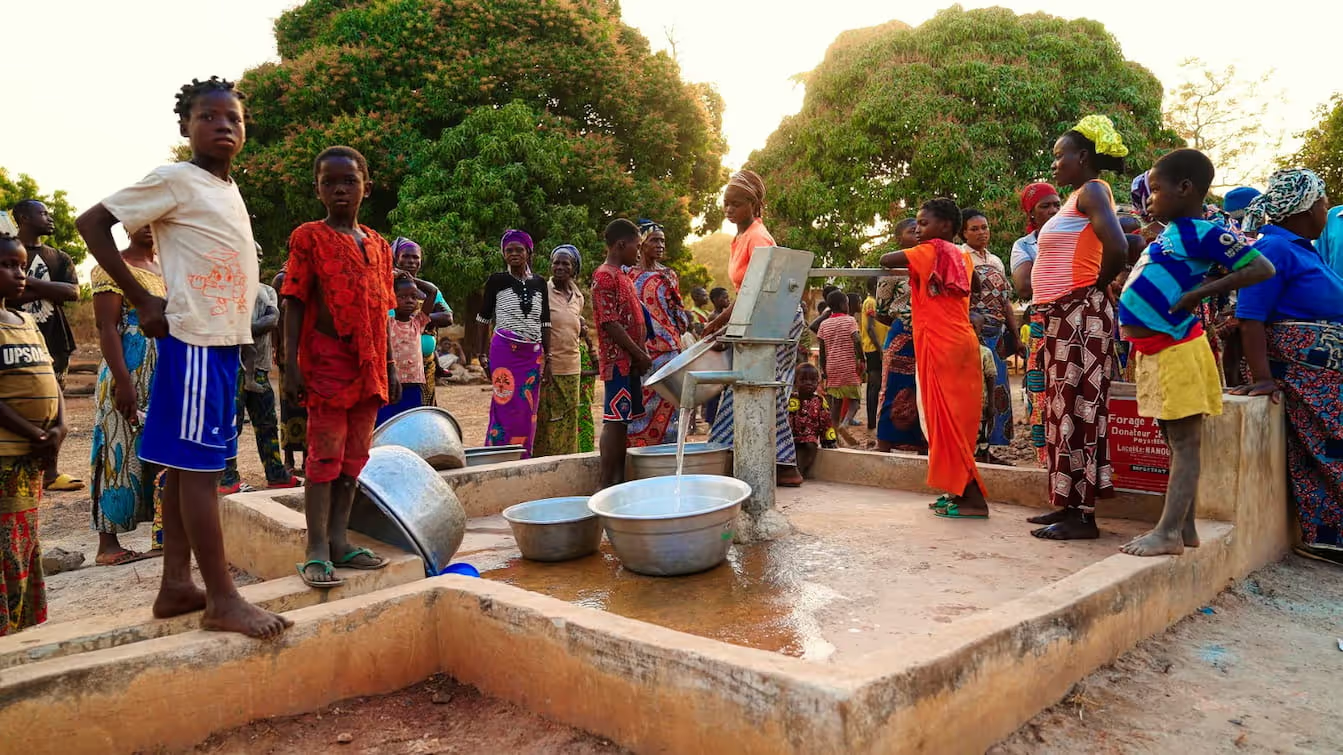
A traditional, shallow well draws on surface water and rainwater infiltration. It works very well in the wet season. But when drought sets in, it drops and then dries up, exactly when the village needs it most.
A deep borehole, by contrast, reaches an underground water table that does not depend on that year's rainfall. It keeps working through the dry season and delivers a constant flow. That is the difference between a seasonal water point and a permanent one.
That is why, in a context of recurring drought, a borehole is not a luxury: it is the only answer that holds over time. Our article Funding a borehole: what are the differences with a well? details this technical distinction.
Faced with drought, the question is not “how do we bring water now” but “how do we guarantee water all year round, every year”. Trucking water in saves lives in an emergency, but it stops. A borehole stays.
The 4 levers of a lasting response
The solutions exist and work together. Here are the four that field practitioners agree on.
1. Go and find water deep down. A borehole reaches water tables that are independent of seasonal rainfall. This is the foundation of any water resilience.
2. Restore soils and replant trees. Planting trees slows erosion, holds moisture and breaks the vicious circle of degradation. Life ONG's Sapousse programme makes it possible to plant a tree for 2 euros, an action that complements the well.
3. Develop adapted farming. Drought-resistant crops, water-efficient irrigation, water conservation techniques: the water that is available must be used intelligently.
4. Hand management over to communities. A structure without a village management committee breaks down. Sustainability comes from local training, maintenance and a common fund for repairs.
These four levers only work together: a borehole without local management stops, and replanting without water does not take.
How to act concretely
Life ONG's water programme applies this logic of resilience. A village well, dug to around 20 metres and fitted with a mechanical or electric pump, serves around 500 people and works regardless of the vagaries of the rainy season.
The specifications cover 7 stages: a geological study to locate the water table, drilling, casing, the pump, a concrete surround, laboratory testing of drinking-water quality, and training for the village management committee. Funding amounts to 2,650 euros in Africa, or around 901 euros after the 66% tax reduction.
To understand the budget in detail, our article How much does a well in Africa cost? breaks down every item. For how the work unfolds, our article Building a well in Africa: stages, costs and real impact follows each phase. And to place drought within the global water crisis, our article The world water crisis gives the full picture.
Discover Life ONG's water programme. A water point that works even in the dry season, for around 500 people. 2,650 euros in Africa, or 901 euros after tax reduction. Donor relations team available.
Discover the water programme →What are the causes of drought in Africa?
Four causes compound one another: climate change, which disrupts rainfall patterns; land degradation (deforestation, overgrazing), which prevents moisture retention; population growth, which increases demand; and the lack of drilling and storage infrastructure. This last cause is the most directly fixable.
How many people does drought affect in Africa?
According to the Regional Climate Centre for West Africa and the Sahel, more than 54.8 million people face acute food insecurity in the Sahel and West Africa over the June-August 2026 period. Globally, the UN estimates that at least 1.5 billion people have been directly affected by drought since the start of the century.
Why does a shallow well not solve drought?
Because it draws on surface water and rainwater infiltration. When drought sets in, it drops and then dries up, precisely when the village needs it most. A deep borehole, by contrast, reaches an underground water table that does not depend on that year's rainfall and keeps working through the dry season.
How does drought actually kill?
Rarely in a direct way. It sets off a domino effect: no more water, so destroyed harvests and dead livestock, so collapsed incomes and malnutrition, so weakened immunity. Families then drink contaminated water for want of anything better, and it is waterborne diseases that kill, above all children under five.
What lasting solutions are there against drought?
Four levers work together: drilling deep to reach water tables that are independent of rainfall, restoring soils and replanting trees to hold moisture, developing adapted and water-efficient farming, and entrusting the management of structures to trained village committees. These levers only work together.