
Sanitation and hygiene: the water-health-education trio

- According to the WHO and UNICEF (2025), 3.4 billion people, almost half of humanity, live without safely managed sanitation services. 354 million still practise open defecation.
- A well on its own is not enough: without latrines, faecal matter goes back to contaminating the water and the disease cycle starts again.
- 1.7 billion people have no basic hygiene service at home, even though washing hands with soap cuts diarrhoea by more than 40%.
- The absence of toilets at school deprives girls of education, particularly during their periods.
- Every dollar invested in sanitation returns 5.5 according to the WHO: it is one of the best public health investments there is.
There is a great deal of talk about access to water, and far less about toilets. That is understandable: the subject is less photogenic and more awkward. Yet without sanitation, drinking water does not deliver on its promises. Here is why these three elements, water, sanitation and hygiene, only work together.
The state of play: 3.4 billion people without safe toilets
The figure is staggering and yet little known. According to the WHO/UNICEF Joint Monitoring Programme (2025 data), 3.4 billion people, almost half the world's population, still live without safely managed sanitation services.
Among them, 354 million people have access to no toilet at all and practise open defecation: in the bushes, in gutters, in fields or near water points. And the problem is overwhelmingly rural: according to the WHO and UNICEF, 66% of people deprived of basic sanitation facilities live in rural areas.
| Indicator (WHO/UNICEF JMP, 2025) | Figure |
|---|---|
| People without safe sanitation | 3.4 billion (almost half of humanity) |
| People practising open defecation | 354 million |
| People without basic hygiene at home | 1.7 billion |
| People with no hygiene facility at all | 611 million |
| Share of people without sanitation living in rural areas | 66% |
In Africa, the situation is particularly critical: according to the JMP, 779 million people there lack basic sanitation services, including 208 million who practise open defecation.
Why water alone is not enough
This is the central point of this article, and the one that is rarely understood at first. You might think a well solves a village's health problem. In reality, it does not.
Here is why. Waterborne diseases are transmitted along a precise pathway: faecal matter contaminates the water, the contaminated water is drunk, the pathogens attack the digestive system. So if a village has clean water but defecation takes place in the open, faecal matter ends up returning to the environment and contaminating the sources, including through run-off towards shallow water points.
In other words: giving clean water to a village without settling the question of latrines is like filling a bath without putting in the plug. The cycle closes again and the diseases persist.
That is why people in the sector always talk about the trio of water, sanitation and hygiene, and never about water in isolation. The three building blocks hold each other up: water protected at the source, latrines to cut off contamination, and hygiene to block transmission through hands.
According to the WHO and UNICEF, unsafe water, inadequate sanitation systems and the lack of hygiene are responsible every day for the deaths of around a thousand children under five. It really is the three factors combined that kill, not water alone.
Hygiene: the most cost-effective act in public health
The third pillar is the simplest and the cheapest: washing your hands. And yet, according to the WHO and UNICEF (2025), 1.7 billion people have no basic hygiene service at home, including 611 million with no facility whatsoever.
The impact of this simple act is nonetheless considerable. As we set out in our article Water and health: how access to water reduces childhood diseases, washing hands with soap reduces diarrhoeal diseases by more than 40% according to UNICEF and the WHO. Few medical interventions show such a return for such a low cost.
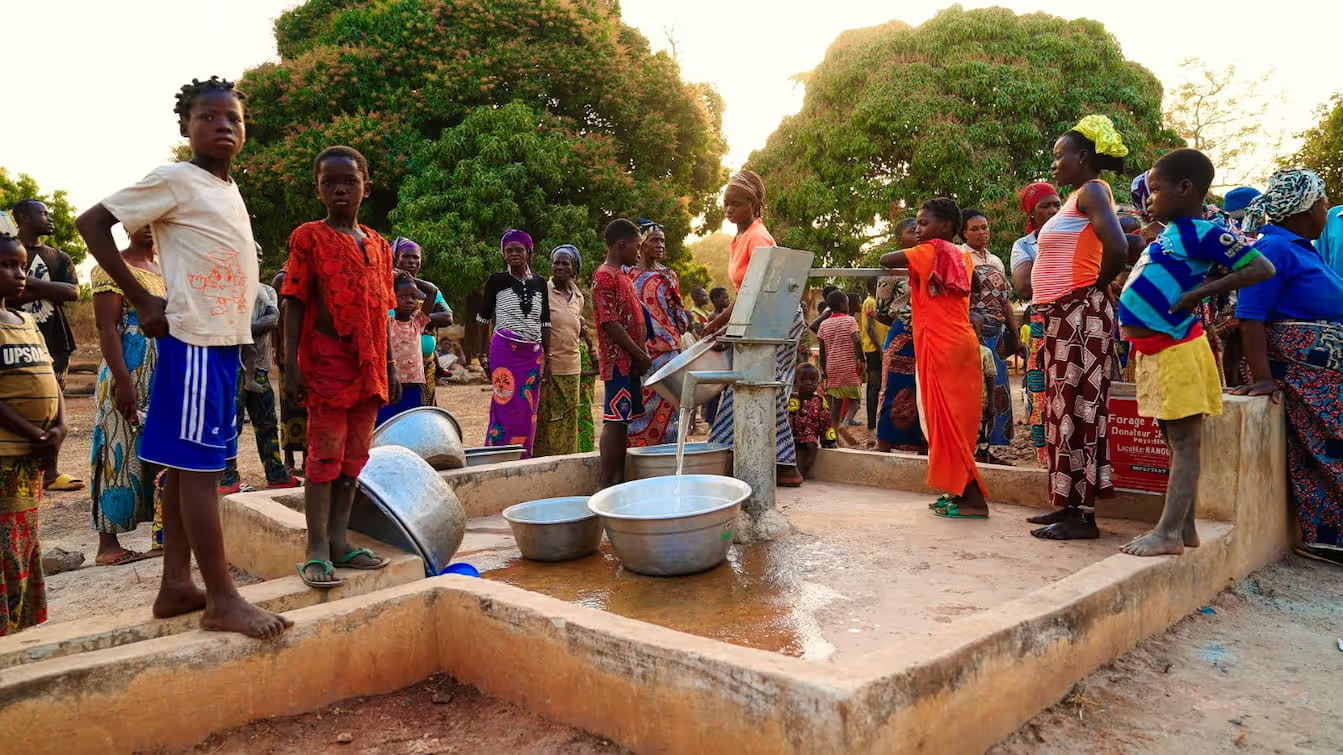
But there is an obvious condition that is often forgotten: to wash your hands, you need water to be available. A handwashing station with no water point nearby is useless. So we come back to the well. The loop is closed: each building block depends on the others.
The little-known link between toilets and girls' education
Here is the most invisible dimension of the subject, and one of the most unjust. The absence of toilets does not just make people ill: it deprives girls of education.
As UNICEF points out, when children, and girls in particular, have no access to private and decent sanitation facilities at their school, the right to education is under threat. In practice, many girls are forced to miss school during their periods, for want of toilets offering sufficient privacy.
These repeated absences, every month, end up creating a lag at school, then dropping out. A simple question of latrines thus decides the schooling, and therefore the professional future, of millions of young girls.
On top of this comes a question of dignity and safety: open defecation exposes women and girls to harassment and assault, particularly at night.
This is how the chain makes sense. Clean water pushes back disease. Latrines protect the water and dignity. Hygiene blocks transmission. The result: healthy children, girls who stay in school, and a community that can finally plan ahead. Every missing block brings the whole thing down.
An investment with an exceptional return
If the health argument were not enough, the economic argument is conclusive. According to a WHO study, every dollar invested in sanitation returns 5.5 dollars, thanks to lower health spending, productivity gains and a fall in premature deaths.
That is higher still than the return on drinking water alone, estimated by the UN at 2 dollars per dollar invested. Our article Donating for drinking water: the action with the best cost-to-impact ratio sets out these calculations in detail.
The problem, then, is not profitability but pace. The WHO estimates that the current rate of progress would have to be multiplied by five to achieve universal access to safely managed sanitation services by 2030. Without acceleration, the target will remain out of reach.
How to act in practice
The approach that works consists of never treating water in isolation, but placing it within a complete chain.
That is the logic behind Life NGO's water programme. A village well, dug to around 20 metres and fitted with a pump, serves about 500 people. Its specifications include a concrete surround to prevent contamination of the water point, a laboratory analysis of drinking-water quality, and above all the training of a village management committee, which also carries out awareness-raising on good hygiene practices.
The funding required is €2,650 in Africa, or around €901 after the 66% tax reduction. To understand the detail of the works, our article Building a well in Africa: stages, costs and real impact follows the 7 stages, and our article How much does a well in Africa cost? breaks down the budget. Life's donor relations team remains available for any question about ongoing projects.
Discover Life NGO's water programme. A protected well, analysed water, a trained village committee. €2,650 in Africa, or €901 after the tax reduction.
Discover the water programme →How many people have no access to sanitation worldwide?
According to the WHO/UNICEF Joint Monitoring Programme (2025), 3.4 billion people, almost half the world's population, live without safely managed sanitation services. Among them, 354 million still practise open defecation. 66% of people deprived of basic sanitation facilities live in rural areas.
Why is drinking water not enough without sanitation?
Because without latrines, faecal matter goes back to contaminating the environment and water sources, notably through run-off. The transmission cycle of waterborne diseases then closes again. That is why people in the sector always talk about the trio of water, sanitation and hygiene: the three building blocks hold each other up.
What is the link between toilets and girls' education?
According to UNICEF, the absence of private and decent sanitation facilities at school threatens the right to education. Many girls are forced to miss school during their periods for want of toilets offering sufficient privacy. These repeated absences create a lag at school, then dropping out.
Is sanitation a good investment?
It is one of the best in public health. According to a WHO study, every dollar invested in sanitation returns 5.5 dollars, thanks to lower health spending, productivity gains and a fall in premature deaths. That is more than the return on drinking water alone, estimated at 2 dollars per dollar invested.
How effective is handwashing?
According to UNICEF and the WHO, washing hands with soap reduces diarrhoeal diseases by more than 40%. It is one of the most cost-effective acts in public health. But it assumes water is available nearby, which brings us back to the need for a water point in the village. Today, 1.7 billion people have no basic hygiene service at home.