
€1 = 1 meal: how one euro can feed a person

- The “1 euro = 1 meal” concept relies on bulk purchasing and local distribution, which bring the cost of a complete meal down to around €1.
- LIFE has been running this campaign since 2009 and has distributed more than 72 million meals across 25 countries in 15 years.
- In France, the Restos du Cœur apply the same principle and served 161 million meals in 2024-2025.
- After the 66 % tax reduction, a €30 donation (30 meals) costs the donor only €10.20.
- A monthly donation of €20 funds around 240 meals a year.
In Paris, a quick lunch costs €12 on average. In Beirut, a family can feed every one of its members for the equivalent of one euro per person. This is not a marketing slogan, it is an accounting fact: in the countries where LIFE works, a complete meal, cooked and distributed, genuinely costs one euro thanks to locally negotiated bulk purchasing and well-oiled logistics chains.
That is the logic behind the “1 euro = 1 meal” campaign, which has been running since 2009. This guide breaks down how that figure holds up, what a meal funded this way actually contains, and how your one-euro donation turns into a hot meal for someone in Sudan, Gaza or Lebanon.
1 euro = 1 meal: is it really possible?
Yes, provided three conditions are met at once.
The first is bulk purchasing. An NGO distributing 8 million meals in a single month, as LIFE did in 2023, does not buy at retail market prices. It negotiates framework contracts with wholesalers, often local ones, and secures rates far below what an individual would pay.
The second is local sourcing. In the field, staple foods cost a fraction of their French price. A kilo of rice in Cambodia, a kilo of lentils in Sudan or of chickpeas in Lebanon are available at incomparable prices. Buying on site cuts logistics costs and supports local economies along the way.
The third is volunteering. At the Restos du Cœur, 75,000 volunteers absorb the bulk of the handling, preparation and distribution work. At LIFE, local partners play that role in humanitarian settings. This factor explains why the majority of donations can be allocated directly to programmes rather than to overheads.
Combined result: the Restos du Cœur report a cost price of one euro per meal distributed, with 93.4 % of their resources allocated to social missions. LIFE reaches the same ratio in its international operations, with a different equation (lower purchase costs, higher logistics costs).
A €100 donation funds 100 complete meals in the field. After the 66 % tax reduction, that same donation actually costs you only €34. It is this mechanism, more than generosity alone, that makes the model viable at scale.
What actually goes into a €1 meal?
The composition varies from one country of operation to another, but the nutritional logic is constant: a meal must provide between 600 and 800 kilocalories, with carbohydrates, proteins and fats, and must respect local eating habits.
Here are three examples of standard rations funded by LIFE as part of the campaign.
| Field | Typical composition of a €1 meal |
|---|---|
| Gaza | Basmati rice, cooked lentils or broad beans, flatbread, dates, olive oil |
| Sudan | Sorghum or millet, chickpeas, onions, vegetable oil, tea |
| Lebanon (refugee camps) | Rice, chickpeas, tomatoes, onions, oil, Arabic bread |
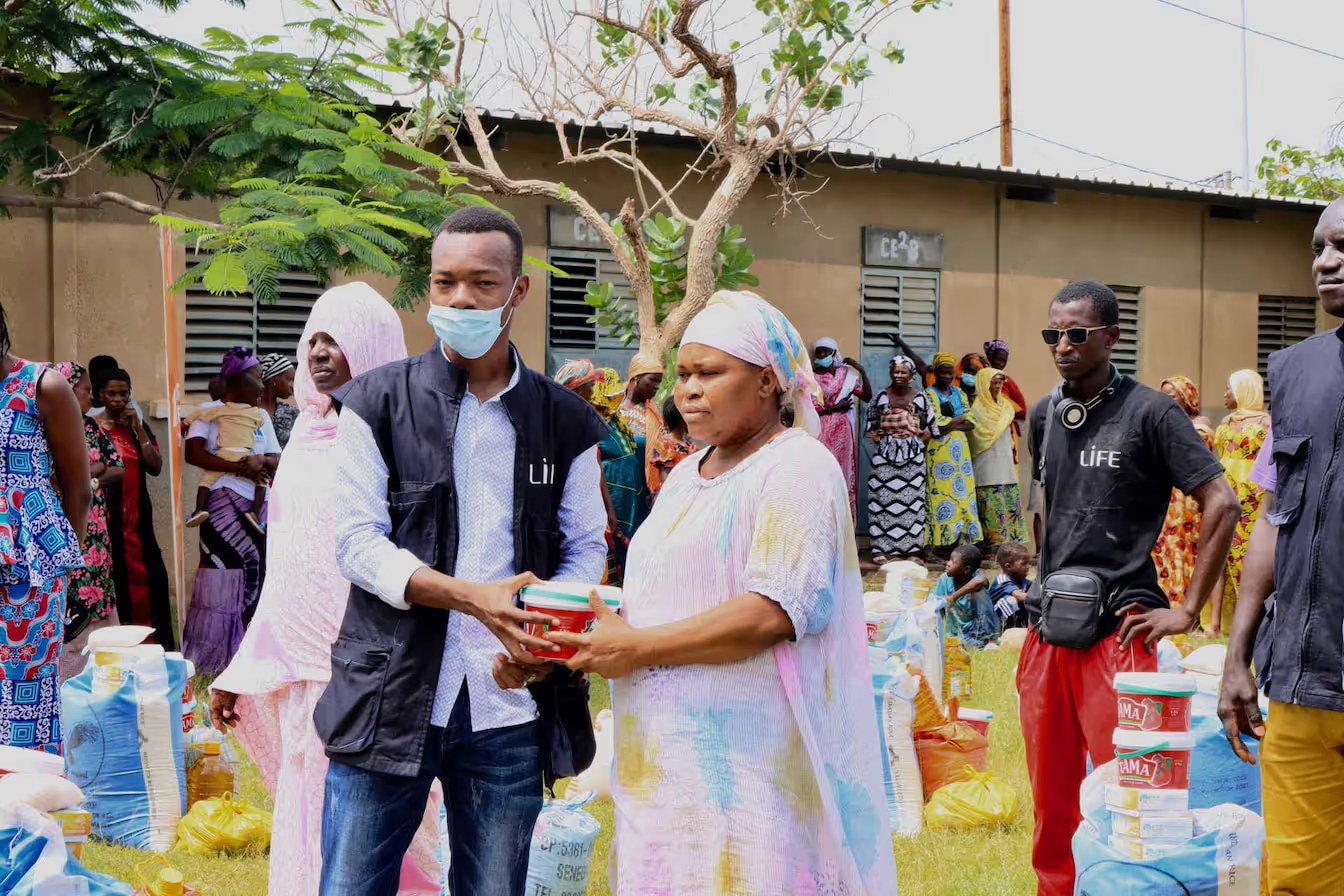
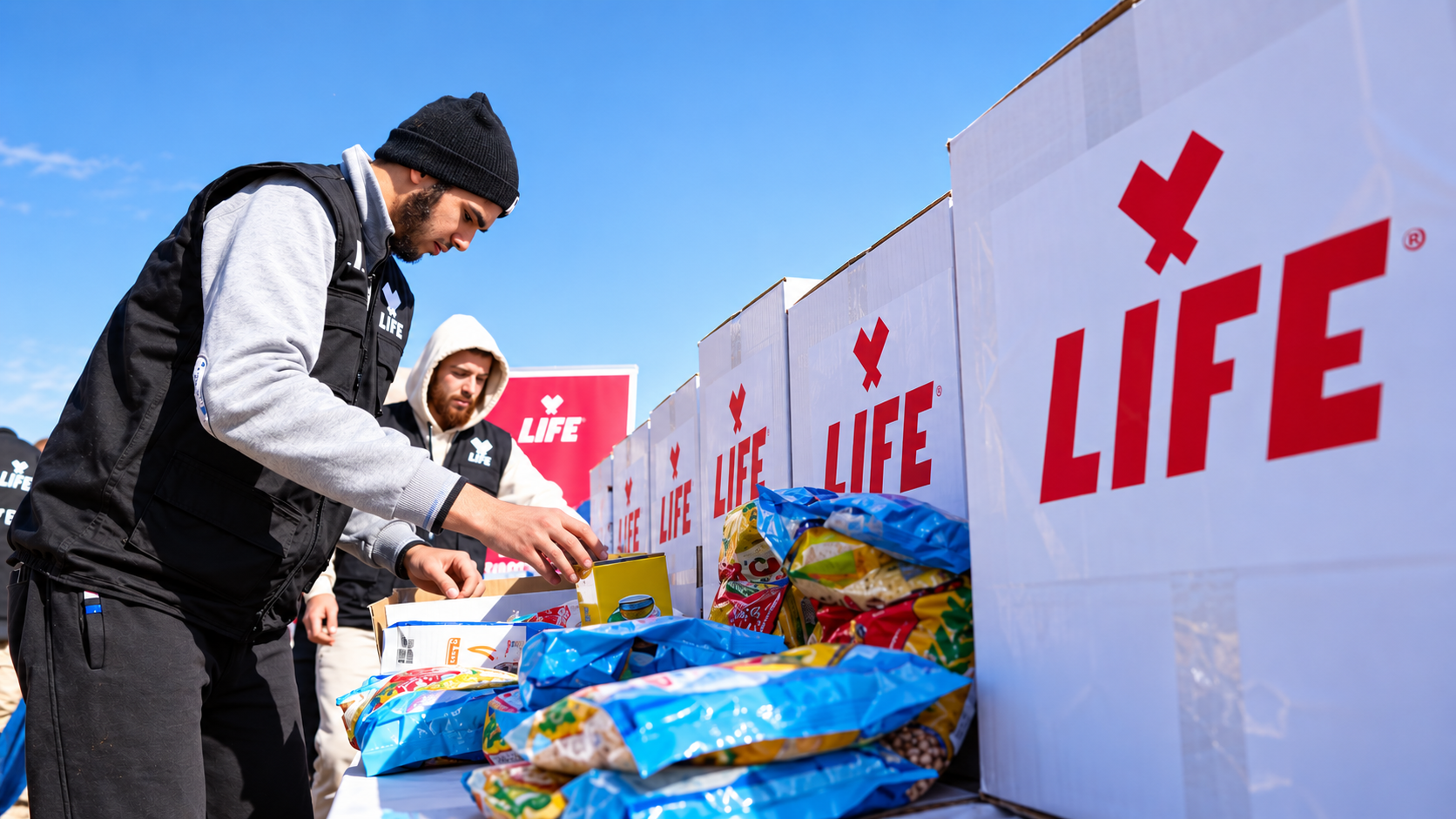
Meals are either prepared in shared kitchens (refugee camps, orphanages) or distributed as food parcels that families cook themselves. In areas with a large Muslim population, all foodstuffs meet halal requirements.
Where does the “1 euro = 1 meal” concept come from?
The phrase was born in France in the 1980s, with the creation of the Restos du Cœur by Coluche in 1985. The principle: centralise purchasing to bring the unit cost of a meal down to one euro. In 2024-2025, the charity served 161 million meals in France on this model.
In 2009, LIFE ONG, founded by Tarek El Kahodi, transposed the concept to international humanitarian aid. The idea: apply the same bulk-purchasing and shared-distribution logic to crisis zones, where food emergencies are even more acute. Since then, the campaign has expanded to 25 countries and passed the milestone of 72 million meals distributed.
How many meals has LIFE distributed through this scheme?
LIFE’s public figures, regularly audited and reported in the media, give a clear order of magnitude.
More than 72 million meals distributed since 2009. In 2023 alone, the campaign reached 8 million meals distributed in a single month during Ramadan, a historic peak. In 2024, the target of 10 million meals per month was exceeded.
On the ground, this translates into very concrete numbers:
- In Gaza, more than 62,500 hot meals distributed despite the war in 2025 (source: Ouest-France, May 2025).
- In North Lebanon, 411 food parcels distributed in the Abu Ibrahim, Al-Imna and Rihaniya camps.
- In Cambodia, 50 water towers built and regular food distributions reaching 46,000 people.
- In Burkina Faso, food distribution combined with a drinking water supply system for 2,000 people in Wibga.
These results have been covered by BBC News Afrique (March 2025), RFI (April 2025), Ouest-France, Beur FM and La Nouvelle Tribune, which subjected them to standard journalistic verification.
How can you take part in the €1 = 1 meal campaign?
Several formats exist, from the most occasional to the most committed. Each one converts directly into a number of meals distributed.
The one-off donation. This is the simplest entry point. A €30 donation funds 30 meals, a €100 donation funds 100. You can give online in under two minutes.
The monthly donation. An automatic debit of €20 a month represents 240 meals over the year. This is the most useful format for the NGO, because it allows purchases to be planned and contracts to be signed with local suppliers.
The solidarity fundraiser. You can create an online fundraiser for a wedding, a birthday or in memory of a loved one, with the proceeds going to the campaign. LIFE provides a dedicated tool for this.
Round-up giving. At certain partner checkouts, rounding up to the nearest euro can be donated to LIFE, with every accumulated cent funding meals.
Every donation to LIFE entitles you to a 66 % income tax reduction, up to 20 % of your taxable income. A one-off donation of €100 (100 meals) costs €34 net after tax relief. A monthly donation of €20 costs €81.60 net over the year.
How can you check that a “€1 = 1 meal” campaign is trustworthy?
The success of the model has inspired many initiatives, some of them less rigorous. Three checks are enough to avoid unpleasant surprises.
The social missions ratio. A serious NGO publishes the breakdown of its spending every year: social missions, fundraising costs, operating costs. The benchmark in the sector is around 80 % for social missions. The Restos du Cœur report 93.4 %, and LIFE sits in the same upper range.
The public annual report. Any recognised charity publishes an annual activity report with accounts certified by a statutory auditor. The absence of such a document is a warning sign.
Official recognition. The NGO must be registered with the French National Register of Associations, issue valid tax receipts and, ideally, be cited by established media outlets that carry out their own verification.
For a full guide to the criteria that identify a trustworthy NGO, read our dedicated article: How to recognise a humanitarian charity you can trust.
This rigour becomes especially important in humanitarian crises, where needs explode and distribution channels can become opaque. Our detailed analysis of the link between conflict and food insecurity examines this point in depth.
How can you give your €1 = 1 meal today?
Donating online takes less than two minutes. You choose the amount and your payment method, and you immediately receive a tax receipt by email.
Join the “1 euro = 1 meal” campaign. Your donation directly funds a hot meal for a family in Sudan, Gaza, Lebanon or one of the 25 countries where LIFE works.
Offer a meal today →If you would first like to grasp the scale of the problem and where this campaign fits into the wider fight, read our guide to the figures and causes of world hunger. And as for the origins of the campaign, it all started with a single conviction: 1 euro = 1 meal, a lesson in solidarity.
How can a meal cost only €1 in 2026?
Thanks to three combined factors: bulk purchasing at negotiated prices, local sourcing in the countries of operation (where staple foods are far cheaper than in France) and volunteering, which absorbs most labour costs. This combination allows the Restos du Cœur in France and LIFE internationally to reach a price of one euro per meal distributed.
Is a meal really delivered to one person for my €1 donation?
Yes. Under the “1 euro = 1 meal” scheme, a one-euro donation funds a complete meal distributed in the field. This is possible because fundraising and operating costs are covered by other flows (unrestricted donations, grants, dedicated funding), which allows the earmarked donation to be allocated entirely to the meal itself.
How many meals has LIFE distributed since the campaign began?
More than 72 million meals since the launch in 2009. The ramp-up has been steady: 8 million meals in a single month in 2023, and an exceeded target of 10 million meals per month in 2024. These distributions take place in 25 countries, with activity peaks during Ramadan and humanitarian crises.
What is the difference between LIFE and the Restos du Cœur?
Both apply the same principle (€1 = 1 meal through centralised purchasing), but in different areas. The Restos du Cœur operate in mainland and overseas France against food poverty. LIFE works internationally in 25 countries, mainly in humanitarian crisis zones (Gaza, Sudan, Lebanon, Palestine, etc.). The two organisations are complementary rather than competing.
Can I organise a fundraiser for the “1 euro = 1 meal” campaign?
Yes. LIFE offers an online solidarity fundraising tool that allows an individual, a company or an association to create a collection for an event (wedding, birthday, tribute, school project, sporting challenge). The funds go directly to the campaign and are converted into meals.
How is the number of meals funded by my donation calculated?
The calculation is straightforward: 1 euro given = 1 meal distributed. This equivalence is verified every year in LIFE’s activity report, on the basis of the observed average cost of a complete meal funded by the campaign, all logistics costs included. In countries where the real cost is below one euro, the surplus funds other related actions (access to water, hygiene kits, emergency medical aid).