
Gaza: 58,000 Orphaned Children, the Greatest Crisis in Modern History
.png)
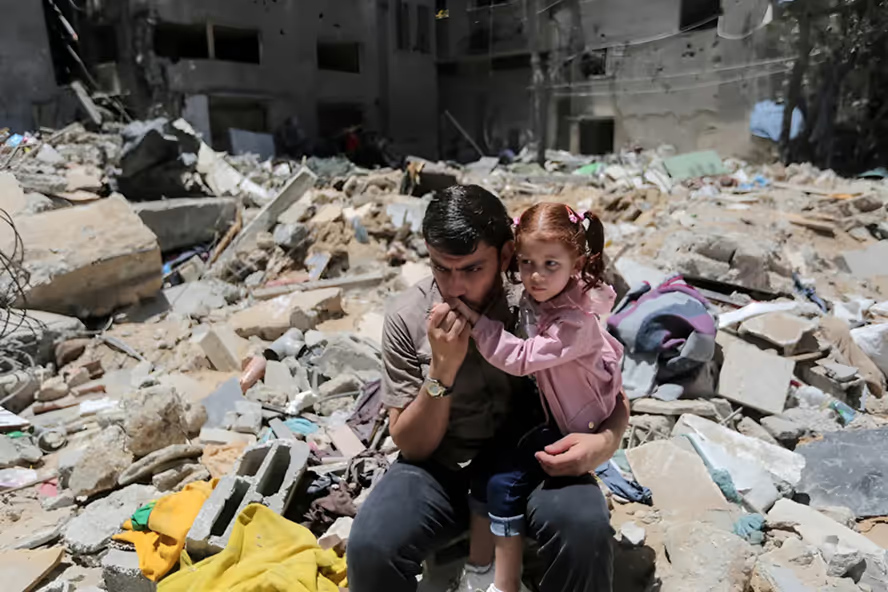
Behind every statistic, there is a child who has seen their home collapse and who has no one left to tell them everything will be alright. In Gaza, these children are no longer counted in hundreds or thousands, but in tens of thousands. Understanding the true scale of this crisis means understanding why usual forms of aid are insufficient, and what can truly make a difference.
How many orphaned children will Gaza have in 2026?
The most recent figure is staggering. According to UNICEF data reported by the Palestinian Central Bureau of Statistics in April 2026, more than 58,000 children in the Gaza Strip have lost one or both parents since the start of the war in October 2023.
This figure has increased dramatically, a progression that can be traced through successive reports. At the beginning of 2024, UNICEF estimated 17,000 children to be "unaccompanied or separated" from their families (press release of February 2, 2024). In April 2025, the Palestinian Central Bureau of Statistics reported 39,000 orphans. A year later, in April 2026, the 58,000 threshold was crossed. The PCBS now describes this situation as the largest orphan crisis in modern history.
It's important to understand the implications of these words. A child orphaned of their father, in a society where the man is often the sole economic provider for the household, means an entire family plunges below the survival threshold. A child who has lost both parents is a child entirely dependent on their community's ability to absorb them.
Why the traditional protection system has collapsed
In Palestinian society, as in many societies, a child who loses their parents is traditionally taken in by their extended family: grandparents, uncles, aunts, cousins. This safety net has functioned for generations, including during previous conflicts.
In Gaza, this safety net has broken. The reason is simple and tragic: extended families themselves are displaced, starving, and destitute.
Social workers conducting orphan identification on the ground report an increasingly frequent phenomenon: relatives who would like to take in an isolated child simply no longer have the means, because they are already struggling daily to feed their own children. Taking in one more child, in a tent where water and food are already scarce, becomes impossible.
This is what makes the orphan crisis in Gaza different from previous ones. It's not just that there are more orphans: it's that the social structure that usually protected them has been destroyed at the same time.
What has become of Gaza's orphanages?
One might think there are facilities to accommodate these children. This is one of the least known realities of this crisis: before the war, Gaza had four orphanages. All of them have been converted into shelters for displaced families.
In other words, at the very moment the number of orphans was exploding, the facilities meant to house them were disappearing. Local initiatives have tried to fill this void, such as orphan camps set up by teachers or associations, accommodating a few hundred to a few thousand children. But as the head of one of these camps acknowledged, the number of children being cared for is just a drop in the ocean of Gaza's orphans.
This lack of institutional structures has a direct consequence on the form aid must take. Since there are no large, centralized orphanages, the most effective aid is that which reaches the child where they live: in a tent, in a foster home, within what little community they have left.
A generation scarred for life: the psychological dimension
Gaza's wounds are not just physical. According to UNICEF, more than1.1 million children in Gaza need psychosocial support, representing almost all children in the territory.
Field data reveals the extent of the trauma. A study conducted by the Community Training Center for Crisis Management in Gaza, published in December 2024, found that 96% of children believe their death is imminent, and nearly half express a desire to die. The symptoms described by caregivers are those of massive post-traumatic stress: enuresis, seizures, aggressive behavior, extreme nervousness, night terrors.
For an orphaned child, this trauma is compounded by the most fundamental loss imaginable. Many children arrive at hospitals injured and in shock, sometimes unable even to state their name. Medical staff have coined an acronym for these cases, which has sadly become common: WCNSF, for "wounded child, no surviving family".
This is why truly effective support cannot be limited to food. It must include psychological care and schooling, which helps the child rebuild and regain a sense of normalcy.
Image : photo of a child participating in a psychosocial support activity at a temporary learning center in Gaza — alt: "Psychosocial support orphaned children Gaza war trauma"
Why the situation remains critical in 2026, despite the ceasefire
A ceasefire came into effect on October 10, 2025, raising hopes for improvement. However, the situation for children has not stabilized.
In early 2026, the regional context deteriorated again. According to UNICEF, the outbreak of a conflict involving Iran in late February 2026 had repercussions across the Middle East, and several crossing points into Gaza were closed again between February 28 and March 2, severely slowing the delivery of aid, fuel, and supplies. Over a three-month period, UNICEF saw 14 of its attempts to deliver emergency aid blocked.
For orphans, this means that even the fragile gains of the ceasefire remain threatened. Malnutrition remains widespread: according to OCHA (February 2026), 64% of children in Gaza consume two food groups or fewer per day, and over 90% do not meet the recommended minimum dietary diversity. For an orphaned child deprived of family support, this nutritional risk is even more acute.
What form of aid is truly effective for orphans in Gaza?
From all of the above, a clear conclusion emerges. Effective aid for an orphan in Gaza must meet four conditions:
- Work through a local actor already established, capable of acting even when international access is cut off
- Target the child by name, as there is no longer a centralized reception structure and each situation is individual
- Address multiple needs at once : food, but also health, schooling, and psychological support
- Be long-term, because trauma and recovery cannot be resolved with one-off aid
This is precisely the logic behind sponsorship. Rather than sending anonymous aid to a general fund, sponsorship links regular support to an identified child, monitored by a local partner. To understand exactly how this mechanism works, its cost, and its traceable voucher system, our article Sponsoring an Orphan in Gaza: How it Works with Life ONG details the entire system.
To place this crisis within the broader context of violence against children in war zones, our article Children in Armed Conflicts: Figures and Actions to Protect Them provides additional insight. And to understand the overall humanitarian situation in the territory, consult our guide Palestine: How to Provide Concrete Aid from France.