
Access to Drinking Water in Africa: Where We Stand in 2026

- In sub-Saharan Africa, only 24% of inhabitants have access to safely managed drinking water (UN data, March 2026).
- Half of the people in the world who drink water from unprotected sources live in Africa.
- Yet the continent is making progress: around 500 million Africans gained access to basic drinking water between 2000 and 2020. But population growth is outpacing infrastructure.
- The gap between towns and countryside is widening: 90% of the people still relying on surface water live in rural areas.
- The African Union has made 2026 the African Year of Water and Sanitation. On the ground, a Life ONG well serves around 500 people for €2,650.
Africa is the continent where the water question is most acute. Not necessarily because it lacks water underground, but because access to safe water remains, for hundreds of millions of people, a daily challenge. Here is where things stand in 2026, without doom-mongering or wishful thinking.
What is the drinking water access rate in Africa in 2026?
The headline figure is harsh. According to UN data presented on World Water Day, 22 March 2026, only 24% of the population of sub-Saharan Africa has access to safely managed drinking water, meaning water available on the premises, free from contamination and accessible when needed.
In other words, more than three out of four people in sub-Saharan Africa lack that access. And the global imbalance is striking: again according to the UN, half of the people in the world who drink water from unprotected sources live in Africa.
| Indicator (UN / WHO-UNICEF data, 2025-2026) | Figure |
|---|---|
| Sub-Saharan Africa with safe drinking water | 24% |
| Global share of unprotected-water drinkers living in Africa | half |
| People who gained basic access in Africa (2000-2020) | around 500 million |
| Acceleration needed for drinking water by 2030 | × 12 |
| Acceleration needed for sanitation | × 20 |
Why Africa is moving forward and backward at the same time
This is the most important paradox to grasp, and the one that is rarely explained.
Africa is making real progress. According to the WHO/UNICEF Joint Monitoring Programme, around 500 million people gained access to basic drinking water there between 2000 and 2020. Thousands of facilities have been built, and ambitious national policies have been launched.
But at the same time, the continent's population rose from around 800 million in 2000 to 1.3 billion in 2020, and has more than doubled since the 1990s. That is the whole problem: infrastructure is progressing, but demographics are progressing faster. As a result, the absolute number of people without access to water is not falling at the hoped-for pace.
This is why a special report by UNICEF and the WHO estimates that meeting the Sustainable Development Goals in Africa would require multiplying the current rate of progress by 12 for drinking water, and by 20 for sanitation. The current pace, positive though it is, is not enough.
The fact that the situation is improving statistically does not mean the emergency is over. Every new water point funded counts twice over: it has to make up the existing shortfall and absorb population growth. That is what makes every well built today so decisive.
The 3 major divides in access to water in Africa
Access to water in Africa is not a uniform problem. Three major divides shape the reality on the ground.
1. The urban / rural divide. This is the sharpest one. According to the WHO and UNICEF, three out of five people who recently gained safe access to water were living in towns, while 90% of the people still relying on surface water live in rural areas. Sub-Saharan Africa is the region of the world where this gap between towns and countryside is widest. A resident of Abidjan and a villager in the Sahel do not live the same reality.
2. The conflict-related divide. Where war strikes, water networks are destroyed and displaced populations gather in areas without resources. In Sudan, where the conflict has displaced millions of families since 2023, daily water shortages are worsening an already critical humanitarian crisis. UNICEF enabled nearly 973,000 people there to access safe water in January 2026.
3. The climate divide. Prolonged droughts, floods that contaminate water points, aquifers running dry: climate change is hitting the Sahel with particular intensity and makes gains fragile. Our article Drought in Africa: causes, consequences and lasting solutions explores this factor in depth.
What are the concrete consequences on the ground?
Behind the percentages, there are lives. The lack of drinking water in Africa translates into very concrete, and often deadly, effects.
The most serious is health. In Benin, according to UNICEF, ten children die every day from waterborne diseases, 90% of which are directly caused by unsafe water and the lack of sanitation. Figures of this kind recur, to varying degrees, in many countries across the continent.
Then comes the cost in time. Fetching water takes up hours every day, and this burden falls mainly on women and girls. Those are lost school hours, economic activities made impossible, and sometimes dangerous journeys.
Finally, there is the brake on development. Without reliable water, there is no stable irrigation, no secure livestock rearing, no craft work. The absence of water locks entire villages into a survival economy. To understand the global scale of the phenomenon, our article The world water crisis: key figures and concrete solutions gives the full picture.
Faced with the emergency, the African Union has proclaimed 2026 the “African Year of Water and Sanitation”. The stated goal is to move from commitments to concrete results. The political signal is strong, but it will not replace the facilities built village by village.
What concrete solutions are there for Africa?
The findings are heavy, but the good news is that the solutions are known and proven. They rest on four pillars.
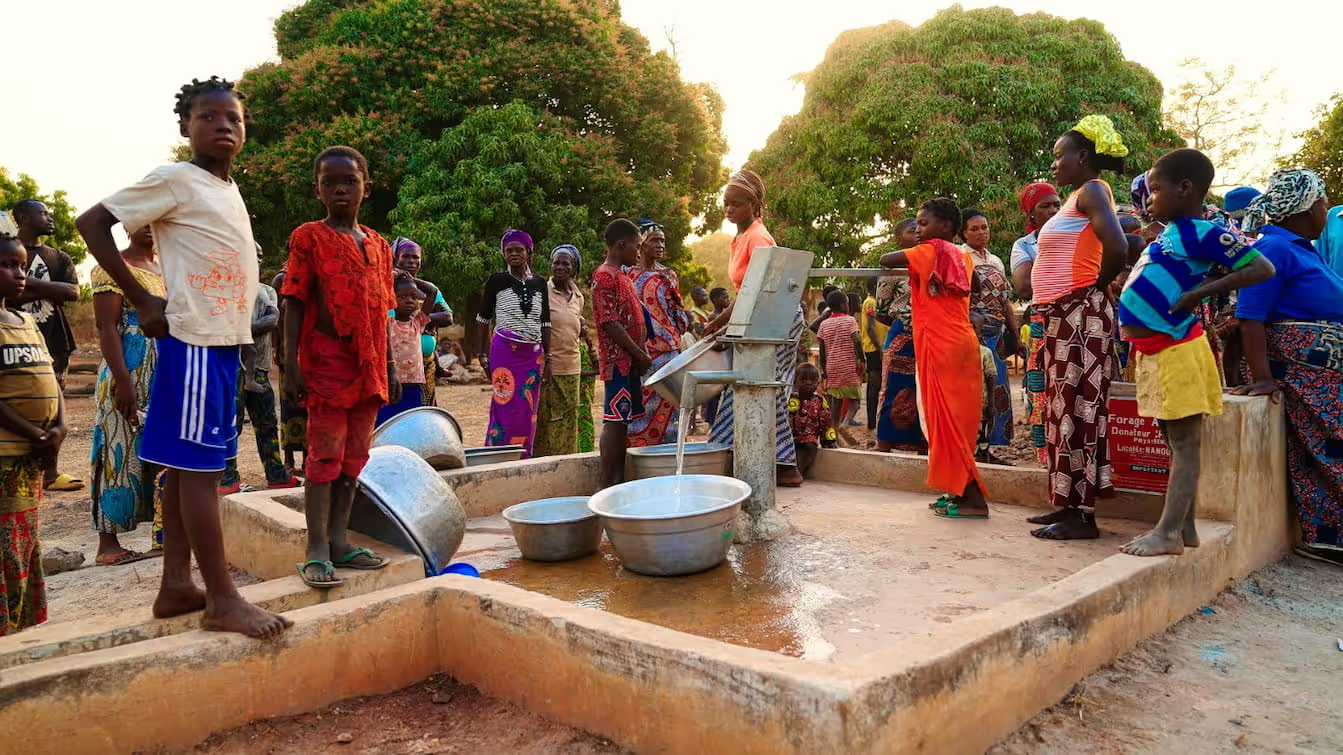
First, we need to reach water at depth. Groundwater is better protected from contamination than the surface water on which rural areas still overwhelmingly depend. That is the role of wells and boreholes.
Next, we need to target rural areas, where 90% of the problem is concentrated, rather than focusing investment on towns that are already better served.
We need to ensure sustainability by training village management committees, without which facilities break down and progress is undone.
Finally, we need to link water to development: farming, livestock, education. Water is only useful if it sets a broader dynamic in motion.
This is precisely the approach of Life ONG's water programme. A village well, dug to around 20 metres and fitted with a pump, serves around 500 people. It is funded for €2,650 in Africa, or around €901 after the 66% tax reduction, and includes training a local management committee. To understand the details of the works, our article Building a well in Africa: stages, costs and real impact describes each phase, and our article How much does a well in Africa cost? breaks down the budget.
Discover Life ONG's water programme. One well serves around 500 people. €2,650 in Africa, or €901 after tax reduction. GPS tracking, photos and a commemorative booklet. Donor relations team available.
Discover the water programme →What percentage of the African population has access to drinking water in 2026?
According to UN data presented on World Water Day in March 2026, only 24% of the inhabitants of sub-Saharan Africa have access to safely managed drinking water. Half of the people in the world who drink water from unprotected sources live in Africa.
Why is the situation not improving faster in Africa?
Because population growth is outpacing infrastructure. Around 500 million Africans gained access to basic water between 2000 and 2020, but the continent's population rose from 800 million to 1.3 billion over the same period. UNICEF and the WHO estimate that the rate of progress on drinking water would need to be multiplied by 12 to meet the 2030 goals.
What is the difference between towns and countryside in Africa?
The gap is the widest in the world. According to the WHO and UNICEF, three out of five people who gained safe access to water were living in towns, while 90% of the people still relying on surface water live in rural areas. That is why projects targeting rural villages are the most useful.
What are the consequences of the lack of water in Africa?
They are health-related, educational and economic. In Benin, according to UNICEF, ten children die every day from waterborne diseases, 90% of which are caused by unsafe water and the lack of sanitation. Fetching water also keeps girls out of school and prevents farming and craft work from developing.
How can you concretely help access to water in Africa?
The solutions rest on four pillars: drilling to reach deep aquifers, targeting the rural areas where the problem is concentrated, training village management committees for sustainability, and linking water to agricultural and educational development. Funding a well with Life ONG costs €2,650 in Africa, or around €901 after tax reduction, and serves around 500 people.