
International Humanitarian Law: The rules that protect civilians in war zones
- Le droit international humanitaire (DIH) est l'ensemble des règles qui limitent les effets des conflits armés sur les personnes qui n'y participent pas ou ne participent plus.
- Il repose essentiellement sur les quatre Conventions de Genève de 1949, ratifiées par tous les États du monde, et leurs Protocoles additionnels de 1977 et 2005.
- En septembre 2025, 89 États ont rejoint une Initiative mondiale pour renforcer le respect du DIH, face à des violations de plus en plus généralisées dans les conflits actuels.
- Les ONG humanitaires comme Life ONG opèrent en lien avec ces règles : elles défendent l'accès à l'aide, la protection des civils et le respect du personnel humanitaire.
- Le pôle relation donateur de Life est disponible pour répondre à toutes vos questions sur les missions en zones de conflit.
Every day, in dozens of conflicts around the world, civilians are killed, hospitals bombed, and humanitarian workers targeted. These acts are not only morally unacceptable: they are illegal. International humanitarian law exists precisely to prohibit them. This guide explains what IHL is, how it works, why it is so difficult to enforce, and the role NGOs like Life ONG play in this context.
What is international humanitarian law?
International humanitarian law (IHL), also known as "the law of war" or "the law of armed conflict," is the set of international legal rules that aim to limit the effects of armed conflicts on people and property. It is based on a fundamental principle: even in times of war, certain limits apply. Not everything can be done in the name of military victory. IHL protects two main categories of people:
- Those who are not participating in hostilities : civilians, medical personnel, humanitarian workers, journalists
- Those who are no longer participating in combat : wounded or sick soldiers, prisoners of war, shipwrecked persons
le DIH ne dit pas qui a le droit de faire la guerre. Il dit comment la guerre doit être menée pour limiter les souffrances humaines. Il s'applique à toutes les parties d'un conflit, qu'elles soient dans leur droit ou non.
The Geneva Conventions: the cornerstone of IHL
The four Geneva Conventions, signed on August 12, 1949, form the foundation of modern international humanitarian law. They were supplemented by two Additional Protocols in 1977 and a third in 2005.
What each Convention covers
| Convention | Ce qu'elle protège |
|---|---|
| 1re Convention | Les soldats blessés ou malades sur terre |
| 2e Convention | Les militaires blessés, malades ou naufragés en mer |
| 3e Convention | Les prisonniers de guerre |
| 4e Convention | Les civils en territoire occupé ou ennemi |
The 4th Convention, which directly concerns the protection of civilians, was the subject of an updated Commentary published by the ICRC in October 2025. This document adapts the interpretation of the rules to contemporary realities: new technologies, social networks, new forms of conflict. The four Geneva Conventions have been ratified by all UN member states. It is one of the rare international legal texts to have universal adherence. What is lacking is not the law: it is its application.
<aside>📌
Image : photo symbolizing the Geneva Conventions (ICRC building in Geneva or red cross on white background) - alt: "Geneva Conventions ICRC international humanitarian law civilian protection"
</aside>
The 4 fundamental principles of IHL
Beyond the texts of the Conventions, IHL is based on four fundamental principles that the ICRC and humanitarian actors consider to be the core of the law of war.
The principle of distinction
Parties to a conflict must at all times distinguish between combatants and civilians, and between military objectives and civilian objects. It is forbidden to deliberately target civilians or civilian infrastructure such as hospitals, schools, or water systems.
The principle of proportionality
An attack may be directed against a military objective, but the harm caused to civilians must not be excessive in relation to the anticipated military advantage.
The principle of precaution
Parties must take all feasible precautions to avoid or minimize civilian casualties, even when conducting legitimate operations against military objectives.
The principle of humanity
It is forbidden to inflict unnecessary suffering on anyone, combatant or not. Persons hors de combat must be treated humanely.
en septembre 2025, 89 États ont rejoint une Initiative mondiale lancée par la France, le Brésil, la Chine, la Jordanie, le Kazakhstan, l'Afrique du Sud et le CICR pour renforcer le respect du DIH. Cette initiative reconnaît ce que les données de terrain confirment : les violations du DIH sont généralisées, délibérées et souvent impunies. Une conférence mondiale de haut niveau est prévue en 2026 pour y remédier.
What exactly does IHL prohibit?
Here are the acts that IHL classifies as "grave breaches" or war crimes:
- Deliberately targeting civilians or civilian buildings
- Bombing hospitals, ambulances, medical personnel
- Attacking humanitarian workers or aid convoys
- Using civilians as human shields
- Torturing or executing prisoners of war
- Using chemical or biological weapons against populations
- Deliberately using starvation as a method of warfare
This last point is particularly relevant: the UN Fact-Finding Mission concluded that the Rapid Support Forces in Sudan are deliberately using starvation as a method of warfare, constituting a war crime under IHL.
<aside>📌
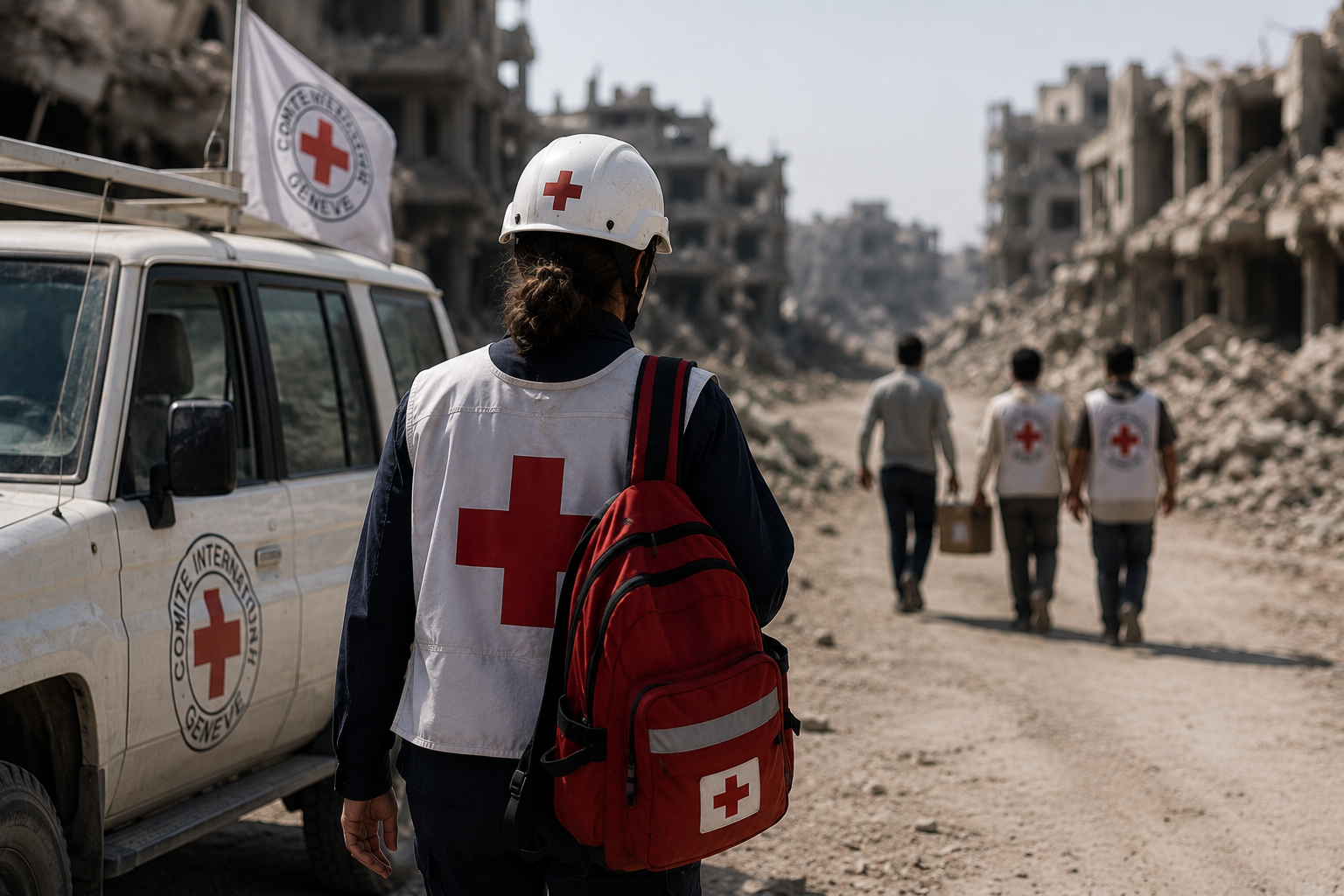
Image : photo symbolizing the protection of medical and humanitarian personnel in conflict zones - alt: "Protection medical humanitarian personnel international humanitarian law conflicts"
</aside>
Who enforces IHL?
This is where the system shows its limits. IHL has no international police force. Its observance depends mainly on the willingness of states and parties to the conflict to comply with their obligations.
The role of the ICRC
The International Committee of the Red Cross (ICRC) is the "guardian" of IHL. Its role is to visit prisoners of war, remind belligerents of their obligations, facilitate humanitarian aid, and document violations. The ICRC operates on the basis of strict neutrality: it does not take sides, which allows it to access both sides of a conflict.
The International Criminal Court (ICC)
The ICC can prosecute individuals responsible for war crimes, crimes against humanity, and genocide. However, its scope of action is limited: it can only prosecute nationals of states that have ratified it, or cases referred by the UN Security Council.
The role of NGOs
Specialized organizations work directly with non-state armed groups to promote respect for IHL. In March 2026, a memorandum of understanding was signed between Geneva Call and the AFC/M23 in the DRC to strengthen the protection of civilians in areas under their control.
What is the link between IHL and humanitarian NGOs like Life?
Life NGO operates in conflict zones, relying on the principles of IHL and the protected status that international law grants to humanitarian personnel. Specifically, this means that:
- Life NGO and its partners have the right to access civilian populations in conflict zones, subject to the agreement of the belligerent parties
- Life's humanitarian personnel benefit from specific protections: they must not be targeted, nor should their convoys or warehouses be targeted
- Life documents the needs of civilian populations, which indirectly contributes to the visibility of IHL violations
If you have any questions about Life's missions in conflict zones or how it protects its teams, our donor relations department is available to answer them. To understand the mechanisms of humanitarian intervention and how your donation is utilized, our article Humanitarian Emergency: How NGOs Intervene on the Ground explains the entire mechanism. And to learn more about the specific situation of children in armed conflicts, our article Children in Armed Conflicts: Figures and Actions to Protect Them details the violations that affect them most.
Life intervient dans les zones de conflit en respectant les principes du droit humanitaire international. Pôle relation donateur disponible.
Faire mon don →Quelle est la différence entre le DIH et les droits de l'homme ?
Les droits de l'homme s'appliquent en tout temps, en paix comme en guerre. Le DIH s'applique spécifiquement en période de conflit armé. Les deux se complètent : en temps de guerre, le DIH précise comment les droits fondamentaux des civils et des combattants hors combat doivent être respectés. Certains droits ne peuvent jamais être suspendus, même en guerre : l'interdiction de la torture, par exemple.
Est-ce que tous les pays respectent les Conventions de Genève ?
Tous les États membres de l'ONU ont ratifié les quatre Conventions de Genève. Mais l'adhésion formelle ne garantit pas l'application réelle. Les violations du DIH sont nombreuses dans les conflits actuels : au Soudan, à Gaza, en RDC, en Ukraine. C'est précisément pourquoi 89 États ont rejoint en 2025 une Initiative mondiale pour renforcer le respect du DIH.
Qu'est-ce qu'un crime de guerre ?
Un crime de guerre est une violation grave du DIH commise intentionnellement. Cela inclut : cibler des civils, attaquer des hôpitaux, torturer des prisonniers, utiliser des boucliers humains, ou employer la famine comme arme de guerre. Les responsables peuvent être poursuivis devant la Cour pénale internationale ou devant des juridictions nationales.
Le personnel humanitaire est-il protégé par le DIH ?
Oui. Le DIH protège spécifiquement le personnel humanitaire, les travailleurs médicaux et les journalistes dans les zones de conflit. Ils ne doivent pas être pris pour cible. Pourtant, des centaines de travailleurs humanitaires sont tués chaque année dans des conflits armés, ce qui constitue autant de violations du DIH.
Comment les ONG contribuent-elles au respect du DIH sur le terrain ?
Les ONG humanitaires ne font pas respecter le DIH au sens juridique : ce rôle appartient aux États et aux juridictions internationales. Mais elles y contribuent en documentant les violations, en plaidant pour l'accès humanitaire, en formant leurs équipes au DIH et en opérant pour réduire les risques pour les populations civiles. En cas de question sur les missions de Life en zone de conflit, le pôle relation donateur peut vous répondre.
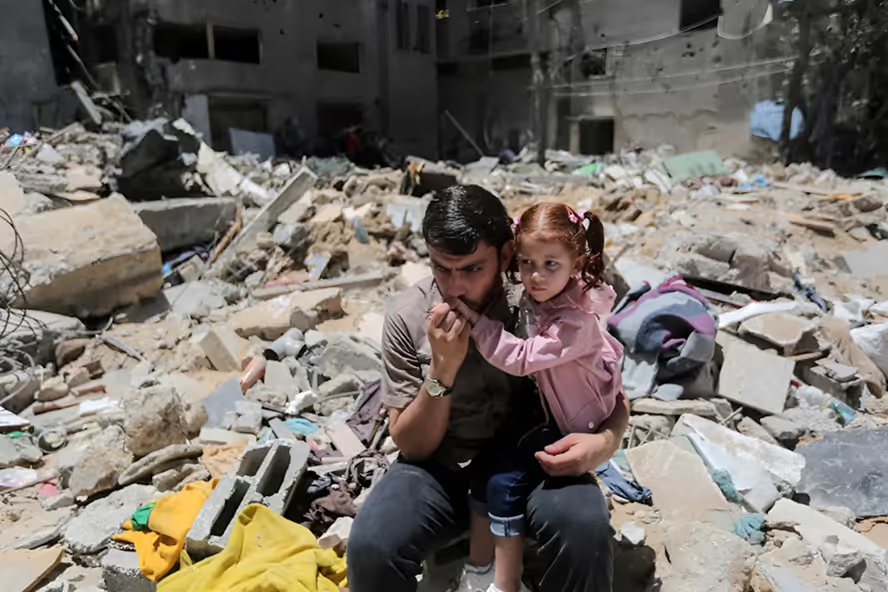
Bring vital aid to families in Gaza. Every donation saves lives.
I give