
Donating drinking water: the humanitarian action with the best cost-to-impact ratio
- Selon l'ONU, chaque dollar investi dans l'eau potable génère un retour économique de 2 dollars, et 5,5 dollars pour l'assainissement. L'eau est un investissement, pas seulement une dépense.
- Améliorer l'accès à l'eau, à l'assainissement et à l'hygiène pourrait sauver 1,4 million de vies par an dans le monde (OMS).
- Un puits Life ONG à 2 650 € dessert environ 500 personnes : cela revient à 5,30 € par personne, soit environ 1,80 € après réduction d'impôt.
- L'eau agit sur 4 leviers à la fois : la santé, l'éducation, l'économie locale et l'égalité femmes-hommes. Peu de dons ont cet effet en cascade.
- Il n'est pas nécessaire de financer un puits entier : Life permet de contribuer dès 15 € par mois ou de se regrouper à plusieurs.
When you decide to give, a legitimate question arises: where will my money have the greatest impact? Every cause is worthy, but not all offer the same human return per euro donated. By this specific metric, donating clean water stands in a league of its own. Here is why, backed by the numbers.
Water: an investment that pays off more than it costs
It is a point many donors overlook: water is not just a humanitarian gesture; it is an economically profitable investment for the communities involved.
According to the United Nations, the multiplier effect of every dollar invested is estimated at $2 for clean water and $5.50 for sanitation. In other words, one euro spent on water access generates two euros in economic value: lower healthcare costs, higher productivity, and fewer premature deaths.
This figure completely changes how we view a water donation. Funding a well is not a sunk cost. It is about triggering a dynamic that produces more value than it costs, and one that continues to yield results years after the check is written.
L'eau agit à la racine de nombreux problèmes à la fois. En réglant l'accès à l'eau, on réduit mécaniquement les maladies, les frais médicaux, l'absentéisme scolaire et le temps perdu en corvée d'eau. Un seul geste, plusieurs problèmes résolus.
The math: how much does water cost per person?
The best way to evaluate a donation is to measure its cost against the number of beneficiaries. Let’s do the math with the Life NGO water program.
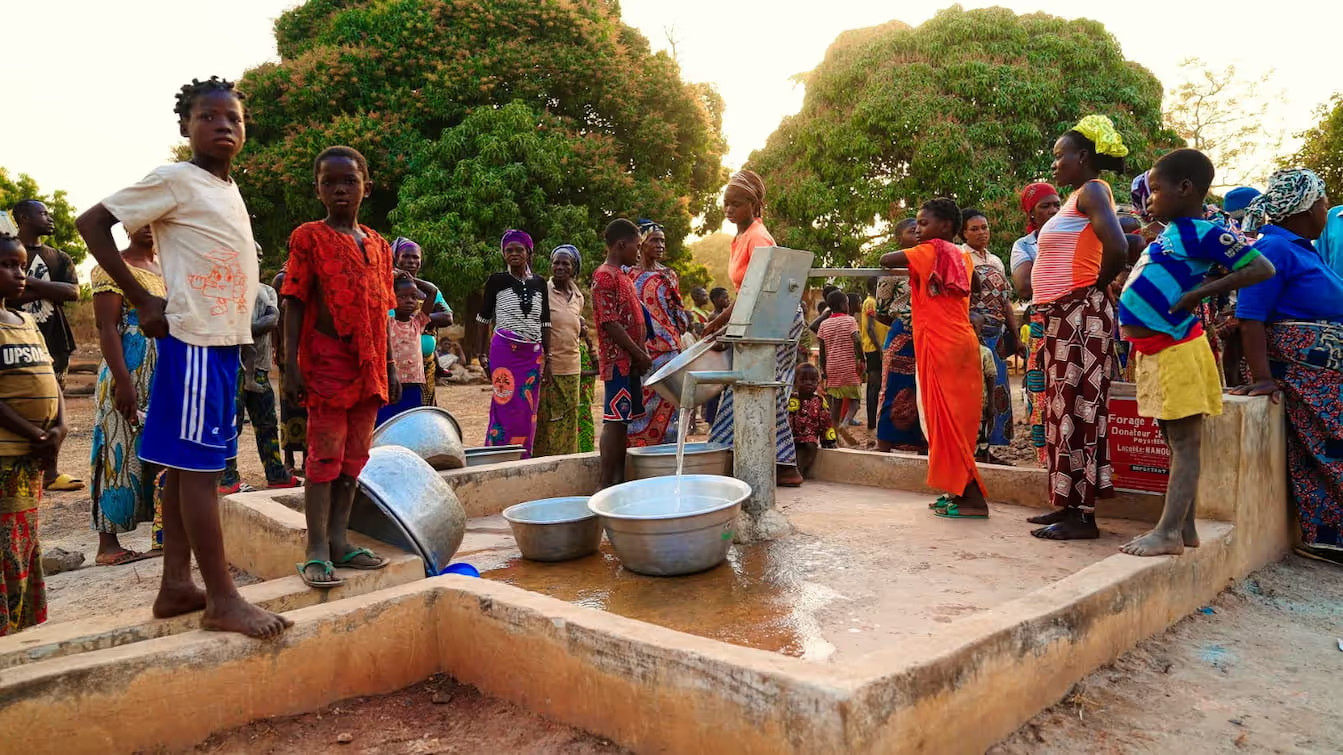
A village well is funded for €2,650 in Africa and serves approximately 500 people. This represents €5.30 per person for sustainable access to clean water.
And that’s not all. Thanks to the 66% tax deduction granted for donations to public interest organizations, this €2,650 donation actually costs about €901. The real cost to the donor then drops to about €1.80 per person served.
| Calcul | Montant |
|---|---|
| Coût d'un puits en Afrique | 2 650 € |
| Personnes desservies | environ 500 |
| Coût par personne | 5,30 € |
| Coût réel après réduction de 66 % | 901 € |
| Coût réel par personne | environ 1,80 € |
Less than two euros provides a person with access to clean water for years. Few donations offer such a return. To understand exactly what this budget covers, our article How much does a well cost in Africa? breaks down every expense.
The 4 levers that water activates simultaneously
The exceptional return on a water donation is explained by a simple mechanism: water doesn't just solve one problem, it solves four at once.
1. Health. Unsafe water is a leading cause of child mortality. According to the World Bank, approximately 446,000 children under five die each year from diarrhea, accounting for 9% of all child deaths. The WHO estimates that improving access to water, sanitation, and hygiene could save 1.4 million lives annually.
2. Education. When there is no water in the village, children are the ones who fetch it, sometimes for hours. A well on-site means time returned to school, especially for girls.
3. The local economy. Water allows for crop irrigation and livestock watering. It makes crafts and small businesses possible. The village shifts from survival to economic activity.
4. Gender equality. The burden of fetching water falls heavily on women and girls. Freeing up this time opens the door to school, work, and community life for them.
It is this chain reaction that distinguishes water donations from many other forms of aid. You aren't just funding a service; you are unlocking potential.
A donation that continues to make an impact for years
Many donations produce an immediate effect and then fade: a meal is eaten, medicine is consumed. A well, however, continues to function long after the donation is made.
This is why water donations are often described as a gift that stands the test of time. With each passing year, the well continues to serve the village, and the cost per person per year of service decreases even further. Provided, of course, that the structure is maintained: this is the role of the village management committee trained during construction. Our article Building a well in Africa: steps, costs, and real impact details this crucial step for sustainability.
This lasting impact is also why so many people choose to donate a well in memory of a loved one. Our article Donating a well in a loved one's name explains how this works.
Selon ONU-Eau, l'accès à l'eau potable sûre est passé de 68 % de la population mondiale en 2015 à 74 % en 2024. Des progrès réels, mais trop lents : il faudrait multiplier le rythme actuel par six pour atteindre l'accès universel d'ici 2030. Chaque puits financé compte dans cet écart. Pour comprendre l'état complet de la crise, notre article Crise de l'eau dans le monde fait le point.
Do you have to fund an entire well to make a difference?
No, that is a common misconception. While the cost of a well may seem high, it is not a barrier to entry.
At Life NGO, you can contribute to our water program starting at €15 per month. You can also team up with family, friends, or colleagues to fund a complete well together. Many projects are financed through these collective efforts.
Regardless of the amount, a 66% tax deduction applies. A donation of €15 per month actually costs only €5.10 per month after the deduction. To fully understand how the tax benefits work, our complete guide to tax deductions for donations details the rules and limits. The Life donor relations team is also available to help you organize a group project.
Découvrez le programme eau de Life ONG. Environ 1,80 € par personne desservie après réduction d'impôt. Dès 15 € par mois. Suivi GPS, photos et livret souvenir.
Donner pour l'eau →Pourquoi le don d'eau potable est-il considéré comme le plus efficace ?
Parce qu'il agit sur quatre leviers à la fois : la santé, l'éducation, l'économie locale et l'égalité femmes-hommes. Selon l'ONU, chaque dollar investi dans l'eau potable génère un retour économique de 2 dollars, et 5,5 dollars pour l'assainissement. Un puits continue par ailleurs de fonctionner des années après le don.
Combien coûte l'accès à l'eau par personne ?
Avec le programme eau de Life ONG, un puits à 2 650 € dessert environ 500 personnes, soit 5,30 € par personne. Après la réduction d'impôt de 66 %, le coût réel pour le donateur tombe à environ 1,80 € par personne desservie, pour un accès durable à l'eau potable.
Combien de vies l'accès à l'eau permet-il de sauver ?
Selon l'OMS, améliorer l'accès à l'eau, à l'assainissement et à l'hygiène pourrait sauver environ 1,4 million de vies par an dans le monde. La Banque mondiale estime par ailleurs qu'environ 446 000 enfants de moins de cinq ans meurent chaque année de diarrhée, soit 9 % de tous les décès d'enfants.
Peut-on donner pour l'eau sans financer un puits entier ?
Oui. Chez Life ONG, il est possible de contribuer au programme eau à partir de 15 € par mois, ou de se regrouper à plusieurs (famille, amis, collègues) pour financer un puits complet. La réduction d'impôt de 66 % s'applique quel que soit le montant : un don de 15 € par mois revient réellement à 5,10 €.
Le don d'eau est-il vraiment durable ?
Oui, à condition que l'ouvrage soit entretenu. C'est pourquoi un comité de gestion villageois est formé lors de la construction, avec souvent une caisse commune pour financer les réparations. Un puits bien entretenu fonctionne des années, ce qui fait baisser encore le coût par personne et par année de service.