
Deforestation: causes, consequences and how to fight it
- Deforestation wipes out an average of 10.9 million hectares of forest per year worldwide (FAO, 2015-2025), the equivalent of the area of Iceland every year.
- Nearly 90% of global deforestation is linked to agricultural expansion: cattle farming, soy, palm oil, cocoa.
- Its consequences affect the climate, biodiversity, water and the people who live from the forest.
- Solutions combine forest protection, responsible consumption, agroforestry and community-led reforestation.
- Everyone can act, by changing certain purchases and by supporting projects on the ground.
Every minute, the planet loses the equivalent of around twenty football pitches of forest. The pace has slowed since the 1990s, but it remains staggering: 10.9 million hectares still disappear every year according to the FAO.
Yet deforestation is not just about chainsaws in the Amazon. It also plays out on our plates, in our cupboards and in our fuel tanks, thousands of kilometres from the forests concerned.
Understanding its causes and consequences helps to see where the real levers lie, including at an individual level.
What is deforestation?
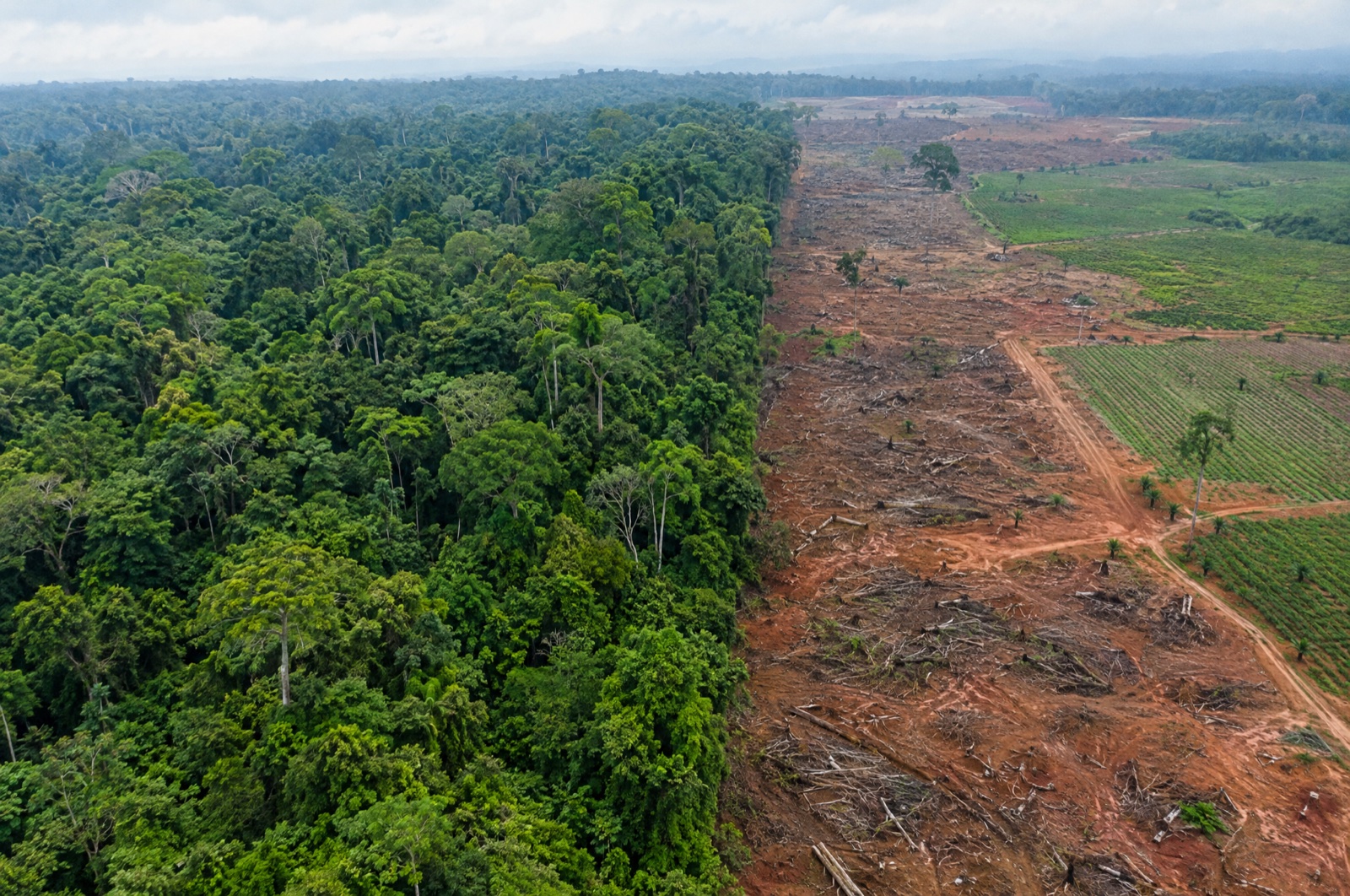
Deforestation means the lasting disappearance of a forest in favour of another land use: a field, pasture, plantation, mine, road or town. It differs from logging followed by regrowth, which does not wipe out the forest.
The planet currently has around 4.14 billion hectares of forest, nearly a third of its land area. Between 2015 and 2025, the net loss stood at 4.12 million hectares per year, once areas where forest is regaining ground are deducted.
Where is deforestation most severe?
Three major basins account for most of the losses: the Amazon, the Congo Basin and Southeast Asia. Africa is the continent with the highest net loss over the last decade measured, at 3.9 million hectares per year between 2010 and 2020.
In 2024, the Democratic Republic of the Congo lost nearly 590,000 hectares of primary forest, a record level for the country.
What are the causes of deforestation?
Agriculture, the main culprit
Nearly 90% of global deforestation is linked to agricultural expansion. Cattle farming, particularly in South America, comes first. Next come the large export crops: soy for animal feed, palm oil, cocoa, coffee and rubber.
Some of this production ends up in Europe. This is known as imported deforestation: the forest is cut down over there for products consumed here.
Firewood and charcoal
In sub-Saharan Africa, a large proportion of households still cook with wood or charcoal. Around cities, this demand creates rings of deforestation that spread year after year.
Mines, roads and towns
Mining, often illegal, and new roads fragment forest areas and open the way to further clearing.
Fires and climate change
Longer droughts and heatwaves are multiplying forest fires, which destroy millions of hectares every year. Climate change, made worse by deforestation, is itself becoming one of its causes.
Deforestation is not primarily a logging problem. It is a land-use problem: as long as it is more profitable to turn a forest into a field than to preserve it, the forest will keep shrinking.
What are the consequences of deforestation?
For the climate
A destroyed forest releases the carbon it was storing. According to the IPCC, agriculture, forestry and other land uses account for around 22% of global greenhouse gas emissions. Deforestation is one of the main components.
For biodiversity
Forests are home to around 80% of terrestrial biodiversity. Their disappearance endangers thousands of species, from great apes to pollinating insects.
For water and soils
Without trees, rain runs off, soils erode and groundwater is poorly replenished. Deforested regions experience more floods as well as more droughts.
For people
More than a billion people depend directly on forests for food, heating or a living. For them, deforestation means lost income, food insecurity and sometimes exile.
Fewer forests mean more warming. More warming means more droughts and fires. And more fires mean even fewer forests. Breaking this cycle means tackling the causes, not just replanting.
What solutions are there to fight deforestation?
There is no single solution. Effective approaches complement each other, and our article on the 8 solutions to take action against deforestation goes through them one by one.
Protecting existing forests
This is the most effective measure: a preserved old-growth forest stores far more carbon and biodiversity than a young plantation. Protected areas, land rights for local communities and satellite monitoring have contributed to the slowdown seen over the past ten years.
Regulating imported deforestation
The European Union has adopted a regulation aimed at banning products from deforested land from the market: wood, soy, beef, palm oil, cocoa, coffee and rubber. Its application has been postponed several times, but it sets a clear course for companies.
Changing farming practices
Agroforestry, which combines trees and crops on the same plot, makes it possible to produce without clearing land. It holds soils in place, improves yields over the long term and diversifies incomes. To understand its principles, see agroforestry in 4 key questions.
More broadly, sustainable agriculture in Africa reduces pressure on forests while strengthening food security.
Restoring and replanting with communities
Reforestation makes sense when the trees survive and benefit local people. The successful reforestation projects in Africa rely on local species and on families who earn an income from the trees.
How can you act against deforestation at your own level?
A few actions genuinely reduce your share of imported deforestation.
| Action | Why it matters |
|---|---|
| Eat less imported beef | Cattle farming is the leading cause of deforestation worldwide |
| Choose certified cocoa, coffee and palm oil | Credible labels exclude recently deforested plots |
| Favour labelled wood and paper | FSC or PEFC labels guarantee sustainable management |
| Cut down on waste | Every product thrown away may have cost some forest |
| Support projects on the ground | Local communities are the best guardians of forests |
This last lever is where LIFE takes action. Through its Sapousse programme, launched in 2016, the NGO has planted more than 250,000 economic trees in eight countries, including Senegal, Mali, Madagascar and Indonesia. The fruit and cash-crop trees are entrusted to families, who look after them because they make a living from them. More than 14,000 people have been supported, with training in sustainable agriculture and responsible market gardening.
The key figures of LIFE's work set out the results achieved country by country.
A donation to plant trees entitles you to a 66% tax reduction. 15 trees for €30 come to €10.20. Calculate your reduction →
With €2, you plant an economic tree looked after by a family that makes a living from it. A practical step for forests and for communities.
Plant trees with LIFE →What is the main cause of deforestation?
Agricultural expansion, responsible for nearly 90% of global deforestation. Cattle farming comes first, followed by soy, palm oil, cocoa and coffee.
How many hectares of forest disappear every year?
According to the FAO's FRA 2025 report, deforestation averages 10.9 million hectares per year over the 2015-2025 period. Taking into account forests that grow back, the net loss is 4.12 million hectares per year.
What are the consequences of deforestation for people?
It deprives more than a billion people of resources they depend on, worsens droughts and floods, impoverishes farmland and encourages the emergence of diseases linked to increased contact with wildlife.
Is planting trees enough to stop deforestation?
No. Replanting is useful, but protecting existing forests remains the priority, because an old-growth forest stores far more carbon and biodiversity than a young plantation. The two approaches are complementary.
Which countries are most affected by deforestation?
Brazil, the Democratic Republic of the Congo, Bolivia and Indonesia are among the countries losing the most primary forest. Africa is the continent with the highest net forest loss.